Histomat: Adventures in Historical Materialism

'Historical materialism is the theory of the proletarian revolution.' Georg Lukács

Saturday, February 21, 2015

Remembering Malcolm X - Black Power, Anti-Capitalism and Revolution
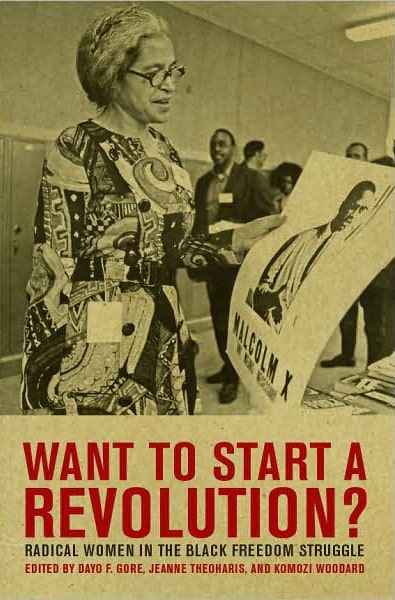
Want to Start a Revolution?: Radical Women in the Black Freedom Struggle
Rosa Parks with a poster of Malcolm X

Malcolm X holding West Indian Gazette, Claudia Jones on cover 1964
Malcolm X paying tribute to Claudia Jones

'Anytime you live in a society supposedly based upon law and it doesn’t enforce its own laws because the color of a man’s skin happens to be wrong, then I say those people are justified to resort to any means necessary to bring about justice when the government can’t give them justice.’
Malcolm X at the Oxford Union

Malcolm X’s legacy on the 50th anniversary of his assassination is to recognise that the fight against racism must be a fight against the system that produces it. 
Anthony Hamilton on Malcolm's X's Road to Revolution 

See also Mike Davis on America's black shining prince, Lee Sustar on Malcolm's revolutionary politics, Brian Richardson on Manning Marable's biography of Malcolm X, Saladin Ambar on Malcolm X at the Oxford Union and Ken Olende and Avtar Singh Jouhl of the Indian Workers Association on when Malcolm X came to Smethwick just nine days before his assassination in February 1965.  For more on Malcolm X in Britain, see Marika Sherwood's study Malcolm X: Visits Abroad.

Labels: , , , , , ,

Saturday, October 10, 2009

The Wire: A Marxist Analysis


In probing the parameters of the intricate interactions between multiple individuals and institutions, the complex script, seen over all the seasons, excavates the underlying structures of power and stimulates engagement with overarching ideas. It bristles, even boils over, with systemic critique. While it offers no expectation of an alternative, it provokes reflection on the need for one and an aspiration towards one. It may not have been written by Marxists to dramatize a Marxist worldview, but it is hard to see how a series written on this terrain by Marxists would be much different from The Wire.
The Wire and the world: narrative and metanarrative by Helena Sheehan and Sheamus Sweeney, from JUMPCUT: A REVIEW OF CONTEMPORARY MEDIA (hat-tip: ISJ)

Labels: ,

Sunday, January 25, 2009

The political economy of law and order

Robert Reiner, a Professor in Criminology at the LSE, is well worth reading on the politics of law and order. This is his response to the news shocker that the current recession suggests that we may, surprise, surprise, see an increase in crime in Britain:

The most disturbing aspect of the political and media discussion of the crime figures is the continuing failure to see the picture for the pixels. The economic collapse of the last 18 months has in most policy areas stimulated discussion of how the overall neo-liberal trajectory of political economy and culture over the last 30 years has had pernicious effects way beyond the financial. But criminal justice policy remains ghettoised within its own narrow law and order discourse. Government and opposition focus only on crime prevention, policing and punishment as the relevant policy responses. But a host of evidence shows that the economic, political, social, and cultural transformation engendered by neo-liberalism over the last three decades has stoked increasing propensity to criminality (assembled in my book on Law and Order, and Steve Hall, Simon Winlow and Craig Ancrum's Criminal Identities and Consumer Culture, for example).

Improved crime control tactics barely kept the lid down on crime levels during the now-departed economic boom. The crash we are facing is likely to unleash increasing crime of all kinds, property and personal. The latest crime statistics offer only some rather tentative harbingers of this gathering storm.

Labels: , ,