Histomat: Adventures in Historical Materialism

'Historical materialism is the theory of the proletarian revolution.' Georg Lukács

Wednesday, September 25, 2019

Cuba, the Pink Tide and revolution in Latin America

International Socialism is hosting two events on Latin America in late October (London on Saturday 26 October and Glasgow, Tuesday 29 October).
Speakers include a Cuban revolutionary and academic who will be debating the legacy of the revolution.
At the turn of the century, Latin America saw an inspiring rise in popular mobilisations against neoliberalism by workers, peasants and indigenous organisations. A reflection of this was the election of several left wing governments, known as the Pink Tide.
But this mood seems to be coming to an end. Venezuela is in acute crisis and Bolivian and Ecuadorian governments are embracing neoliberal policies.
Worst of all, Jair Bolsonaro is president of Brazil. The far-right leader has opened up protected indigenous reserves in the Amazon to mining, farming and logging, showing how far he will go to further the interests of big business.
The victories of left governments, notably in Venezuela, also gave breathing space to the Cuban regime established 60 years ago. But even the Cuban rulers are seeking to break from decades of isolation by embracing the market. At the same time, Donald Trump is renewing hostilities against the island state.
Come to these one of these events to discuss and debate where next for Latin America.

Full details:
London
Cuba, the Pink Tide and revolution in Latin America
With sessions on
·         Brazil and Venezuela: the retreat of the Pink Tide
·         60 years on from the revolution: where is Cuba going?

Saturday 26 October, 2pm-6pm.
Birkbeck, University of London, Malet Street, London, WC1E 7HX
Tickets: £6 or £3 unwaged/student
Book tickets online here  or call 0207 840 5640.
https://www.eventbrite.co.uk/e/cuba-the-pink-tide-and-revolution-in-latin-america-tickets-64365974362
Glasgow 
Where is Cuba going today?
Tuesday 29 October, 7pm-8.30pm
City centre venue to be confirmed, FB event here

Some suggested reading from International Socialism
Class battles in Latin America, by Andy Brown. (A review of Mike Gonzalez, The Ebb of the Pink Tide: The Decline of the Left in Latin America), http://isj.org.uk/class-battles-in-latin-america/
Where is Venezuela going? By Andy Brown http://isj.org.uk/where-is-venezuela-going/
Brazil: how big a defeat? Interview with historian Valério Arcary http://isj.org.uk/brazil-how-big-a-defeat/
The new Cuba: myths and realities, by Mike Gonzalez (A review of Steve Cushion, A Hidden History of the Cuban Revolution: How the Working Class Shaped the Guerrillas’ Victory), http://isj.org.uk/the-new-cuba-myths-and-realities/
Cuba behind the myths, by Chris Harman (A review of Sam Farber, The Origins of the Cuban Revolution Reconsidered and Richard Gott, Cuba: A New History), http://isj.org.uk/cuba-behind-the-myths/


Labels: , ,

Wednesday, September 11, 2013

The Other 9/11 - Forty years after Pinochet's coup in Chile

Allende can no longer hope to satisfy the owners of industry and the working class. He will have to choose to side with one or the other.
But one side is armed, the other not. And Allende shows no inclination at all to break his pledges to the middle class of a year ago not to “interfere” with the state machine.
Instead he will probably use his influence, and that of the bureaucrats within Chile’s working-class based parties and trade unions, to persuade workers to put up with harsh conditions and an erosion of last year’s reforms.
Such a course will tend to create confusion and a lack of direction among many workers. But it is not likely to lead to any great loss in the spontaneous militancy in the factories and mines. Because of that it will not satisfy those who continue to hold real power in Chile. In the past we have seen a number of examples of regimes in some ways similar to Allende’s.
After a period their mass support became demoralised and the government themselves were easily overthrown by right-wing military coups.
Socialist Worker, 20 November 1971

Tragically, that analysis of 'the Chilean road to socialism' as led by Salvador Allende was proved correct and forty years ago today - as the current issue of Socialist Worker reminds us - on 11 September 1973, the Chilean military led by General Pinochet organised a bloody military coup and killed some 30,000 people as it overthrew Salvador Allende’s Popular Unity (UP) government - killing Allende himself.  Like the Egyptian military takeover recently, this had the blessing of the United States.  As Henry Kissinger had famously put it in June 1970,
I don't see why we need to stand by and watch a country go communist due to the irresponsibility of its people. The issues are much too important for the Chilean voters to be left to decide for themselves.
 The lessons of Chile remain important - if contested ones  - for the coup is a classic demonstration of the classical Marxist analysis of the state machine as fundamentally an instrument of class oppression and domination designed to defend the rich - and a reminder of the fallacies behind the notion of a 'parliamentary road to socialism'.  As Ian Birchall and Chris Harman noted in September 1973 just after Pinochet's coup,

The lessons of the Chilean experience, are not particularly original ones. They were first drawn by Marx, at the time of the Paris Commune more than 100 years ago, and they were reiterated by Lenin writing ‘State and Revolution’ on the eve of October: there is no way of carrying through a socialist transformation of society without first destroying the old state apparatus, with its standing army, its police, its judiciary, its bureaucratic hierarchy. In its place has to be established the rule of directly elected and recallable workers’ delegates, backed up by a workers’ militia.
Many would-be marxists have claimed that under modern conditions the bourgeois state can be reformed peacefully, at least in countries with strong parliamentary traditions.
These were the arguments used by Allende and the Communist Party in Chile. They are also the arguments of the labour left and the Communist Party in Britain. The Chilean coup has proved their fallacy. The ruling class will not just sit back and accept in-roads into its privileges, however ‘constitutionally’ reforms are carried through or however deep-rooted parliamentary traditions. The state machine in even the most democratic bourgeois states is built on strictly hierarchic principles, with control over the activities of the army, the police and the civil service concentrated in the hands of the relatives and friends of those who hold economic power. And the ruling class will use this state machine to re-establish its own, untrammelled domination the moment it feels the balance of forces are favourable to it.

That said, as the Chilean socialist Mario Nain notes today, if Pinochet's Chile was subsequently the laboratory for testing the ideas of 'neoliberalism' in practice, then in recent years anti-capitalist resistance and revolt have swept the country, led by new generations of workers.  If there is hope today in Chile after the memories and legacy of Pinochet's tyranny, it lies with them.

Edited to add: See the Chile 40 Years On website for some anniversary events etc in the UK around this.


Labels: , ,

Wednesday, March 06, 2013

Mike Gonzalez on Hugo Chavez

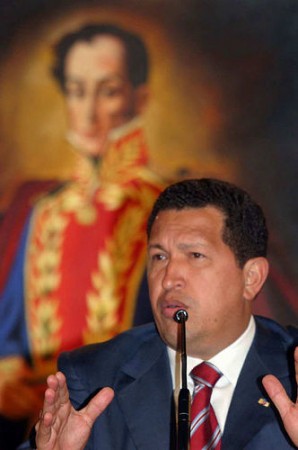
 http://isnblog.ethz.ch/wp-content/uploads/2010/08/Chavez-Bolivar-298x450.jpg
In 2005, speaking at the World Social Forum, Chavez announced that Venezuela was constructing “21st century socialism”. While it was received joyfully, it remained unclear what it meant. It was clearly different from Stalinism, emphasising democracy and popular participation, and it was radically anti-imperialist. Chavez scourged Bush and the US invasion of Iraq at the UN, and began to build organisations of Latin American unity linking other “new left” governments in Bolivia and Ecuador. 

And in a series of electoral tests it became clear that Chavez’s support was growing. In 2006 he won the presidency again with over 60 percent of the national vote. Some weeks later he announced the formation of a new party, the United Socialist Party of Venezuela (PSUV). Had the revolutionary nationalist become a revolutionary socialist? Chavez and others frequently referred to Leon Trotsky, Rosa Luxemburg and Antonio Gramsci—as well as Simon Bolivar, and God. If the transformation was real, then the PSUV would be an expression of power passing directly into the hands of the mass organisations, which was the brief expectation of many on the left. Nearly six million joined the new party, a testimony to Chavez’s enormous popularity. 

 But the model of the party adopted by the PSUV appeared to be the Cuban Communist Party, not noted for its democratic character. The irony of the Bolivarian revolution is that its undoubted social advances were made possible by the rising price of oil. This funded the social programmes and oil remains the country’s main export earner. Chavez diversified Venezuela’s international dependencies. China, Russia and Iran came to play an increasingly central role. Yet, despite the hysteria of the anti-Chavez camp, there was no policy of redistribution. Some firms were nationalised and compensated at market rates, but for the most part only when they were abandoned or guilty of the most barefaced manipulations. 

The year 2006 was in many ways a crossroads. The creation of Latin American blocs such as ALBA and CELAC were expressions of Chavez’s Bolivarianism, his Panamerican vision. Yet this was not the 21st century socialism, the democratic revolution, that had been promised... 
 Read the full obituary here

Labels: ,

Sunday, January 13, 2013

International Socialism # 137

Internationalism seems to be the theme of the new ISJ (full contents here), with Phil Marfleet writing on the latest stages of the Egyptian Revolution, an interview with Pete Alexander about the Marikana massacre of mineworkers in the new neo-liberal ANC led South Africa, Mike Gonzalez on politics in Latin America which once again hang in the balance given Chavez's illness, as well as other pieces including Jane Hardy on 'new divisions of labour in the global economy. There are also other treats, including Alex Callinicos's review of Neil Davidson's epic work on bourgeois revolution, a piece on how the German Left failed to stop the rise of Hitler's Nazis to power 80 years ago this month, as well as Ian Birchall on Ed Miliband's new hero, the 'One Nation' Tory Benjamin Disraeli.

Labels: , , , , ,

Saturday, October 16, 2010

John Pilger on Chile's ghostly silences

The rescue of 33 miners in Chile is an extraordinary drama filled with pathos and heroism. It is also a media windfall for the Chilean government, whose every beneficence is recorded by a forest of cameras. One cannot fail to be impressed. However, like all great media events, it is a façade...The accident that trapped the miners is not unusual in Chile, but the inevitable consequence of a ruthless economic system that has barely changed since the dictatorship of General Augusto Pinochet. Copper is Chile's gold, and the frequency of mining disasters keeps pace with prices and profits.

For all the media circus at the rescue site, contemporary Chile is a country of the unspoken. At Villa Grimaldi, in the suburbs of the capital, Santiago, a sign says: "The forgotten past is full of memory." This was the torture centre where hundreds of people were murdered and disappeared for opposing the fascism* that Pinochet and his business allies brought to Chile. Its ghostly presence is overseen by the beautiful Andes, and the man who unlocks the gate used to live nearby and remembers the screams.

Full article here

*Whether Pinochet's bloody dictatorship was 'fascist' as Pilger claims or not is debatable in my opinion. The fact the world was celebrating smiling miners on the week of Pinochet's good friend Margaret Thatcher's 85th birthday was however quite fitting in its own way, and hopefully contributed to her feeling too ill to celebrate...

Labels: ,

Saturday, September 20, 2008

The Coke side of Life

'Trade unionists, for example. They stop the people from working. That's why we kill them.'

Mark Thomas explores the link between Columbian paramilitary death squads and Coca-Cola...

Labels:

Friday, June 13, 2008

Lula's Brazil

Sean Purdy, who runs the highly recommended Dissenting Historian blog, has written a useful account of the state of politics in Brazil under Lula, whose 'Workers' Party' Government has been pro-big business at home and engaged in imperialist intervention abroad in Haiti.

Labels:

Wednesday, February 28, 2007

Galloway champions the Bolivarian Revolution

'These orchestrated attacks on Chávez are a travesty' declares Galloway in today's Guardian, hammering the British neo-cons around Blair who claim to support 'democratic Socialism' in theory but hate the sight of it in practice.

'The atmosphere in Caracas is fervid. The vast shanty towns draping the hillside around the cosmopolitan centre bustle with workers' cooperatives, trade union meetings, marches and debates. The $18bn fund for social welfare set up by Chávez is already bearing fruit. Education, food distribution and primary healthcare programmes now cover the majority for the first time. Queues form outside medical centres filled with thousands of Cuban doctors dispensing care to a population whose health was of no value to those who sat atop Venezuela's immense wealth in the past.'

Labels: , ,

Sunday, October 15, 2006

'Pirates of the Caribbean'

Whatever else one thinks of veteran Marxist writer Tariq Ali, one cannot deny he has an excellent sense of humour, not least when it comes to designing the covers of his books. Take a look at his forthcoming book, Pirates of the Caribbean:


Marvellous stuff (though I can't for the life of me understand quite why Fidel Castro has a halo above his head - he is not an 'angel', despite the claims of many people including George Galloway). Anyway, clearly Tariq's forthcoming book is not about Johnny Depp or Keira Knightley, far from it:

'A revolution is moving across Latin America. Since 1998, the Bolivarian revolution in Venezuela has brought Hugo Chávez to world attention as the foremost challenger of the neoliberal consensus and American foreign policy. Tariq Ali shows how Chávez's views have polarized Latin America and examines the aggression directed against his administration. Pirates of the Caribbean guides us through a world divided between privilege and poverty, a continent that is once again on the march.'

It looks like it will be an interesting book certainly - though I have one initial concern. Portraying Chavez, Morales and Castro as 'pirates' - outlaws fighting the Project for the New American Century - ignores the fact that they are all (well, bar Castro) currently heads of capitalist states. Their progressive nationalist politics of 'socialism from above' are distinctly 'un pirate like' in this sense - real pirates like Blackbeard et al were enemies of all state powers, 'villains of all nations' (as Marcus Rediker puts it). There is therefore a contradiction here in the politics of Chavez et al, one which I hope Tariq Ali does not simply pass over in what I am sure will be a facinating work.

Edited to add: A critical review of the book in SW.

Labels: ,

Friday, August 04, 2006

The legacy of Simon Bolivar (1783-1830)


I apologise for not having read the new biography of Latin American anti-colonialist leader Simon Bolivar by John Lynch, but I thought I would just highlight a couple of reviews of it - in the New Left Review by Tariq Ali and in Socialist Review by James Dunkerley. This is from Tariq Ali's piece on 'Simon B':

'Of all the revolutionary leaders that bestrode Europe and the Americas in the 18th and 19th centuries, Bolívar’s political goal was the most audacious. A republican, he wanted nothing less than the liberation and unification of the entire Spanish-speaking continent. All his energies were devoted to that end, on which he brooked no dissent. San Martín, O’Higgins and Sucre were undoubtedly brilliant generals, but Bolívar far excelled them in his capacity to think strategically. Experience taught him that if even a single Spanish base were allowed to exist in the Americas, it would always remain a focal point of counter-revolution. For fifteen years he led an epic resistance against the Spanish Empire, conducting a series of long marches across the Andes that have no equal in anti-colonial history, and in 1825 finally succeeded in expelling the Viceroys and Captains-General of the Spanish Army. But though the liberation movement now controlled a region that was five times larger than Europe, continental unity remained elusive. The idea and its originator had triumphed themselves to death. In 1830, as Bolívar lay dying from consumption in a remote farmhouse in Santa Marta, on the Caribbean coast of modern-day Colombia surrounded only by a few loyal friends and far away from the cities he had liberated, he compared his struggle for Spanish American unity to "ploughing the sea". It was necessary, he repeated, to start all over again.'

Labels: , ,

Saturday, March 18, 2006

Paddington at play


After becoming Histomat's Latin American correspondent, and reporting from Argentina here and here, as well as Paraguay, 'Paddington' has, on his return to Britain (and after a great deal of deliberation), decided to set up his own blog. I guess he maybe got tired of sending me great links, such as Chomsky's recent interview where he talks of the hopeful signs emerging from the new social movements sweeping Latin America, only for me to continue to piss about writing about long dead and long forgotten English monarchs.

Anyway, Paddington's long awaited blog is called Homo Ludens, which apparently means 'The Playful Man' or 'Man as Player'. According to Wikipedia, 'Homo Ludens' was the title of a book written in 1938 by the Dutch historian Johan Huizinga, which apparently 'discusses the importance of the play-element in culture and society'. However, whatever the exact inspiration for the title, and without further ado, it is an honour to be asked to introduce Homo Ludens to my friends and comrades in the 'blogosphere'. Paddington - welcome to the twenty-first century 'Grub Street'.

Labels: ,

Wednesday, December 21, 2005

Reasons to be cheerful


1. 'America's worst nightmare', Evo Morales from the Movement Towards Socialism won the Presidential election in Bolivia - Paddington is no doubt writing a report from whereever he is now in Latin America for this blog about this step forward for the Left.

2. As noted earlier on this blog, John Prescott seems to have finally made his move against Blair, meaning that Blair is truly at the end of his reign - it seems inevitable he will go after Labour get hammered in May's local council elections, if not sooner.

3. I noticed from Dave Renton's site that the International Institute of Social History has produced nifty little 'e-cards' to send to people - but I can't really be bothered to go to that trouble - so this is just to wish readers of Histomat a happy new year for 2006.

Edited to add this: Vote for the top political moment of 2005 in the UK here...

Labels:

Monday, December 12, 2005

Dispatches from Latin America #3: Paraguay

Paddington's Latin American adventure continues. After losing his wallet and losing in love on a visit to Argentina, you'd think he'd send us some good news - but instead he decides to mention Ipswich Town FC in his latest post - the recent performances of which are hardly likely to bring any 'Christmas cheer' to anyone except Norwich fans (who are now above us in the Championship). However, there is some good news - he has finally made to to Paraguay, and so I'll let him describe that country in all its beauty to you:

'On Saturday, I left the comparative security of
Argentina behind to take an 18 hour bus journey to
Asuncion, the capital of Paraguay. The Lonely Planet
reckons that in Paraguay travellers are less common
than jaguars. P.J. O'Rourke said that "Paraguay is
nowhere and is famous for nothing." After Bolivia, it
is South America's poorest country, and is certainly
the least visited by gringos. So, to try and explain
why this might be, and why Paraguay is considered by
the rest of the world to be so obscure and
unappealing, here is another of Paddington's
under-researched history lessons.

PARAGUAY THEN:

In my first post about Argentina, I outlined a rough
template into which the histories of most Latin
American countries seem to fit. It went roughly like
this:

- Indigenous tribes cultivate the land, creating
small-scale agricultural and fishing communities, or
otherwise were nomadic hunter-gatherers.
- During the 16th century, the continent is invaded by
Europeans.
- During the 19th century, republican movements spring
up across the continent and independent states are
formed.
- During the late 20th century, partly induced by the
fear of Castro´s Cuban Revolution spreading
southwards, much of the continent comes under the rule
of right-wing repressive military dictatorships.
- These have now all but disappeared, but the
governments of the continent are under great pressure
from the US to sign up to radical free-market policies
- policies which have thus far been strongly resisted
by the continent´s people.

Conveniently (though not for Paraguayans), Paraguay
follows this template fairly closely. Paraguay
achieved independence five years before Argentina in
1811, and was governed by Jose Gaspar Rodriguez de
Francia (or El Supremo, as he was known in porn
films) until 1840. Francia was a child of the French
Revolution, studied Rousseau, and was determined that
his republic should be ruled with an iron rod. He was
universally accepted as being honest, personally
disciplined, and dedicated to developing his country -
in other words, the total opposite of today´s career
politicians, who are intent only on lining their own
pockets and those of their chums in the
multinationals. Francia even returned his unspent
salary to the Treasury´s coffers - can you imagine any
of the current UK Cabinet doing that? I think not.

In building up the power of the State, Francia seized
land from landowners and expropriated property from
the Church. But wait a second - before I make Francia
out to be some sort of redistributive left-wing saint,
let´s have a wee look at his political methods. His
policy of shutting Paraguay´s borders was borne more
out of xenophobic prejudice than promoting Paraguayan
autonomy. He was by nature a suspicious character:
suspicious of foreigners and suspicious of his own
people. After an assassination attempt in 1820, he
forbade his subjects from standing less than six paces
away from him. Anyone caught looking at his Palace in
Asuncion was shot on sight (I took a photo of it
yesterday and felt quite the rebel), and at the end of
his reign he ordered that all dogs in Paraguay should
be shot. Some must have escaped Francia´s doggie
death-squads, for Asuncion is now generously populated
with stray mongrels.

Francia died in 1840 and his body was fed to caimen in
the Rio Paraguay. During his reign he had
simultaneously terrorised, tortured and killed his own
people, and turned his country from an undeveloped
infant state into one with highly successful
nationalised internal industries.

In 1865, Francisco Solano Lopez, whose father had
opened Paraguay´s borders, decided he would go one
further and invade Paraguay´s neighbours. All of
them. At the same time. Because Paraguay´s internal
growth required trade with the outside world, and
because Paraguay was landlocked, Lopez decided that
Paraguay needed to capture land with a seaport
attached to it. Meanwhile, Brazil and Uruguay had
been wrangling over disputed lands, so Lopez offered
himself up as a honest broker between the two states.
This plan went badly wrong and on 18 March 1865,
Paraguay declared war on Brazil and Argentina; Uruguay
aligned itself with its two neighbours. By the end of
the five-year conflict, up to 300,000 Paraguayans were
killed - or up to 90% of the male population. In
1870, less than 10% of Paraguay´s population were men.
For more information on the War of the Triple
Alliance, Wikipedia has a decent page
here.

In the 1930s, Paraguay was once more at war, this time
with another neighbour, Bolivia, over the border lands
of the Chaco. Chaco became an area of dispute because
of its suspected oil reserves (plus ça change). Rival
oil companies sided with each of the two countries:
Standard Oil with Bolivia, Shell with Paraguay. In
1938, after 38,000 lives had been lost on both sides,
Paraguay was granted 225,000 square kilometres of the
Chaco land. To this day, oil has never been found
there.

After a brief civil war during the 1940s and a coup in
1954, General Alfred Stroessner came to power.
Francia-style terror-politics resumed for another 35
years, supported by the US who found favour in
Stroessner´s rampant anti-Communism. Up to 3000
people were tortured, "disappeared" or were killed
during his reign, and Paraguay became something of a
haven for ex-Nazis.

PARAGUAY NOW

Although Stroessner was deposed by a coup in 1989, his
Colorado Party have maintained power ever since.
There have been elections on a fairly regular basis
during the 90s and 00s, but they seem to be fairly
meaningless - the government always wins, as the
expression goes, and besides there have been
widespread allegations of fraud and other dodgy
goings-on (assassinations of a vice-president and a
president's daughter, attempted coups etc). On
several occasions since the turn of the century,
peasants and workers have taken to the streets
demanding that the government stops its free-market
policies and pursues a policy of land redistribution.

Actually, the government has recently been involved in
land redistribution, selling off a forest which was
home to the Ayoreo Indian tribe. It is not the first
time that an indigenous group has been forcibly
removed from its home, giving rise to an increase of
home-grown refugees. Unfortunately, Paraguay's
peasants and indigenous groups do not seem to have the
leadership of next-door Bolivia's Evo Morales.

Oh, and Paraguay - unlike most of the Southern Cone of
South America - is still best buds with that nice
Señor Bush. In July 2005, US special forces began
military operations in Paraguay, though both
Washington and the US Ambassador in Asuncion deny that
there are plans to set up a permanent base in the
Chaco region. In exchange for letting 400 US Marines
stay in the area for 18 months, Paraguay receive
$585,000 in "aid" (actually, only 2 of the 13 military
exercises planned are humanitarian). Some
commentators believe that the US are there partly to
counter FARC 'terrorists' from Columbia, but most
reckon the main reason for their presence is to deal
with neighbouring Bolivia if Evo Morales wins the
upcoming election.


As I say, the reason I have come to Paraguay is that
nobody else does. Every other country in Latin
America has its fans, but Paraguay sits there, hemmed
in by its more popular neighbours, semi-tropical,
loved by nobody. I scoured the Lonely Planet and the
Internet for things to do in Asuncion before I came
here, and found very little. I have now scoured
Asuncion personally, and think that LP and the web are
probably right. There really is nothing to do here.
I have never been to a capital city that behaves less
like a capital city. I have seen the Palacio de
Gobierno, the Camara de Diputados and the Museo del
Barro, and I have a cheap porn flick pencilled in for
this afternoon (v popular in downtown Asuncion cinemas
apparently!).

And yet I will be as sorry to leave this place
tomorrow as I was to leave Buenos Aires last weekend.
There is something highly seductive about Asuncion´s
laziness. Nobody rushes anywhere, a few people walk
from one block to another, and most people sit in the
local plaza or on their doorsteps or on street
corners, sipping their iced maté and chilling out.
Since my favourite cities in South America have been
the ones where it is easiest to spend quality time
doing nothing, I can see why Asuncion has found a fan
in this gringo. The negligible pace must be something
to do with heat - it is approaching 40ºC here and
humid as hell, making it physically impossible to do
anything particularly energetic. But let´s not
over-romanticise: Paraguay is seriously poor, and
there are simply not the opportunities for its 5.5
million people to do much to improve their lot. The
people here have been as fabulous as the guidebooks
promised: warm, funny, inquisitive (the question of
why the hell I would want to visit Paraguay has come
up over and over) and incredibly helpful. They are
also rightly proud of their country, and especially of
their football (and incidentally, South Americans are
SERIOUSLY knowledgable about football - several
Argentinians and one Paraguayan knew more about
Ipswich Town than I do, and I was born there!) - but
nonetheless, the country is poor and is getting
poorer. Although they are less vociferous in their
protests than the Argentinians, the graffiti on
Asuncion´s walls gives a strong hint of what
Paraguayans think is at the heart of their sinking
economy: PRIVATIZACIÓN = POBREZA.

¡Suerte! y hasta Brasil,

Paddington'

Labels: ,

Sunday, December 04, 2005

Dispatches from Latin America #2

The latest missive from 'Paddington', a friend of mine currently in Argentina:

'Every Friday back in the UK, I and a friend (who is
presumably only slightly less bored of his job than I
am) email each other a series of questions which
attempt to sum up the previous seven days. I thought
I´d try and sum up my first three weeks in South
America in this way, as otherwise my interminable
descriptions of Argentina will bore you rigid.

Just to give you a bit of background, I arrived in
Buenos Aires on 13 November, spent almost two weeks
there, and then took a 25-hour bus trip to Bariloche,
a hiker´s mecca set in the Andes. I was in Bariloche
for two days, then in San Martin de los Andes tomorrow
for a day before ending up in Mendoza, where I am now.

ON THIS TRIP...I HAVE EATEN:
On the whole, rather disappointingly. One meal in
BsAs was especially awful - hilariously bad in fact.
It featured a turd of overcooked rump steak, fries
which looked like they had been microwaved then
dressed liberally with lukewarm vegetable oil, a
side-salad consisiting of a teaspoon of grated carrot
- and all topped off with ice-cold red wine. In
Bariloche, however, I ate the best piece of steak I
have ever tasted - thick, the rare side of medium,
juicy, succulent, and washed down with good local wine
at its optimum temperature. And so cheap!

ON THIS TRIP...I HAVE DISCOVERED:
That people are at their best, and certainly their
most open, when travelling. From talking to people
who are on the move, you´d think they were all a bunch
of f**k ups, because everybody appears to be running
away from a trauma back at home. Whether it´s
people´s families, broken relationships,
disillusionment at work, everyone has a story to tell,
and usually a fairly bleak one. But I think this is
because we are all f**k ups, and we only open up fully
when in the company of strangers in a strange land.

Although I do not plan to go there (too frickin´cold),
I have also learned the following facts about
Antartica:
- Antartica is technically a desert, since it has 50mm
less rain per year than the Sahara.
- No human being had set eyes on Antartica until 1820.
- Its largest land animal is belgica antartica, a
midge measuring just 13mm across.

ON THIS TRIP...I HAVE READ:
Vladimir Nabokov, "Bend Sinister" - where "Lolita" is
ingenious, I found "Bend Sinister" merely precocious.
In "Lolita" he can get away with being a smartarse
because he´s writing as Humbert Humbert, whose morals
and tastes are questionable; in "Bend Sinister,"
whether he is writing as a narrator or as Krug, he
just sounds like the equivalent of one of those women
who carve incredibly ornate scultures from carrots and
radishes: very pretty, very clever, but not at all
fulfilling.
I have also read Mark Twain´s "Pudd´nhead Wilson," an
excellent and ambiguous tale of slavery in Virginia in
the 18th century, and am currently reading Jaroslav
Hasek´s "The Good Soldier Svejk," from which I quote
the following:

"For people who did not want to go to the front the
last refuge was the garrison gaol. I once knew a
probationary teacher who was a mathematician and did
not want to serve in the artillery and shoot people.
So he stole a lieutenant´s watch to get himself into
the garrison gaol. He did this deliberately. War
neither impressed nor enchanted him. Shooting at the
enemy and killing with shrapnel and shells equally
unhappy probationary teachers of mathematics serving
on the other side seemed to him sheer idiocy."

ON THIS TRIP...I HAVE LISTENED TO:
Creedence Clearwater Revival, especially "Fortunate
Son," a song written 35 years ago about American rich
kids getting richer, and as such could have been
written yesterday. But, overwhelmingly, "Aerial" by
Kate Bush. The second CD, which is a kind of concept
album about painting and parenthood, is gorgeous -
probably the best music she´s ever made.

ON THIS TRIP...I HAVE DRUNK:
Cafes dobles, Quilmes (the main Argentinian lager),
Malbec from Mendoza, caiparinhas, margueritas, and a
couple of gins and tonics which I regret to say
Argentinians can´t make for shit (the French, in my
experience, are the kings of G´n´T pouring).

ON THIS TRIP...I HAVE FANCIED:
How long have you got? Argentinian women are
gorgeous, and everybody - male and female -
shamelessly flirts with each other as they go about
their daily business.

But the real answer to this question is Abby, a girl
from Washington State. We fell for each other almost
instantly and spent loads of time together in Buenos
Aires. We also had a perfect day in Uruguay before I
left for Bariloche. The plan was to return to Buenos
Aires to be with her next week, but I received an
email from her yesterday to say she couldn´t handle
seeing me again and then having to go our separate
ways (sorry, is this getting a bit Oprah?). So what
could have been an incredible relationship is not
meant to be. C´est la vie.

(An American guy in my hostel jockishly said that
American girls were like that, the insinuation being
that they are slutty and like to lead guys on. I came
as close to punching his lights out as a person can
without actually following it through).

ON THIS TRIP...MY HERO IS:
Heroes plural in this instance: the people of
Argentina. The reputation they have is of being
arrogant, surly, rude, Anglophobic and faintly
ridiculous - particularly porteños (natives of BsAs).
In my experience, this could not be more wrong. They
are friendly, helpful, chatty, engaging, patient when
listening to my feeble attempts to speak their
language - and only taxi driver I have encountered
said he would happily kill all English people.
Actually, my parents as well, who have furnished me
with money - I lost my wallet on the second night
after I arrived, and thus have no access to money. It
is like being a smoker who is carrying a packet of
cigarettes but has no matches with which to light them
- i.e. frustrating as hell.

ON THIS TRIP...I HAVE BEEN IMPRESSED BY:
The variety of landscapes I have seen in Argentina.
The hiking areas around the Lake District are how I
imagine the Alps to be. In Bariloche we took a short
hike up to a vantage point over Lago Nahuel Huapi (in
which a Nessy-type monster apparently resides) - the
view was staggering. I will try and send some photos,
but they don´t do it justice. Every colour - whether
the white of snow on the higher mountains, the blue of
the sky, the deeper blue of the lake, the green of the
trees - was iridescent.

And yet, the scenery between San Martin de los Andes
and Neuquen is just the opposte - barren, stark, all
greys and browns. In its own way, it was just an
impressive, and close to how I imagine Patagonia to
be.

I think the most breathtaking scenery could be yet to
come: Foz de Iguazu are the somethingest waterfalls in
the world (can´t remember if it´s highest, widest,
most water etc), and they will form the start of a
tour I will make up to Rio over the course of 10 days.

ON THIS TRIP...I HAVE BEEN DEPRESSED BY:
My truly pathetic attempts to learn the tango -
certainly the most emasculating experience of 2005.

The cricket reports I have been reading on the BBC
website - where are Ramprakash, Hick and Crawley when
you need them?

And one of the most noticeable things about Argentina
is that, despite an air of general affluence, there is
a hell of a lot of poverty. Whereas American and
European cities generally do a very good job of hiding
their poverty, shunting poor people into slums on the
outskirts of town and ensuring they do not blight the
areas which attract tourists, poverty seems to be much
more open in Argentina, and BsAs in particular. I
haven´t quite grasped the attitudes of the middle
classes towards the poor - I think it is a mixture of
sympathy and patronisation. It is common to see kids
on the subway attempting to sell things for a couple
of pesos. They are not treated with the contempt that
they might be in London, but nobody ever buys
anything. It is as if the poor are filling a role -
as long as it is they who are poor and not the middle
classes, they are tolerated.

I have also noticed that people of European descent
and indigenous people do not socialise, unless on a
employer / skivvy basis.

And of course, I have been pretty depressed by the
thought that two people who are head over heels about
each other can´t be together, but that´s a story for a
different blog.

The next time I write, I will probably be in either
Paraguay or Brazil, which - please contain your
excitement - will mean another history lesson.

Until then, it´s ciao for now.

Paddington'.

Labels: ,