Histomat: Adventures in Historical Materialism

'Historical materialism is the theory of the proletarian revolution.' Georg Lukács

Saturday, July 27, 2013

Memo to Princes Charles, William and George

And English history speaks loudly to kings as follows:
If you march at the head of the ideas of your century, these ideas will follow and sustain you.
If you march behind them, they will drag you with them.
If you march against them, they will overthrow you!
Prince Napoleon Louis Bonaparte (later Napoleon III), Fragments Historiques, 1688 et 1830 (Paris, 1841), p. 125, quoted in Eric Hobsbawm, The Age of Capital (London, 1991), p. 88.

Labels: ,

Wednesday, March 28, 2012

Colin Sparks on the English Republican tradition

The classic 1977 Stuff the Jubilee Badge - order your replica ones (plus mugs!) from Bookmarks

[With the kind permission of Colin Sparks and Socialist Review, Histomat is proud to republish Sparks's article 'The English Republicans' which appeared in Socialist Review, July 1981 in this jubilee year -this article followed another timely article also republished on this blog entitled The horrible history of the House of Windsor].

Scottish, Welsh and, especially, Irish republicans are ten a penny. The English, on the other hand, are allegedly inflicted with some genetic mental defect that makes them cower before crowns and thrones and leap to attention and bare their heads at the sound of the opening bars of the National Anthem. There is, unfortunately, a lot of truth in this: royalism has a deep hold on English thinking and penetrates well into the labour movement. From Ramsay MacDonald to Harold Wilson, Labour Prime ministers have displayed a quite sickening devotion to whichever crowned clown happens to be sitting at the top of the mall. That is not all of the story, though. There is a long and stubborn republican tradition in England. Colin Sparks looks at it.

There have been at least two periods in which republicanism has commanded mass support. On both of these occasions, the leading republican thinkers were the ideological representatives of the bourgeoisie, but in both cases the bourgeoisie itself, once it saw the consequencies of consistent republicanism, backed down and made its peace with royalty. It was left to the plebian, and later proletarian, inheritors to keep up the struggle.

The first mass flourishing of English republicanism was during the English Revolution of 1641-60. For a long time, the leaders of the Parliamentary forces comforted themselves with the notion that they were actually fighting for the King, and only against his advisers who had misled him. A consequence of this was that they did very badly, suffering defeats and missing opportunities for victories. But the dynamic of the war was already forcing new men to the fore, who had far fewer illusions in the King and were determined to beat him.

The best known of these was Oliver Cromwell. He told his troops:

'I will not deceive you nor make you believe, as my commission has it, that you are going to fight for the king and parliament: if the king were before me I would shoot him as another; if your conscience will not allow you to do as much, go and serve elsewhere.'

Once the king had been beaten, there was the problem of what to do with him. The compromisers still wanted to do deals with him, but Cromwell and his independent party controlled the armed forces and suitably intimidated the opposition, telling the special court that: 'We will cut off his head with the crown upon it.'

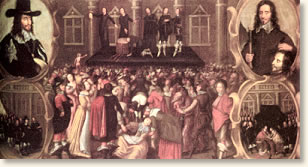
Charles Stuart was duly judged as a 'tyrant, traitor, murderer and enemy to the country'. Cromwell himself wrote out the death warrant, and on 30th January 1648 the King was beheaded in Whitehall. The regicides had their theoreticians. The best known was the foreign minister and poet, John Milton. Less than two weeks after the execution he published a book justifying it called: The Tenure of Kings and magistrates; proving that it is lawful, and hath been held so through all ages, for any, who have the power, to call to account a tyrant, or wicked king, and after due conviction, to depose, and put him to death.

Milton broadened his ideas to a general statement of republican principles, which he publised as The Readie and Easie Way to Establish a Free Commonwealth, and the Excellence thereof compar'd with the inconvenience and dangers of readmitting kingship in this nation, just before the Restoration of 1660. In this, he argued:

'People must needs be mad or strangely infatuated that build the chief hope of their common happiness of safety on a single person... The happiness of a nation must needs be firmest and certainest in a full and free Councel of their own electing, where no single person, but reason only sways.'

By then, there were few to listen to Milton. Cromwell's own generals
negotiated and arranged the restoration of monarchy. Among their reasons was the dangerous implication of the arguments that Milton was using. If the revolution had been led by landlords, merchants, even great nobles, much of the hardest fighting had been done by working men from the towns and fields and, in the course of the war, they developed their own, radical ideas.

The Leveller, Overton, wrote:

'It is naturally inbred in the major part of the nobility and gentry to oppress the persons of such sort that are not as rich and honourable as themselves, to judge the poor but fools and them wise... It is they that oppress you, insomuch that your slavery is their liberty, your poverty is their prosperity.'

Another group of Levellers went even further:

'We were before ruled by Kings, Lords and Commons, now by a General, a Court Martial and a House of Commons; we pray you, what is the difference? ... We have not the change of kingdom to a commonwealth; we are only under the old cheat, the transmutation of names but with the addition of new tyrannies to the old ... and the last state of this commonwealth is worse than the first.'

To the left of the Levellers stood the Diggers, who had a clear idea as to the origin of all this misery and a theory and a programme for righting it.

Diggers and Levellers alike were crushed by the generals, shot at Burford Church for refusing to serve in Ireland or driven from St George's Hill by soldiers. But the idea was there still, rooted in the brain of the common people and rooted in the brain of the rich. It was this that the elegant arguments of Mr Milton led to. Better by far to forget the ideals of republicanism, compromise with a rotten king and a rotten court, lest in the struggle against them there was a loss of all power and privileges.

The next great outburst if popular republicanism was at the end of the eighteenth and the start of the nineteenth century. The monarchy was widely hated on all sides, and new sections of the rich were emerging, an industrial bourgeoisie who wanted their place in the system which the existing set-up denied them. The upsurge was crystallised and given form by the journalist Thomas Paine.

In 1776, Paine published a pamphlet Common Sense, which was an immediate best seller and made him a famous man. The pamphlet is a justification of the American Revolution, but in his argument Paine raised more general questions.

Paine asked what was the origin of kingship:

'... It is more than probable, that could we take off the dark covering of antiquity, and trace them to their first rise, that we should find the first of them nothing better than the principal ruffian of some restless gang, whose savage manners or pre-eminence in subtilty obtained him the title of chief among plunderers.'

And if kings in general owed their origins to a robber band, the King of England in particular held his title purely by that
right:

'England, since the conquest hath known some few good monarchs, but
groaned beneath a much larger number of bad ones, yet no man in his senses can say that their claim under William the Conqueror is a very honourable one. A French bastard landing with an armed banditti, and establishing himself king of England against the consent of the natives, is in plain terms a very paltry rascally original. It certainly hath no divinity in it. That William the Conqueror was an usurper is a fact not to be contradicted. The plain truth is, that the antiquity of the English monarchy will not bear looking in to.'

The American Revolution echoed across the Atlantic. When the British
general Cornwallis surrendered at Yorktown, he ordered his band to play a tune called 'The World Turned Upside Down'. Before long that choice proved very apposite. In 1789 the people in Paris stormed the Bastille and the French Revolution had begun.

Having seen the birth of two free nations, Paine wished to see the birth of a third - that of Britain.

He wrote The Rights of Man, which became an instant best seller. In this book Paine repeated and developed his ideas about the origins of kingship, and was particularly savage about hereditary monarchy:

'Hereditary succession is a burlesque upon monarchy. It puts it in the most ridiculous light, by presenting it as an office which any child or idiot may fill. It requires some talents to be a common mechanic; but, to be a king, requires only the animal figure of man - a sort of breathing automaton.'

For Paine, the spread of republican principles was the guarantee of a new and better world:

'Never did so great an opportunity offer itself to England, and to all Europe, as is produced by the two revolutions of America and France ... When another national shall join France, despotism and bad government will scarcely dare to appear. To use a trite expression, the iron is becoming hot all over Europe. The insulted German and the enslaved Spaniard, the Russ and the Pole, are beginning to think. The present age will hereafter merit to be called the age of reason, and the present generation will appear to the future as the Adam of a new world.'

The movement which Paine had done so much to inspire met savage repression and was broken. But the ideas of republicanism continued to have widespread circulation. The poet Keats, for example wrote in 1815 a poem On 29 May: the Anniversary of the Restoration of Charles II:

Infatuate Britons, will you still proclaim
His memory, your direst, foulest
shame?
Nor patriots revere?
Ah! while I hear each traitorous lying
bell,
"Tis gallant Sidney's , Russell's, Vane's
sad knell, That pains my wounded ear.
(Sidney, Russell and Vane were condemned to death by Charles II for having voted for his father's execution.)

But, though many capitalists and intellectuals were distanced from the idea of monarchy, active republicanism was more and more a prerogative of the newly emerging working class movement. Paine himself had always been a defender of private property, believing that this was the way to establish freedom, equality and plenty.

But the arguments that he used against the idea of monarchy and hereditary government were ones which had dangerous consequences. Consider his crushing demolition of Burke's argument for hereditary legislators:

'The idea of hereditary legislation is as inconsistent as that of hereditary judges, or hereditary juries; and as absurd as an hereditary mathematician, or an hereditary wise man; and as ridiculous as an hereditary poet-laureate.'

That is a fine and irrefutable argument, but it is open for some wage slave to take it a lot further. What answer comes if we ask what basis there is for any sort of hereditary social power - for example the private ownership of the means of production? By Paine's own logic, the answer is a socialist one.

It is thus that the republican tradition has, since then, been almost exclusively a proletarian one. There have been bourgeois republicans since, and probably many of the capitalists even today consider the monarchy a quaint and outdated institution. Even an editor of The Economist, Bagehot, considered it as 'decorative' rather than 'efficient'. But it was the illegal and working class newspaper The Republican which denounced the Peterloo massacre in 1819, and it was in Julian Harney's The Red Republican of 9 November 1850 that a lead article Manifesto of the German Communist Party, by a certain K. Marx and F. Engels, appeared.

The tradition continued with William Morris. The name of his paper Commonweal harks back to Milton, and it was there that the denunciation of the 1887 Jubilee appeared:

'Socialists feel of course that the mere abolition of the monarchy would help them little if it only gave place to a middle-class republic... Nevertheless, now the monstrous stupidity is on us - one's indignation swells pretty much to the bursting point. We must not, after all forget what the hideous, revolting, and vulgar tomfoolery in question really
means nowadays...'

The modern revolutionary movement is proud to claim to stand in this republican tradition. Of course, the real power of the English crown is feeble today. Charles III will be no despot like Charles I. He will do
exactly what his capitalist masters tell him to do. He will be, in substance, little more than an enormously expensive parasite upon the backs of the working people. But the monarchy is more than substantial
importance; it also carries an enormous symbolic weight. It is one of the key pins of the ruling ideology. The struggle against the monarchy is an important part of the ideological struggle for socialism.

It is a struggle which only socialists can now wage. In previous epochs, like the ones we have glanced at, the monarchy represented the interests of classes, or parts of classes, which were at odds with important sections of property owners. Some of them were prepared to fight the king in their own interests, and others were happy to denounce him. That is not true today. The English throne is linked by chains of gold to the capitalist order. The only class which has an interest in the overthrow of the monarchy is the class which has an interest in the overthrow of capitalism: the working class.

The last words belong to that great republican Thomas Paine. When he wrote them, they were not yet exactly true and he certainly could not foresee what their future meaning would be. But today they are precisely right:

'Monarchy would not have continued so many ages in the world, had it not been for the abuses it protects. It is the master-fraud, which shelters all others.'

Labels: , ,

Tuesday, February 07, 2012

Colin Sparks on the horrible history of the House of Windsor

Edward VIII with Wallis Simpson and 'a friend' - you might have missed this bit in Madonna's new film

[At a time when the Tories and right wing press are engaged in a full blown rabid demonisation of supposed 'benefit scroungers' and those supposedly living a life of luxury at the expense of the hard-working majority, it is paradoxical - to say the least - that the same Tories and their media baron friends are in full blown propaganda mode to celebrate the Queen's Diamond Jubilee in June this year - despite quite overwhelming and quite shocking evidence that, yes, the Queen has somehow successfully got away for sixty years living in a palace and cruising around the world at the taxpayers expense. Moreover, given the sad fact it seems kind of unlikely that Terry Deary and the BBC are going to turn their popular 'Horrible Histories' series around to the House of Windsor to mark the Diamond Jubilee, it seems it is our revolutionary democratic duty - to say the least - to republish an article from Socialist Review from July 1981 on 'The horrible history of the House of Windsor'. I am indebted to the author - Colin Sparks - and Socialist Review for kindly giving me permission to republish this article, written around the the time of the marriage of Charles and Diana]

An undistinguished military man in his early thirties is to be married in front of vast crowds and the world's press. How does this come about? What is there about the man which makes his person and doings so fascinating to millions of people? It can hardly be his personal qualities. Despite acres of newsprint, there seems to be nothing very special about him which would distinguish him from thousands of other upper-class twits who merit much more modest treatment. The only possible explanation is the family he was born into. But what's so special about the Windsor family? Colin Sparks investigates.

All families have long histories and they are usually littered with rather sordid events about which it would be better to say nothing. It is in the nature of the institution that it makes people behave in very strange ways. But since this particular family is held up as a model to us all, and rests its wealth and power purely and simply on its history, it is well worth looking hard at that history.
If Charles is going to be King because, and only because, of his descent, it must be admitted that his family's record is so spectacularly sordid, and so riddled with malice and accident, that he would do better to change his name and try to lead a normal life.
Without delving too far into the murky and bloody history of the English Crown, with its murders, imprisonments, usurpations, massacres and general bloodiness, we can conveniently begin with one James II. His subjects suspected him, quite rightly, of secretly preparing tyranny and of being a crypto-Catholic (about the worst thing you could be at the time). He was consequently deposed in the 'Glorious Revolution' of 1688. This was a bloodless coup, largely because the commander of the royal forces, a certain John Churchill, later Duke of Marlborough and ancestor of the current war-monger Winston Churchill, was bribed to change sides just before the decisive battle. This noble act founded the young officer's future fortune but left the old king with no army and no choice: he had to run away.
He was replaced by his daughter Mary. Her claim to fame was that she was a Protestant and was married to the equally Protestant William of Orange - King Billy himself. So the origins of the modern monarchy are based upon a military coup and surrounded by bribery, treachery and foreign mercenaries.
After a few years, the direct line of descent ran out. The descendants of James II were disqualified for their obstinate persistence in Catholicism. So Parliament had to look around for someone else. There were two qualifications: some sort of distant claim and Protestantism - the second of which was much more important. They lighted on an obscure German prince, the Elector of Hanover, and duly shipped him over to be George I.
There was not much wrong with him as a King, apart from the fact that he could not speak English.
Despite having locked his wife up in a castle for 32 years, George I somehow managed to produce offspring, and he was duly succeeded by his son George II, who managed to learn English. His main claim to fame was that, despite having fought in many battles, he eventually died by falling off a lavatory seat in Kensington Palace, striking his head against a chest and expiring from the wound thus gloriously received. His son, Frederick, was already dead, having been hit by a tennis ball nine years earlier, so he was succeeded by his 22 year old grandson, George III.
If Georges Mark I and Mark II had been harmless if rather expensive, George III was not at all harmless. He was simply the most prominent of a pretty bad lot.
His sister, Caroline Matilda, for example, was married off at the age of 15 to the King of Denmark, whose major activity was, as the chronicles quaintly put it, pursuing 'low amours'. To recompense herself she took as a lover the Prime Minister, Struensee. This being discovered, he was hanged for his temerity and she was locked up in a castle for the rest of her life. George's youngest brother, the Duke of Cumberland, seduced Lady Grosvenor was sued by her husband for 'criminal conversation' (ie adultery) and had his love letters read out in open court. Another brother lived with a woman who had the triple handicap of being a widow, illegitimate, and the daughter of a tradeswoman.
George III, who was a bit of a snob and a lot of a puritan, decided that these goings on were getting the family a bad name, and he determined to clean things up a bit. One of his main instruments was the Royal Marriages Act, which he forced through parliament in 1772. This piece of despotism, which is still in force, states that any marriage of a descendant of George II is null and void if contracted without royal consent. This caused an awful lot of trouble because, while George III had a lot of children, they were, in the main, a very much worse lot even than his brothers and sisters.
All of his morality had an unfortunate effect on poor George, and he became a little crazy. On one occasion, driving through the Royal Park at Windsor, he stopped his coach, got out and tried to shake hands with an oak, being under the impression that it was Frederick the Great, King of Prussia. This state of mind came and went with George until, opening the 1811 session of Parliament, he began his address: 'My Lords and Peacocks This was going too far: he was declared unfit to rule, locked away in Windsor Castle, and his eldest son was made Prince Regent.
Now, if George III was mad, his son was positively bad. He had, for example, committed the greatest crime that any future King of England is capable of: he had married a Catholic. Besides this, his extravagance, his reaction, his general uselessness, were nothing. His marriage, to a Mrs Fitzherbert, in 1785, he kept a secret, but it presented him with problems. It made it difficult to marry legally and beget an heir, and without that assurance of future monarchy, Parliament would not agree to pay off his enormous debts. Fortunately, Mrs Fitzherbert was a reasonable woman, and for a bribe of £3,000 a year, agreed to keep quiet about the whole thing.
This noble gesture freed the Prince of Wales to marry his cousin, Caroline of Brunswick, who had been located on the Prince's instructions that, 'One damned German frau is as good as another.' The couple met for the first time three days before the wedding, and hated each other on sight. The Prince was drunk during the wedding, and had to be supported by the Duke of Bedford. The bride nearly fell down under the weight of her wedding dress. Despite these ill omens, the marriage produced a daughter, the succession was secured, and Princess Caroline was given her marching orders in the shape of a formal letter of separation. The Prince of Wales resumed his life with Mrs Fitzherbert.
So far, things have been simple if unpleasant, but at this point it starts to get complicated. In 1817, the successor, Princess Charlotte, died giving birth to a still-born child, and the whole business was back in the melting pot.
The Prince Regent was in a mess. He was married to Mrs Fitzherbert, but she was a Roman Catholic, and if this was discovered he would forfeit his title and be convicted of bigamy to boot. He could shelter behind the Royal Marriage Act but his second regal wife was completely estranged from him. One recourse Was to divorce Caroline and find a third wife. This could only be done on grounds of adultery, which was quite drastic, since the adultery of the wife of the heir to the throne is High Treason, and if convicted, Princess Caroline would have to be beheaded.
(Incidentally, this piece of barbarism is still law, so Lady Di had better keep her vows if she wants to keep her head.)
There were plenty of children floating around from his various brothers, but they were all illegitimate - due once again to the aforesaid Royal Marriages Act - and none of them would do. The Prince started proceedings to divorce his wife, which turned up a good deal of extremely unsavoury evidence as to her activities with her brother Bergami, but she died before she could be tried. The Royal Brothers also took matters in hand. They left their long-standing mistresses in the lurch and hurried off to find eligible princesses.
The situation was pretty desperate. The unemployed regularly took pot shots at the Prince Regent with live ammunition, and if one of them were to aim straight, the first 17 candidates for the throne had no children who could legally inherit. And the first 14 candidates were all themselves over 40. Unless one of them could get legally married and produce a legal heir, then it was a fair bet that the crown would pass from ageing hand to ageing hand quicker than the ball at Cardiff Arms Park. This, it was felt, would be bad publicity for an already detested monarchy and might give occasion for seditious activity tending in a distinctly Jacobin direction.
There was an additional incentive: legal marriage and legal heirs were the only things that would persuade Parliament to raise the salaries of these extravagant drones and pay off their vast debts.
Fortunately for all concerned, the numerous royal houses of Germany had numerous offspring whose parents were quite happy to overlook the moral and personal shortcomings of future spouses who might be expected to sit on the throne of England. Consequently a ready supply of royal brides and bridegrooms were on hand. Thus a Princess Adelaide of Saxe-Meiningen had no qualms in marrying the foul-mouthed and disgustingly reactionary Duke of Clarence, despite the fact that he had only just left the actress Mrs Jordan with whom he had lived happily for 20 years. And at the same ceremony, a Princess Victoria of Saxe-Coburg took on the relatively progressive Duke of Kent, who had just left Madame de St Laurent, with whom he had lived for 27 years.
There were a flurry of other Royal Weddings, but the succession was soon secured: the Duke of Kent and Princess Victoria produced a daughter named Victoria. Thus, when George III described by Shelley as 'An old, mad, blind, despised and dying king' finally snuffed it in 1820, the Prince Regent duly became George IV. He was succeeded by his brother the Duke of Clarence as William IV, and he by Victoria.
With her, things settled down a bit. She reigned for an awfully long time and was pretty respectable. Around her, the myth of the modern monarchy was built. Some idea of the breadth of her comprehension can be judged from the fact that female homosexuality has never been illegal in Britain, since she refused to believe that women did that sort of thing and consequently it was exempted from legislation.
She married yet another royal German stud, Prince Albert, and produced an enormous brood. Her successor, Edward VII, was rather less respectable, gambling prodigiously and allegedly cheating at cards, but his personal scandals were confined to illicit liaisons with actresses and married women rather than horrendous crimes like secret marriages to Catholics. His successor, George V, was again very respectable. On being told that a famous man was a homosexual, he replied, 'But I thought that chaps like that shot themselves.'
So far, the vagaries of the succession had depended on the bizarre accidents of dynastic matrimony, and with George V's marriage to Princess Mary of Teck, great-grandaughter of George III, it looked as though things were nicely sewn up among the petty German princes. Almost without exception, these people had been political reactionaries of the deepest hue, but they had never been too far out of step with the ruling classes. At this point there comes about a filthy coincidence of reactionary politics and the absurd regulations of royal marriage which once again shifted the line of succession drastically.
The successor to George V was Edward VIII. He wanted to marry a Mrs Simpson, who was a commoner, an American, and a divorcee. About the only thing going for her was that she was not a Catholic. In addition, young Edward was an enthusiastic admirer of Adolf Hitler. The British ruling class did not much mind fascism as long as it kept the workers in check, but some of them saw a war coming with Germany over the spoils of the world, and thought that they needed to watch their backs. Consequently, Edward was forced to abdicate.
He immediately shuttled off to the Bertschesgarden to have an audience with Hitler, who went on record as considering him 'an ideal fascist monarch'. He continued his contacts with the Nazis during the war. In 1940 the Spanish foreign minister, one of the intermediaries, reported: 'The Duke is a firm supporter of a peaceful arrangement with Germany. The Duke definitely believes that continued severe bombing would make England ready for peace.' A later dispatch said: 'The Duke was considering making a public statement... disavowing present English policy and breaking with his brother (ie the King).' Even when shipped off to the West Indies, he continued in contact with Nazi agents, and after the war settled down next door to Oswald Mosley outside Paris.
His brother and successor, George VI, broke with tradition by marrying a commoner, Elizabeth Bowes-Lyon, the current Queen Mother and an enthusiastic supporter of Ian Smith. Their eldest daughter is now Queen, married to a Greek of German royal origin, and mother of the splendidly undistinguished Charles. It is on that illustrious history that his claim to our attention and respect rests.
Nothing sums up the tacky nature of the British royal house so much as its name. We have traced a welter of Guelphs, Saxe-Coburgs, Saxe-Meiningens, and god knows what else, none of which seem to bear much relation to homely old Windsor. The fact is that it was changed to Windsor for 'patriotic' reasons during the wave of anti-German feeling at the start of the First World War. They are a family whose record proves time and time again that they will do literally anything to hang on to their wealth and power.
None of this would count for much, or even be worth the telling, if it were not for the ideological importance of the House of Windsor. They are projected as a central image of our society. They buttress the idea of the family. They prove that some are born to rule and others to be ruled. They embody the notion that merit is of no importance and inheritance is everything. They are the focus of every attempt to paper over the stinking decaying reality of British society with pretty pictures of an ideal dream of the past. Like the reality they conceal, they are a festering sore, and the great lie that they are fitted by breeding to reign over us is the apex of a system of lies which drowns the truth every day.

Labels:

Friday, April 29, 2011

Some thoughts on monarchy on this historic day

As something of an authority on the British royal family, you can imagined how busy I have been over the past few days, weeks and months, as an advisor to innumerable number of TV programmes with the interchangeable titles featuring the words 'William and Kate' and 'Royal Romance', and I apologise that this blog has been somewhat neglected. Today I am going to be as busy as ever with appearances on Sky and BBC News and so on, but in order to mark this 'happy and historic day' properly, I thought I would leave you with some fitting quotes to remind us of the wonders of the British royal family - helpfully compiled from here.

'Certainly that people needs be mad or strangely infatuated that build the chief hope of their common happiness or safety on a single person; who, if he happen to be good, can do no more than another man; if he happen to be bad, hath in his hands to do more evil without check than millions of other men.'
John Milton, 1660

'Of the various forms of government that have prevailed in the world, a hereditary monarchy seems to present the fairest scope for ridicule'. Edward Gibbon, Decline and Fall of the Roman Empire,(1776-1788)

'This boy [the future Edward VIII] will be surrounded by sycophants and flatterers by the score and will be taught to believe himself as of a superior creation. A line will be drawn between him and the people whom he is to be called upon some day to reign over.'
Keir Hardie, 28 June 1894

This romancing about the royal family is, I fear, only a minor symptom of the softening of the brain of socialists enervated by affluence, social prestige and political power'
Beatrice Webb on the 1929 Labour government

'He, too, is going the dictator way, and is pro-German, against Russia, and against too much slipshod democracy. I shouldn't be surprised if he aimed at making himself a mild dictator.'
Chips Channon on Edward VIII, 1936

'It would be a tragic thing for the world if Hitler was overthrown'. Edward VIII as Duke of Windsor to Liberty magazine, 1941

'She would have made a good Queen.'
Adolf Hitler on the Duchess of Windsor, September 1939

[The royal family] often drink a toast at the end of the dinner to Mrs Thatcher. She [the Queen Mother] adores Mrs Thatcher.
Woodrow Wyatt Diaries, 1986

Labels:

Sunday, February 20, 2011

John Maclean on the Monarchy

[One hundred years ago, Britain saw not only 'a strike wave spread throughout Britain that saw troops on the streets and a strike committee virtually running a major city' - a wonderful upturn in the class struggle known as the Great Unrest - but also the coronation of George V. In a short article on 'Democracy and the Coming Coronation', the great revolutionary socialist John Maclean penned his thoughts on the role of the monarchy in a modern class society, warned workers not to be distracted from their main aims and objectives by the whole charade and called for a new democratic People's Charter...]

'Our protest against the mockery of the coming monarchical mummery should take the form of a demand for more political freedom for the masses instead of a direct demand for the establishment of a republic...

We Social Democrats, Republicans though we may be, have been essentially responsible for teaching the people that the real political enemy our class is not the king; but the propertied class that, out of the plunder taken from us, is prepared to spend the sum needed to maintain the Royal Family.

The capitalists cheerfully pay out this sum, as the maintenance of Royalty at this critical juncture in the country’s history seems to them necessary as an agency that helps to cover over with superstitious ornament the class war between the capitalists and the workers, and which thus helps to stave off those demands for political equality that would naturally ensue upon the establishment of a republic.

The capitalists cannot afford, then, to dethrone the monarch in this country, especially on account of their supreme control of the political machinery of the land and on account of their fear of the people’s desire for participation in the gentle art of law making and administration. And, on account of their propaganda, the people are conscious that the social inequalities in the land are in no way due to the crowned head...

But the workers are ripe, and over ripe, for the passing into law of a new political People’s Charter...And in our efforts we need place no reliance on the Labour Party... The consciousness now prevalent amongst the masses that their real wages are considerably below those obtained when the Labour organisation came into existence, the further consciousness that the Labour Party has failed to defend the workers, when on strike against reduced wages or oppression, and the fact that the Labour Party has made no real outstanding fight for the workers at all since it began its Parliamentary career, warns us to place no reliance for support on these slippery eels of statesmen whose chief end in life seems to be the destruction of Socialism.

Let us directly appeal to the people, and with our clamour, widespread and prolonged, let us drown the chorus of false praise that will herald the approach of the nearing comic opera. Thus will we make history and perhaps march a stage nearer our goal.

Labels: , ,

Sunday, January 11, 2009

Off with their heads

At a time when that Prince 'All is good in the Empire' Harry continues to try to inspire more young people in Britain facing economic uncertainty, shit jobs and low wages to go and fight and die for the profits of gigantic multinational oil companies and arms manufacturers in Afghanistan and Iraq, it is worth remembering the radical popular traditions of revolutionary democracy that have existed in the past - and continue to express themselves on anti-war demonstrations and the like up to the present day. The following conference organised by the London Socialist Historians Group should therefore be very timely indeed, and should be attended by all those who feel it is not those racists like Prince Harry deem 'ragheads' that are in particular need of a 'civilising mission' but rather the likes of Prince Harry and the British ruling class...

1649 and the Execution of King Charles

30 January 1649 is the day when King Charles 1st was beheaded and the Commonwealth of Oliver Cromwell, the foundation of modern Parliamentary democracy, came into effective being. It was a revolutionary moment and it brought onto the historical stage people, ideas and movements that went well beyond anything that Cromwell and the senior leadership of the New Model Army had in mind. Brian Manning in his seminal book on 1649 notes that this was a year when popular mobilisations did not happen. There was no popular uprising to mark the Commonwealth, and no popular protest at the execution of the King. There was however an Army revolt at Burford, also celebrating its anniversary this year, which was brutally put down by Cromwell. 1649 was also the year when Cromwell landed in Dublin to initiate brutal episodes in Ireland. This conference will look at the liberties and democratic practices
ushered in by 1649 and at those who wanted to take them further.

1649 and the execution of King Charles

Saturday 7 February 2009
Venue: Institute of Historical Research, Senate House, London.

Programme

9.30 – Registration (Wolfson Room)

10.00-11.15 Welcome and Keynote addresses (Wolfson Room)
Chair: Keith Flett, LSHG
Geoffrey Robertson, author of The Tyrannicide Brief
John Rees, author of A Rebel's Guide to Milton, forthcoming

11.15-11.30 Coffee

11.30-12.30 PANEL ONE: Cromwell's coalition and its critics (Wolfson Room)
Chair: David Renton, LSHG
Martyn Everett, 'The Agitators – between Rebellion and Reaction'
Dr. Ariel Hessayon, Goldsmiths College, 'Early modern Communism: the
Diggers and community of goods'

11.30-12.30 PANEL TWO: 1649 in contemporary eyes (Pollard Room)
Chair: Tobas Abse, LSHG
Claudia Guli, University of Melbourne, 'Historical Precedent in
Contemporary Justifications of the Trial of Charles I'
Ángel Alloza, CSIC (Spain), '"An Outrageous Incident": the execution
of Kings Charles seen from Abroad'

12.30-1.30 Lunch

1.30-2.30 PANEL THREE: The regicide, terror and Restoration (Pollard Room)
Chair: David Renton, LSHG
Jerome de Groot, University of Manchester, '"Original Villany":
Foundational Terrorism'
Alan Marshall, Bath Spa University, 'The Trials of Thomas Harrison, regicide'

1.30-2.30 PANEL FOUR: The Republic and something more (Wolfson Room)
Chair: Paul Burnham, LSHG
Alejandro Doering De Rio, Queen's College Cambridge, 'James Harrington
as a theorist of political of equality'
Dr John Seed, Roehampton University, 'The politics of remembering: the
execution of Charles in C18 England'

2.30-2.45 Coffee

2.45-4.00 Closing Plenary (Wolfson Room)
Chair: Keith Flett
Norah Carlin, author of The Causes of the English Civil War
Geoff Kennedy, author of Diggers, Levellers and Agrarian Capitalism

£10 waged, £5 unwaged. Order from Keith Flett keith1917@btinternet.com

Labels: , , ,

Saturday, September 13, 2008

Conference: 1649 and the execution of King Charles


Call for papers: 1649 and the execution of King Charles

Conference to be held at the Institute of Historical Research Senate House, Malet Street London WC1

Saturday 7 February 2009

30 January 1649 is one of the key dates in the history of British democracy but it is commemorated nowhere in Britain. It was the day when King Charles 1st was beheaded and the Commonwealth of Oliver Cromwell, the foundation of modern Parliamentary democracy, came into effective being. It was a revolutionary moment and it brought onto the historical stage people, ideas and movements that went well beyond anything that Cromwell and the senior leadership of the New Model Army had in mind. Brian Manning in his seminal book on 1649 notes that this was a year when popular mobilisations did not happen. There was no popular uprising to mark the Commonwealth, and no popular protest atthe execution of the King. There was however an Army revolt at Burford, also celebrating its anniversary this year, which was brutally put down by Cromwell. 1649 was also the year when Cromwell landed in Dublin to initiate brutal episodes in Ireland. This conference will look at the liberties and democratic practices ushered in by 1649 and at those who wanted to take them further.

Keynote speakers confirmed so far include

Geoffrey Robertson (author,The Tyrannicide Brief),
Geoff Kennedy (author, Diggers, Levellers and Agrarian Capitalism, forthcoming),
John Rees (author, A Rebel's Guide to Milton, forthcoming)
and Norah Carlin (author, The Causes of the English Civil War).

Papers will be considered on any aspect of the year and its legacy, but suggested topics that might be addressed include:
i) The origins of the decision to execute: in parliamentary discussions or outside parliament
ii) The relationship between execution and the civil war
iii) Discussion of whether the decision to execute King Charles was justified
iv) The connection between tyrannicide and the republican political movements or theory of the 1640s
v) The demands of the New Model Army, its relationship to parliament,and its part in the decision to execute
vi) The discussion of tyrannicide in Royalists or Parliamentarian literature after 1649
vii) The impact of the execution on movements such as the Levellers or Diggers, or on the religious movements of the time; their discussion of the execution, or its impact on their fortunes after 1649

For further information or to send abstracts of papers (up to 1,000 words) until 31 November 2008 contact the organisers at conference2008@londonsocialisthistorians.org.

Find out more about the LSHG

Labels: , , ,

Tuesday, July 15, 2008

Who was the worst ever British monarch?

Apparently English Heritage want to know who was the worst British monarch ever. Still, I guess it makes a nice change from the recent media fawning over Princes Harry and William on the grounds that they have now apparently at long last started 'working'. The problem of course in choosing the worst ever British royal is knowing where to start amid the incompetent, corpulent, tyrannical, pretentious, tight-fisted, greedy, war-mongering, despotic, pompous, cruel, militaristic, imbicilic, power-hungry, blood-thirsty, flatulent, imperialist, greedy, half-witted, obnoxious, warmongering, murderering, slave-trade sponsoring, Nazi-supporting bastards.

Still, at least one of them was held to account, and next year in February 2009 the London Socialist Historians Group are holding a conference to mark the 360th anniversary of that glorious moment in British history.

Labels: ,

Thursday, August 16, 2007

Dead King Watch: Elvis Presley


Elvis Presley died thirty years ago and there is a great article in this week's Socialist Worker by Ian Birchall about how socialists might remember 'The King of Rock 'n' Roll'. Birchall notes that the contradictions of rock and of Elvis in particular were missed at the time by most of the Left:

Unfortunately the left was looking the other way. The New Left that had emerged after the Suez crisis defeat for British imperialism and the revolt against Stalinism in Hungary in 1956 preferred jazz and folk music. Communist intellectual Eric Hobsbawm declared that "the habitual rock-and-roll fan, unless mentally rather retarded, tended to be between ten and 15 years of age."

One might take issue here with Birchall a bit - surely Hobsbawm's hostility to rock came out of the rather crude anti-Americanism which affected members of the Communist Party of Great Britain at this time (Americans were routinely labelled 'Yanks' in the context of the Cold War) - and so perhaps Hobsbawm (who stayed in the CPGB after 1956) is here far more representative of the 'Old Left' rather than the 'New'? However, Birchall was around at the time - I wasn't. Yet Birchall is right to take issue with the Left's general dismissal of rock music - I am personally well up for watching the Smashing Pumpkins later this month - yet we wouldn't have got to the heights of the Pumpkins (whose excellent new Kafka-referencing album 'Zeitgeist' surely marks a political turn of sorts) without Elvis - and so it is surely right to salute 'the King' (even if this post was really an excuse for me to discuss the Pumpkins).

Labels: ,

Thursday, May 17, 2007

Should Prince Harry go (and get a job)?

As the compiler of the official Dead King Watch, you can imagine how often I am asked by journalists to comment on matters concerning the royal family. The recent controversy over whether or not Prince Harry should serve in Iraq is obviously a question which is close to my heart. According to many bourgeois historians - to pick one at random, say, Tristram Hunt, Harry should go as after the Royal Navy's hostage fiasco, a bit of 'gung-ho militarism' could restore a bit of 'lost mettle...a touch of Old Britain might not come amiss.'
The young aristocrat certainly symbolises the Old British imperial spirit alright - ever since he attended a 'colonials and natives' party (dressed in a tasteful German Nazi desert uniform and a swastika armband in the run up to Holocaust memorial day) - there have been no worries on that score. Whether the presence of Harry's 'gung-ho militarism' would have been enough to turn the tide in Iraq is more questionable. Yet the fact that Harry is not now due to go to Iraq does indeed raise some awkward questions, one of which Hunt did put his finger on - if Harry had gone, this would have shown 'not only that there remains a continuing connection between monarchy and militarism but that the wider royal family still has a purpose. For if he can't join his fellow Sandhurst cadets in the back of a Scimitar, what can he do?' Indeed - Harry is now 21 years old and despite the most privileged education he hasn't actually ever really had a job - though there is form here among the upper class and particularly the monarchy. But more to the point, the whole catastrophe of Iraq and the fact it is 'too dangerous' for Harry to go surely underlines the need to bring all the British troops home from Iraq and Afghanistan now - unless we really do want them all to come back in bodybags. Socialists in Britain need to be agitating through the Stop the War Coalition and making sure that if it is 'too risky' to send a rich braindead drink-sodden ex-Nazi little shit like Harry to Iraq, then it is also too politically risky for Brown to act as an imperial overlord and maintain New Labour's disastrous occupations of Iraq and Afghanistan.

Labels: , , ,

Saturday, January 20, 2007

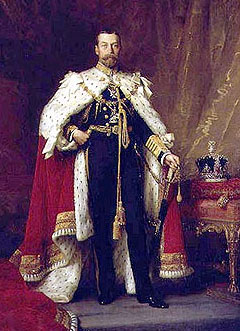
Dead King Watch: George V


Today marks the 71st anniversary of the death of King George V, who reigned as King of Britain and 'King-Emperor' of India from 1910 until his death in 1936. Born on 3 June 1865, his official biographer gives a good insight into what he was like as a young man: 'He did nothing at all but kill [i.e. shoot] animals and stick in stamps.' In 1901, Queen Victoria died, and George's father, Albert Edward, ascended the throne as King Edward VII, and when he died in 1910, George became King George V.

In 1911, the new King and Queen travelled to India where they were presented to an assembled audience as the Emperor and Empress of India. In India, George took the opportunity to indulge in hunting tigers, shooting 21. On 18 December 1913 George shot over a thousand pheasants in six hours at the home of Lord Burnham, later acknowledging that 'we went a little too far' that day. Perhaps so.

The outbreak of World War I was difficult for the Royal Family, as they were kind of on the 'wrong side'. George had many German relatives and the family name was Saxe-Coburg-Gotha. The German Emperor Wilhelm II was the king's first cousin, 'Willy.' The King had brothers-in-law and cousins who were British subjects but who bore German titles such as Duke and Duchess of Teck, Prince and Princess of Battenberg, Prince and Princess of Hesse and by Rhine, and Prince and Princess of Schleswig-Holstein-Sønderburg-Augustenberg. It is not therefore surprising writer H G Wells wrote about Britain's 'alien and uninspiring court'.

King George V's first cousin was Russian Tsar Nicholas II (their mothers - Queen Alexandra of the United Kingdom and Empress Maria Fyodorovna of Russia - were sisters)and when so the Tsar was overthrown in the Russian Revolution of February 1917, it came as a bit of a shock. The British Government offered asylum to the Tsar and his family but worsening conditions for the British people, and fears that revolution might come to the British Isles, led George to think that the presence of the Romanovs might seem 'inappropriate' under the circumstances. However, they decided in 17 July 1917 to change the name of the British Royal House from the German-sounding House of Saxe-Coburg-Gotha to the House of Windsor.

During and after World War I, many of the monarchies which had ruled most European countries fell. In addition to Russia, the monarchies of Austria, Germany, Greece, and Spain also fell to revolution and war, although the Greek monarchy was restored again shortly before George's death. Most of these countries were ruled by relatives of George.

To get some idea of how his subjects came to view King George's time in power, it is hard to do better than quote from a 1935 pamphlet - The Jubilee-and how - written by the British Communist writer T. A. Jackson to counter the rubbish coming out at the time of the Silver Jubilee held to celebrate twenty five years of King George's reign.

'On May 6th we shall all have a holiday. For most of us this will be without pay; but all of us will be (officially) expected to rejoice! Why? Because King George the Fifth has kept his job for twenty-five years. To hold a job in a competitive market market for a quarter of a century, is nowadays, no small feat. And although the post of King can hardly be said to fall within the competitive category, there have been in the past twenty-five years so many cases of Kings deposed, dethroned, and otherwise placed on the retired list that we can well understand why King George and all his fans find the occasion one for sincere gratitute and rejoicing.'

After noting the fall of the Kaisers in Germany and Austria, the Tsar of Russia, the Sultan of Turkey, the Emperor of China, the Kings of Bulgaria, Greece, Spain, Portugal, the Shah of Persia and the King of Siam, Jackson notes that the Jubilee was however a 'trade stunt'. 'Selling' Royalty to the Public began with the cunning Disraeli 'advertising' Queen Victoria, which was useful as people needed to be 'persuaded that but for the King and the Royal Family the world would stop spinning on its axis and the British Empire would blow up with a bang!' Queen Victoria was made out to be 'just like us' but at the same time always achieving 'more than we could do' - 'her domestic virtues were exploited to the full...her bourgeois respectability and the piety and diligence of her spouse were of immense importance in the period when all the thrones of Europe were rocking under the impact of the forces generated by the Industrial Revolution.' Victoria was 'a petty bourgeois monarch around which was organised the cult of Empire worship' - becoming Empress of India in 1877 and then Jubilees were organised in 1887 and 1897 to celebrate her reign.

The Jubilee then was not really for the monarch - who had no power - but to 'hide the reality of the capitalist plutocratic dictatorship of Government', a 'Lord Mayor's show on a world scale'. What exactly are we celebrating 25 years of?

George V's reign saw the bloody First World War which left one million British troops dead and a further million wounded - while elections were suspended at home, followed by economic crisis, high unemployment and repression in the colonies. From the Black and Tans in Ireland, the Meerut Trial in India, as well as events in Egypt these years are marked by a fear of nationalist revolution. And now we have seen the rise of Fascism - 'Hitler's "Aryan" dominance myth is simply the practice of British Imperialism' together with 'bogus science and developed to its logical absurdity'. And now we have the new threat of war.

'To celebrate the Jubilee is to rejoice over the fact that whereas the reign began with the British Government in general sympathy with the Tsar and the Kaiser, its twenty fifth birthday finds it in no less sympathy with Mussolini and Hitler' [His successor, Edward VIII would take 'sympathy' for Mussolini and Hitler to even greater heights]. Jackson noted it is not a question of the personality of the monarch - 'so far as essentials are concerned George V has had no more to do with determining the historical sequence of events and their economic and political outcome than you or I. To blame George V for the present situation at home and abroad would be as foolish as the praise lavished upon him by the press hirelings of capitalist imperialism and by its political mouthpieces'. 'The Jubilee celebrations are deliberately determined to divert public attention - particularly that of the workers from realities to fake issues. They constitute as a whole one elaborate "circus" staged expressly to divert attention from the fundamental rottenness of the social structure for which the British monarchy serves as a single figurehead' - the monarchy is but 'a puppet of Finance State Capital'.

Of the Silver jubilee King George could not really understand why there was so much to celebrate about his reign either, saying in response to the crowd's adulation, 'I cannot understand it, after all I am only a very ordinary sort of fellow.' The shock of war and revolution did seem to take its toll on George's health, which now began to deteriorate. He had always had a weak chest, a weakness exacerbated by heavy smoking. A bout of illness saw him retire to the sea, by Bognor Regis in West Sussex. A myth later grew that the King's last words, upon being told that he would soon be well enough to revisit Bognor Regis, were "bugger Bognor!" In the evening of 15 January 1936, the King took to his bedroom at Sandringham House complaining of a cold; he would never leave the room alive. The King became gradually weaker, drifting in and out of consciousness. The diary of his physician, Lord Dawson of Penn, reveals that the King’s last words, a mumbled "God damn you!", were addressed to his nurse when she gave him a sedative on the night of the 20 January.

Labels: ,

Thursday, November 30, 2006

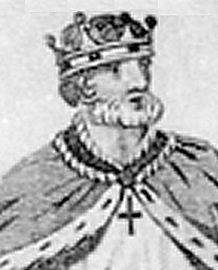
Dead King Watch: Edmund Ironside


Edmund Ironside was pleasantly surprised on being told he had made it onto Dead King Watch.

After ruling for a mere seven months, Edmund Ironside died on November 30 1016, which makes this the 990th anniversary of his death.

Born in 989, Edmund was the second son of King Ethelred the Unready , but when his elder brother Ethelstan died in 1014 Edmund was heir. A power-struggle began between Edmund and his father, but this was put on hold when Canute attacked England with his Viking forces. When Ethelred II, who had earlier been stricken ill, died suddenly on April 23, 1016 Edmund succeeded to the throne, though with little support from the Southern nobility who preferred Canute.

When Edmund forcefully recovered Wessex from Canute’s previous invasion in 1015, Canute responded by laying siege to London, yet Edmund’s defence was successful earning him the name 'Ironside'. Despite the victory, conflict continued until Edmund was defeated on October 18 by Canute at the battle of Ashingdon in Essex. After the battle the two kings negotiated a peace in which Edmund kept Wessex while Canute held the lands north of the River Thames. In addition, they agreed that if one of them should perish, territories belonging to the deceased would be ceded to the living. Sadly for Edmund, he died first and his territories were ceded to Canute who then became King of England.

Labels:

Thursday, November 23, 2006

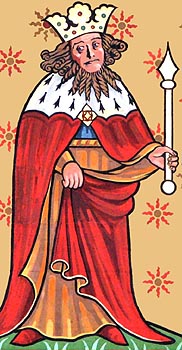
Dead King Watch: Edred


On 23rd November 955, King Edred passed away, which makes this the 1051st anniversary of his death. Born in 923, he became King aged 23 and then ruled for about ten years before dying of an illness in his mid to late thirties. I know one can't judge anyone by their appearance, but I think an exception can be made for Kings and Queens. Just look at Edred. And then laugh.

Labels:

Sunday, November 12, 2006

Dead King Watch: Canute


'Cnut' is the bloke on the right.

Today marks the 871st anniversary of the death of Canute, a Danish King who ruled England and so gets to be part of Dead King Watch. Lucky old Canute. Canute is perhaps best remembered while King of England for the legend of the waves, about how he commanded the waves to go back. Was 'Cnut' simply a Cnutter? Well, according to the legend, not really. Apparently, Canute grew tired of flattery from his courtiers and when one such flatterer gushed that the King could even command the obedience of the sea, Canute got so annoyed that he took the courtier down to the seaside to prove him wrong. However, Wikipedia notes that 'It is quite possible that the legend is even simply pro-Canute propaganda' and I find the idea of any feudal King getting 'tired of flattery' a little far fetched myself. Still, whether true or not - it means old Canute gets to be remembered for something.

Canute was born in about 995, son of Sweyn I of Denmark. Little is known about his life before 1013, but that year, in August, he accompanied his father on his successful invasion of England. While King Sweyn was off conquering England, Canute was left in charge of the remainder of the Danish army at Gainsborough. Upon the sudden death of his father the following February, in 1014, Canute was proclaimed king by the Danish army. However, the assembly of magnates refused to accept him and instead voted to restore the defeated king Ethelred the Unready from exile in Normandy.

Ethelred quickly raised an army, forcing Canute to abandon England and sail back to Denmark with the remnants of his army. When he sailed past Sandwich, Canute was so pissed off that he mutilated hostages given to his father as pledges of support from local nobles. Nice.

Canute’s older brother Harold became the King of Denmark on their father’s death. Canute suggested that the two brothers should jointly rule the Kingdom, which found little appeal with his brother. However, Harold promised him assistance and support for his conquest of England if Canute renounced his rights to the Danish throne. Canute kept silent and waited for an opportunity to present itself when he would 'reclaim' his throne in England.

Canute did not wait long, but returned to England in the summer of 1015 with a Danish force of approximately 10,000 men. The invasion force landed in Essex, which was occupied quickly. Northumbria fell next, and Canute executed its Earl Uhtred for breaking an oath pledged to Sweyn Forkbeard two years earlier. In April 1016, Canute entered the Thames with his fleet and besieged London. King Ethelred died suddenly during the siege, and his son Edmund Ironside was proclaimed king. When Edmund left London to raise an army in the countryside, he was intercepted by Canute at Ashingdon, Essex. After a decisive victory for Canute in the Battle of Ashingdon, Edmund was forced to negotiate under unfavourable circumstances.

Meeting on an island in the Severn River, King Edmund II was forced to accept defeat and sign a treaty with Canute in which all of England except for Wessex would be controlled by Canute, and when one of the kings should die, the other king would take all of England; his sons being the heir to the throne. After Edmund's death (possibly murder) on 30 November, Canute ruled the whole kingdom. Canute was recognised by the nobility as the sole king in January 1017.

By dividing the country (1017) into the four great earldoms of Wessex, Mercia, East Anglia and Northumbria, Canute instituted the system of territorial lordships which would underlie English government for centuries. The very last Danegeld ever paid, a sum of £82,500, went to Canute in 1018. He felt secure enough to send the invasion fleet back to Denmark with £72,000 that same year. After about two decades of presiding over relative social peace, no mean achievement, Canute died in 1035, at Shaftesbury in Dorset, and was buried in the Old Minster in Winchester. On his death, Canute was succeeded in Denmark by his son Harthacanute.

Labels:

Friday, October 27, 2006

Dead King Watch: Athelstan


Today marks the 1067th anniversary of the death Athelstan, who ruled England from 924-939, not that one would know it from reading the bourgeois press of course. What are they trying to hide, (no) one wonders?

Athelstan was born in 895, the son of King Edward the Elder of the Anglo-Saxons, and grandson of Alfred the Great. In 924, Edward died and so Athelstan became King of Mercia and eventually King of Wessex (both in the South of England). Yet rather than rest contented, his desire for more power meant he soon made a move up North, to wage war on the Viking Kingdom of Northumbria - conquering them to become ruler of more territory than any other Anglo-Saxon before him. The other rulers of tribes in Great Britain seem to have now submitted to Athelstan: 'first Hywel, King of the West Welsh {Cornish}, and Constantine II, King of Scots, and Owain, King of the people of Gwent, and Ealdred...of Bamburgh' records the Anglo-Saxon Chronicle. Athelstan was effectively now the first real King of England worthy of the name, extending his rule to Wales and Cornwell. When he died in 939, he chose to be buried in Malmesbury rather than at Winchester, and apparently in Malmesbury if few other places his name lives on into the 20th and 21st centuries, 'with everything from a bus company and a second-hand shop to several roads and streets named after him'. Such a commemoration seems to me to be more than enough a tribute to this warmongering, power-hungry King.

Labels:

Dead King Watch: Alfred the Great


It has been a while since I updated Dead King Watch, and so how better to relaunch the thing by remembering the 1107th anniversary of the death yesterday of King Alfred the Great, who apparently died on 26 October 899. He styled himself 'King of the Anglo-Saxons', though because of his defence of his Kingdom of Wessex (in the South of England) against the Vikings he is known as 'Alfred the Great'. It is telling that no other English monarch has been deemed worthy enough to have been called 'the Great', though does Alfred really deserve the accolade?

Alfred was born in Oxfordshire in about 849, a son of King Ethelwulf of Wessex - who has quite a cool name and who made his name conquering Kent. Alfred was sent to Rome age 5 apparently, where he met the Pope of the day, along with other tribal leaders. Yet his father was soon to die and Alfred's elder brothers ruled. When about 18, Alfred began to fight alongside his brother against the invading Danes - who had been invading since about the 790s - and Alfred made his name in a series of intensive battles in Wessex around 870. However, the Vikings by now had seized York, established their own Kingdom in southern Northumberland, and defeated two other Kingdoms (East Anglia and Mercia) leaving only Wessex as the last surviving Anglo-Saxon Kingdom. In 871, his brother King Ethelred died - possibly from wounds recieved in battle - and Alfred became King of Wessex over Ethelred's young sons. For most of the 870s, Alfred fought a kind of guerilla war against the Viking invaders - famously staying undercover in a peasant woman's hut and letting her cakes burn, though whether there is any evidence for this legendary story is debatable. By the end of the decade, he had turned the tide in defeating the Vikings, achieving his greatest victory in May 878, at the battle of Edington.

According to his contemporary biographer Bishop Asser, 'Alfred attacked the whole pagan army fighting ferociously in dense order, and by divine will eventually won the victory, made great slaughter among them, and pursued them to their fortress (Chippenham) ... After fourteen days the pagans were brought to the extreme depths of despair by hunger, cold and fear, and they sought peace'. Good old divine will, eh?

Alfred then set about negotiating for peace while improving Wessex's defences - building a series of fort like garrison 'boroughs' around his base in Winchester and even developing some sort of navy. His rule now extended to West Mercia and Kent - the rest of the country was under 'Danelaw'. Despite several other attempted invasions, by the 1890s the Danes gave up trying to conquer Wessex. Alfred therefore seems to have had more time to translate and write, and so probably died quite happy.

Labels:

Wednesday, August 30, 2006

Dead King Watch: Henry V


Apparently when the current Queen saw that Henry V didn't look anything like Kenneth Branagh she was not amused.

Yep, another Dead King ('Once more unto the breach, dear friends, once more'). King Henry V died on August 31st 1422, which makes today the 584th anniversary of his death.

He was born at Monmouth, Wales, in either 1386 or 1387, the son of Henry of Bolingbroke, who in 1399 became Henry IV, and Mary de Bohun. Henry IV's reign was troubled, and the young Henry grew up fighting various rebels against his father. Indeed, in 1403, the sixteen-year-old prince was almost killed by an arrow which became lodged in his face. After his father Henry IV died on March 20, 1413, Henry V succeeded him to the throne.

Henry was lucky in that he came to power at a time of rare social peace at home - and so took the opportunity to do what all powerful rulers tend to do at such times - wage war abroad. In 1415, he invaded France but his campaign was a complete disaster - and his army was saved only from total annhilation when the French lost the tactical battle at Agincourt (October 25), probably one of the most famous battles in English history. Today, that battle is held up by right wing historians to show how glorious history can be. David Starkey would doubtless see this battle as one episode of which English people should all be proud. Writing in July 8th's Daily Telegraph, Starkey writes that 'Liberty is something more than an aspiration, it is something which if you are British or English is built into your ancestors. They fought for liberty, they died for it, they struggled for it and we should be doing the same'.

The lines given to Henry V on the eve of Agincourt by Shakespeare certainly make this King sound cool.

'We few, we happy few, we band of brothers;
For he to-day that sheds his blood with me
Shall be my brother; be he ne'er so vile,
This day shall gentle his condition:
And gentlemen in England now a-bed
Shall think themselves accursed they were not here,
And hold their manhoods cheap whiles any speaks
That fought with us upon Saint Crispin's day.'


But 'liberty' had nothing do with any of this. In 1417, Henry returned to France and this time he strategically outwitted the French and in two years had reached Paris. The French collapsed, and Henry ruled as King of both England and France until his death. If he is to be remembered, it should be as a tyrannical leader who liked to wage bloody wars of aggression abroad. Thank goodness, over five hundred years after Henry V's death, modern rulers are so different today.

Labels:

Tuesday, August 22, 2006

Dead King Watch: Richard III


The late great Peter Cook as Richard III (yes, I know, I have used this picture on my blog before)

Richard III died on 22 August 1485, killed by the army of Henry Tudor at the Battle of Bosworth, which makes today the 521st anniversary of his death. Richard appears in the 2002 List of '100 Great Britons' (sponsored by the BBC and voted for by the public) though the BBC History Magazine lists him under 'doubtful entrants, based on special interest lobbying or "cult" status', and comments: 'On the list due to the Ricardian lobby, but a minor monarch'. The Ricardian lobby? Eh? Who the hell are these guys? And why have they formed a cult around someone who died 521 years ago? Well, this is apparently a frequently asked question on their site...

Q:Why do you believe Richard was a good king?

A: 'As king, Richard attempted to provide justice for all, including the poor and the vulnerable and this was demonstrated in his parliament. Richard understood the value of peace and trade, and he encouraged foreign trade and immigration of skilled craftsmen. He had an open mind with regard to invention and innovation and he encouraged the fledging printing industry. He was a talented administrator and following his elevation to the crown established the Council of the North to govern his former palatinate, an organisation that was so successful it was retained by the Tudors and survived until the mid-seventeenth-century. As duke, Richard had a reputation for being good and fair in his dealings but his reign as king was too short for his potential to be fully realised.'

Well - I am no medieval historian, and while it is true that if Richard III did encourage the immigration of skilled craftsmen to England he was a braver man than most of today's politicians, overall this is about as convincing as the stories - given colour by Shakespeare - which simply portray him as an evil 'poisonous hunch-backed toad'.

Richard was born in 1452 at Fotheringay Castle, the eighth and youngest and fourth surviving son of Richard Plantagenet, 3rd Duke of York and Cecily Neville, and there had therefore been no thought of him ever becoming King. However, his Dad did have a minor claim to the throne and when he was just three years old, the Wars of the Roses began - between his dad and the House of Lancaster - another noble family over this. When his father was killed in 1460, at the Battle of Wakefield, Richard's older brother, the 18 year old Edward, took charge of the Yorkist forces and led them to victory at the battle of Towton in 1461 - claiming the throne in the process and becoming Edward IV.

At this time, Richard was just nine years old and, bless him, he didn't really have a clue what the fuck was going on. One moment he was told that his dad and one of his brothers had been killed and their heads placed on spikes for the public to see at York - and the next moment another of his brothers was declared the King of England. Richard spent much of his childhood at Middleham Castle in Wensleydale, under the tutelage of his uncle Richard Neville, 16th Earl of Warwick - a family friend.

During the reign of his brother, King Edward IV, Richard demonstrated his loyalty as well as his skill as a military commander. He was small, stocky but a good jouster. He was rewarded with large estates in Northern England, and given the title Duke of Gloucester and the position of Governor of the North, becoming the richest and most powerful noble in England and a loyal aide to Edward IV. By contrast the other surviving brother, George Plantagenet, 1st Duke of Clarence, was executed by Edward for treason.

By 1471 - the Lancastrians - and others who had stood in Edward's way like Warwick - were completely crushed. Henry VI was murdered in order to make sure of their defeat - and the only rival left was Henry Tudor - in exile abroad. In 1472 - at this time of peace, Richard married Anne Neville, Warwick's daughter and a childhood friend. He lived in York.

Then in 1483 - his brother Edward died, leaving his sons age 12 and 9 the heirs to the throne and Richard as Lord Protector. However, Edward's wife - their mother - Elizabeth Woodville - did not want Richard around exerting influence while the boys were growing up, so Richard had the Woodville's executed and the boys imprisoned in the Tower of London and then murdered. Richard was now King. When one of his supporters - Lord Hastings - thought Richard was in danger of becoming a tyrant, Hastings too was arrested and executed. This act of despotism horrified even his closest supporters like Buckingham - but when Buckingham rebelled he was also executed on the orders of Richard.

As AL Morton notes, Richard's struggle with the nobles who had helped him to power was an 'inevitable struggle [which] involved all the kings of the period in a contradiction that remaned insoluable till almost all the great families had become extinct.'

Rather like Stalin later on, even Richard's family were now stressed by the whole power struggle thing. Richard's son died in childhood in 1484, and the sadness of this prompted his wife, Anne to illness and also death. Richard was now completely alone - and deeply unpopular - save for a few sycophantic hangers on.

The exiled Henry Tudor now saw his chance to return to England and place his claim to the throne, promising to marry the daughter of Edward IV and so unite the Houses of York and Lancaster in peace if he won. Richard stood only for eternal war - he wanted his enemies and rivals destroyed.

As Morton notes, 'When Henry Tudor, who produced a remote claim to the throne, landed at Milford Haven, the treason and desertion that had been a constant feature of the age reasserted itself and Richard found himself almost without supporters. The Battle of Bosworth field, fought on August 22nd, 1485, by a mere handful of men on either side, ended the Wars of the Roses and with them a whole historic epoch in Britain.'

In the battle, Richard led his 120 strong hand-picked mounted bodyguard into a suicide attack in order to try and reach Henry Tudor and kill him, and in doing so achieve an instant victory. Richard cut through Henry's men but at the crucial moment was let down by the Duke of Northumberland, who refused to join battle and help him out. Richard was cut down crying 'treason, treason' to Northumberland - making him the only King to have been killed in battle. The battle stopped and the Crown was placed on the head of Henry Tudor.

According to local tradition in Leicester, Richard had gone to see a seer in the town before heading off for the Battle of Bosworth Field. She told him 'where your spur should strike on the ride into battle, your head shall be broken on the return'. On the ride into battle his spur apparently struck the bridge stone of the Bow Bridge. Afterward, as his naked dead body was being carried from the battle over the back of a horse, his head struck the same stone and was broken open. With all due respect to the people of Leicester, this story strikes me as being complete and utter bollocks. Richard's corpse was then left exposed in a house by the river for two days so all could see him, before it was placed in an unmarked grave.

Labels:

Wednesday, June 28, 2006

Dead King Watch: George IV


One French Romantic painter, Gericault's, portrait of young George.


Another portrayal of the Prince Regent with his loyal servants...

King George IV died on the 26 June 1830, which meant the 176th anniversary of his death took place a couple of days ago.

George, the eldest son of George III and Charlotte of Mecklenburg-Strelitz, was born in St. James's Palace in 1762. At the time of his birth, he automatically became Duke of Cornwall and Duke of Rothesay, which doubtless made the people of Cornwall and Rothesay very happy. George, who also became the Prince of Wales, was a talented student, quickly learning to speak not only English but also French, German and Italian. This highlights the effect of inbreeding on the Royal Family - Prince Harry for example had to cheat in order to pass 'A-level' Art, let alone manage a foreign language.

The Prince of Wales turned 21 in 1783, when he obtained a grant of £60,000 from Parliament and an annual income of £50,000 from his father. He then established his residence in Carlton House, where he lived a profligate life of luxury annoying his father who thought more frugal behaviour on the part of the heir-apparent might look better. Yet as Prince Regent he continued to amass enormous debts - for example inn 1796 reaching the extraordinary sum of £660,000 - and Parliament (ie. the British taxpayer) had to bail him out. Being unwilling to make an outright grant to relieve these debts, Parliament provided him an additional sum of £65,000 per annum. In 1803, a further £60,000 was added, and the Prince of Wales's debts were finally paid. See Blackadder III - picture above - for more on his greed.

In 1811, his father's illness got so bad, George had to become Prince Regent. While the Napoleonic wars raged, George took an active interest in clothes. He took matters of style and taste very importantly, and his associates such as the dandy Beau Brummell and the architect John Nash created the 'Regency style'. In London Nash designed the Regency terraces of Regent's Park and Regent Street. George took up the new idea of the seaside spa and had the Brighton Pavilion developed as a fantastical seaside palace, adapted by Nash in the "Indian Gothic" style inspired loosely by the Taj Mahal, with extravagant "Indian" and "Chinese" interiors. Again see Blackadder III for his love of socks.

When George III died in 1820, the Prince Regent ascended the throne as George IV, with no real change in his powers. George's coronation was a magnificent and expensive affair, costing about £943,000. By the time of his accession, he was obese and utterly useless for anything except buying clothes. He was also showing signs of having inherited his father's mental illness.

On George's death in 1830 - having done nothing to improve the lives of his subjects - even the establishment paper The Times commented unfavourably: There never was an individual less regretted by his fellow creatures than this deceased king. What eye has wept for him? What heart has heaved one throb of unmercenary sorrow? [...] If he ever had a friend - a devoted friend in any rank of life - we protest that the name of him or her never reached us.

Labels:

Friday, June 23, 2006

Dead King Watch: Edward III


King Edward III died on 21 June 1377, which meant the day before yesterday was the 629th anniversary of his death. His reign lasted over fifty years making him one of the longest reigning English monarchs. Ironically, though he lived a long time during his reign saw the Black Death which meant the lives of his subjects was often very short indeed.

Edward was born in 1312, and so crowned aged only 14 in 1327. He got married at 15,
to Philippa of Hainault. The couple produced thirteen children, including five sons who reached maturity. Their eldest son and Edward's heir apparent, Edward the Black Prince (so called because he wore a black suit of armor) who was doubtless an inspiration for the TV character Edmund Blackadder, was born in 1330 and was a famed military leader.

Edward's accession to the English throne was of questionable legality as his father, Edward II, was still alive at the time and was deposed in order for Edward to become king. There is still a debate today whether anyone had the authority to depose him. As Edward was still a teenager at the time the main actors were his mother Isabella of France and her lover, Roger Mortimer, who proceeded to rule the country in Edward III's name. In 1330, the seventeen-year old Edward seized control over the English court, overthrowing Mortimer, who was executed, and removing Isabella from power.

The reign of Edward III was marked by continued war with Scotland, but much more by the war with France - The Hundred Years War. This sounds grand but was really a series of raids along the French coast by English armies. After Edward declared himself king of France on January 26, 1340 the French unsurprisingly decided to fight back and the wars continued sporadically up to the 1450s. While early victories were eventually reversed, English and, later, British monarchs would continue to claim the title "King of France" until the Treaty of Amiens in 1802. Edward III quartered his coat of arms with "France Ancient", the Azure semé-de-lis (a blue shield with a tight pattern of small golden fleur de lis of the French royal house), and it remained a part of the English Coat of Arms until removed by George III.

While the king and the black prince campaigned abroad, the government was left largely in the hands of the prince's younger brother, John of Gaunt. Economic prosperity from the developing wool trade created new wealth in the kingdom, but the ravages of the bubonic plague, or Black Death, had a significant impact on the lives of his subjects. Commercial taxes became a major source of royal revenue, which had previously been largely from taxes on land. The Parliament of England became divided into two houses. At the beginning of Edward's reign, French was still the language of the English noblesse, following the Norman invasion, but by the end this had changed - in 1362 English was made the official language of the law courts.

The king also founded an order of knighthood, the Order of the Garter, allegedly as a result of an incident when a lady, with whom he was dancing at a court ball, dropped an item of intimate apparel (possibly a sanitary belt, though sources describe it as being made of velvet). Gallantly picking it up to assuage her embarrassment, Edward tied it around his own leg, and remarked Honi soit qui mal y pense ('Shame on him who thinks evil of it'), which became the motto of the Order of the Garter.

Despite having an unusually happy marriage, and producing thirteen children with Philippa, Edward was a notorious womaniser. After Philippa's death in 1369, Edward's mistress, Alice Perrers, became a byword for corruption. Facing a resurgent French monarchy and losses in France, Edward asked Parliament to grant him more funds by taxing the wine and wool trades, but this was badly received in 1374–1375 as a new outbreak of bubonic plague struck. The "Good Parliament" of 1376 criticised Edward's councillors, including Alice Perrers' family, and advised him to limit his ambitions to suit his revenues.

Edward died of a stroke brought on by severe constipation in 1377. He was said to have been infected with gonnorhoea by Alice Perrers. Supposedly, she was there when he died and removed the rings from his fingers before fleeing. Edward was buried in Westminster Abbey. His son Edward, the Black Prince, predeceased him in 1376, and Edward III was succeeded by his young grandson, King Richard II of England.

Labels: