Histomat: Adventures in Historical Materialism

'Historical materialism is the theory of the proletarian revolution.' Georg Lukács

Monday, July 03, 2017

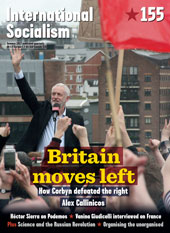
International Socialism #155 out now


The latest issue of International Socialism is out now, with analysis of the glorious general election of 2017 in Britain and also an interview with a French activist regarding 'the meaning of Macron'.  Other topics discussed include Podemos in Spain, the Russian Revolution at its centenary, and the state of the class struggle in Egypt and China - check out the full contents list anyway and consider subscribing if you do not currently... 

Labels: , , , , , , ,

Wednesday, October 21, 2015

Another World is Necessary - Marxism in Scotland 2015

Another World is Necessary - Marxism in Scotland 2015

Saturday 31 October, 10am-5.30pm

Renfield St Stephens, 260 Bath Street, Glasgow G2 4JP

A day of political debate, analysis and discussion on key questions including:

How can the left unite?

How do we challenge racism and scapegoating?

How can we build resistance to the Tories?

How do we win LGBT and women’s liberation?
What do socialists say about Europe?

Speakers include:

Gail Morrow
Anti Bedroom Tax Federation vice chair

Petros Constantinou
Athens councillor & founder member of KEERFA Greece anti-fascist movement

Judith Orr
author of Marxism & Women's Liberation

Laura Miles
author of Pride, Politics and Protest & UCU Left activist

Plus speakers from Glasgow Campaign to Welcome Refugees and Glasgow home care strikers


Tickets: £3 unwaged, £5 student, £10 waged, free for refugees & asylum seekers

Hosted by the Socialist Workers Party
https://www.swp.org.uk/event/marxism-scotland

Labels: , , ,

Friday, May 08, 2015

La Lutte Continue


After the generally disastrous general election, the struggle continues...

Labels: , , , , , , , , , ,

Friday, October 17, 2014

International Socialism # 144 out now

Cover of issue 144

The latest issue of International Socialism journal, a quarterly journal of Marxist theory, is out now - highlights include critical discussions of Lahs Lih's work on Lenin, Lise Vogel's work on women's liberation, Vivek Chibber's work on the Subaltern Studies school, plus articles on Scotland, South Africa, Ukraine, imperialism and global warming.  There is also an online only article on 'The birth of a new generation under tear gas: the umbrella movement in Hong Kong' by Vincent Sung, which is most timely and brings out the tensions and how that movement is at something of a crossroads.  To subscribe to the ISJ, see here.


Labels: , , , , , ,

Thursday, October 09, 2014

Marxism in Scotland

After the Referendum - which way forward for the Left?
Saturday 11 October - Glasgow

On the 18th September, 1.6 million people (45% of voters) in Scotland voted yes to independence. It was a truly historic referendum result with 97% of eligable voters registered and an 85% turnout, breaking all existing voting records in British history.

Although the referendum result narrowly rejected independence by 55 percent to 45 percent. Scottish voters gave the British ruling class the fright of its life—and politics in Scotland will never be the same again.

The genie is out of the bottle! There is a new movement that has emerged from the independence campaign. A movement with a positive vision for the future and the ideas, the creativity and the potential to transform Scotland.

Last year over 250 socialists, campaigners and activists attended Marxism in Scotland.

This year's event takes place just 3 weeks after the independence referendum result and one week before the major anti-austerity demonstrations in both Glasgow and London.

Come along and be part of a fantastic day for sharing experiences, political discussions, debates, strategy and tactics with local, national and international speakers on how we can take the struggle for a better world forward.

Speaking at Marxism in Scotland...

Kevin McKenna, Observer Scottish columnist

Bob Thomson, former Scottish Labour Party Chairman and leading supporter of Labour for Independence

Cheryl Gedling PCS Union NEC member, President Scottish Government Group (personal capacity)

Professor Greg Philo, research director of Glasgow University Media Unit. Co-author of Bad News from Israel (2004), More Bad News from Israel (2011) and Bad News For Refugees, written with Emma Briant and Pauline Donald

Amal Azzudin, community worker and one of the Glasgow Girls whose struggle against the deportations of asylum seekers from Glasgow has since been turned into a play and television drama/documentary.

Ian Hodson, president, Bakers, Food and Allied Workers Union)

Alex Callincos, author of Imperialism and the World Economy

Weyman Bennet, Unite against Fascism National Joint Secretary, recently returned from Ferguson, Missouri

Keir McKecknie. author of top selling 'Independence Yes, Nationalism No' pamphlet

Full programme coming soon with speaker details of the opening rally, the closing plenary and workshops on...

How can Palestine be Free?
Understanding Imperialism Today - Iraq, Syria and Ukraine
The Struggle for Womens Liberation
Fighting Racism and Fascism Today
The Assault on Welfare
Fighting Austerity in the Workplace.

Registration: 10 - 11am
Tickets: £5 waged, £3 unwaged (£10 solidarity price).

There is a free creche for Marxism in Scotland. Please private message or email swpscotland@gmail.com before 2pm Friday 10th to book places.

Book online: https://www.swp.org.uk/event/marxism-scotland (at bottom of page)

Labels: ,

Sunday, September 14, 2014

Vote Yes - Make Britain History


Ruling classes rarely like mass popular participation in any kind of political activity - it smells too much of real, direct democracy for them.  So news that 97% have registered to vote in the Scottish referendum is terrifying the British ruling class, raising as it does the all too real spectre of a 'Yes' vote for independence that not once of them had conceived as being possible just a month or so ago.  Now in desperation, David Cameron is urging ordinary people in England and Wales to engage with this political process and 'love bomb' Scots through social media etc to try and persuade them to do what he and his fellow politicians from the 'Better Together' campaign could not do - and vote to 'stay together', and so while I have not said anything really about Scottish independence to date I thought as a blogger I should now also say something about this question.   So this is for my thousands of Scottish readers, who have doubtless been patiently waiting and wondering to see what my thoughts on this question were before they arrived at their final position...

For Marxists, the question of Scottish independence is not an issue of principle (that needs to be raised at all times and in all places) but rather a tactical question - but in the current period and climate the case for agitating for a Yes Vote seems to be a no-brainer for any anti-imperialist, let alone a Marxist.  One only needs to see the unholy alliance of forces opposed to the break up of the British state - from the rulers of the American and Chinese empires, to champions of British imperialism old and new, to see why the majority of revolutionary socialists in Scotland have thrown themselves into the 'Yes' campaign, and they have played a small but significant role in making the rallying cry 'Another Scotland is Possible' one which has tapped into working class communities and ethnic minorities.  Just watching one of Tommy Sheridan's speeches for independence on You Tube - speeches which have attracted audiences of hundreds of people - gives a sense of the mood of hope and optimism in radical politics being fired up by the referendum.  What has been propelling the mass movement and campaign for Yes has been these aspirations of dreams long deferred among millions.

The chance to deliver a body blow to British imperial power by the closing of the Trident nuclear submarine base at Faslane is in itself reason enough to vote Yes - but a Yes vote would also throw Cameron's Tories into chaos and further infighting and have many other repercussions and reverberations that are impossible to predict as yet.  Though in itself, a Yes vote for Scottish independence cannot be the end of the story, given Alex Salmond and the SNP's cosy relationship with Scottish big business, NATO and the British Crown, such a vote on 18 September would enable the Left in Scotland to begin to make the kind of demands - such as nationalisation of banks and energy companies - that would make the idealism of 'Another Scotland is Possible' into reality - and find a mass popular audience for such a radical vision for the first time in decades.  This would give hope to trade unionists and socialists in England and Wales in the wider fight against austerity and the likes of Tories and UKIP.   So my 'love-bomb' to Scottish readers of Histomat goes something like this:  Yes to Independence, No to Nationalism - Fight for Socialism!

Edited to add - in the aftermath of the No vote, an analysis of the vote and where next by Keir McKechnie and Charlie Kimber - see also this piece by Irvine Welsh.

Labels: , , , ,

The passion of Ed Miliband

SPEECH: Ed Miliband yesterday told an audience in Blantyre, South Lanarkshire that a Labour government was coming. Picture: Getty

Ed Miliband rarely shows any passion about anything - so to see him revealing his passionate desire to preserve the unity of the British imperialist state while giving a speech in Scotland warning against independence - came as a bit of a shock to the system.  It is a damning indictment of Miliband that he refuses to show 0.0001 percent of the same passion when it comes to supporting striking Care UK workers in his own constituency of Doncaster, which he refuses to do despite the fact these workers are victims of NHS privatisation, which Miliband is supposed to be passionately against...  perhaps the reason he shows such newly discovered passion about the Scottish referendum is because his own job as Labour leader will be threatened if Scottish people vote Yes?

Labels: , ,

Friday, August 19, 2011

Peter Petroff and the origins of British Bolshevism

The now forgotten but once legendary veteran Russian Marxist
Peter Petroff
(1884-1947) now has a significant collection of his writings in English up on the Marxists Internet Archive. Ted Crawford has written a short biography of him for the site. Petroff played an important role in the origins of not only Russian Bolshevism but also British Bolshevism. In 1907, he had arrived in Britain as a refugee from Tsarist Russia and worked with John Maclean and other socialists up in Glasgow, learning English and relating to them in turn something of the history of the Russian revolutionary movement. Imprisoned during the Great War, Petroff maintained links with Trotsky and returned to Russia after the revolution in 1918, joining the Soviet government. By the 1930s, after being sent to Germany as a special envoy and witnessing the disastrous role Stalinism played at the time of the rise of Hitler, he broke with the Communist International. He then escaped from Nazi Germany back to Britain, where he wrote a classic work The Secret of Hitler’s Victory with his German wife, Irma (1891-1968), published in 1934 by Woolf’s Hogarth Press - which provided a Marxist analysis of the resistable rise of Hitler.

Labels: , , ,

Sunday, February 20, 2011

John Maclean on the Monarchy

[One hundred years ago, Britain saw not only 'a strike wave spread throughout Britain that saw troops on the streets and a strike committee virtually running a major city' - a wonderful upturn in the class struggle known as the Great Unrest - but also the coronation of George V. In a short article on 'Democracy and the Coming Coronation', the great revolutionary socialist John Maclean penned his thoughts on the role of the monarchy in a modern class society, warned workers not to be distracted from their main aims and objectives by the whole charade and called for a new democratic People's Charter...]

'Our protest against the mockery of the coming monarchical mummery should take the form of a demand for more political freedom for the masses instead of a direct demand for the establishment of a republic...

We Social Democrats, Republicans though we may be, have been essentially responsible for teaching the people that the real political enemy our class is not the king; but the propertied class that, out of the plunder taken from us, is prepared to spend the sum needed to maintain the Royal Family.

The capitalists cheerfully pay out this sum, as the maintenance of Royalty at this critical juncture in the country’s history seems to them necessary as an agency that helps to cover over with superstitious ornament the class war between the capitalists and the workers, and which thus helps to stave off those demands for political equality that would naturally ensue upon the establishment of a republic.

The capitalists cannot afford, then, to dethrone the monarch in this country, especially on account of their supreme control of the political machinery of the land and on account of their fear of the people’s desire for participation in the gentle art of law making and administration. And, on account of their propaganda, the people are conscious that the social inequalities in the land are in no way due to the crowned head...

But the workers are ripe, and over ripe, for the passing into law of a new political People’s Charter...And in our efforts we need place no reliance on the Labour Party... The consciousness now prevalent amongst the masses that their real wages are considerably below those obtained when the Labour organisation came into existence, the further consciousness that the Labour Party has failed to defend the workers, when on strike against reduced wages or oppression, and the fact that the Labour Party has made no real outstanding fight for the workers at all since it began its Parliamentary career, warns us to place no reliance for support on these slippery eels of statesmen whose chief end in life seems to be the destruction of Socialism.

Let us directly appeal to the people, and with our clamour, widespread and prolonged, let us drown the chorus of false praise that will herald the approach of the nearing comic opera. Thus will we make history and perhaps march a stage nearer our goal.

Labels: , ,

Thursday, April 19, 2007

Is turning rebellion into money courageous?


Why is it Gordon Brown has to try and make money out of everything? Is nothing sacred? Apparently not, if his soon to be published book Courage: Eight Portraits is anything to go by. This is apparently about Gordon Brown's political heroes, but it seems to me to more about cashing in on his rise to fame and power than anything else. Still, lets hear him out.

As far back as I can remember, I have been fascinated by men and women of courage. When I was 10, I was given an encyclopedia of 20th-century history. In it were recorded great deeds: the daring of Shackleton, the sheer determination and inspired improvisation that took his expedition across the Antarctic; the bravery and ill-fated amateurism of the Mallory and Irvine attempt on Everest in 1924; Scott's expedition to the South Pole in 1912, and Captain Oates and his last sacrifice. All of them I admired'

What sort of 'encyclopedia of 20th century history' was that? The Boys Own guide to plucky British adventurers in the age of Empire? However, though he is not mentioning it now, Brown soon discovered socialism and with it a set of Scottish heroes and heroines. In his twenties, in 1975, he wrote an article of which I put extracts up on my blog, The Socialist Challenge, where he praised 'Scotland's socialist pioneers, Hardie, Smillie, Maxton, Maclean, Gallacher, Wheatley and others' - indeed he even wrote a biography on James Maxton based on his PhD research. All of them, even the beloved Maxton, are forgotten now by Brown.

Who are his heroes now?

Edith Cavell, a British nurse executed by the Germans during WWI.
Dietrich Bonhoeffer, a German Lutheran pastor who was killed by the Nazis for opposing them.
Raoul Wallenberg, a Swedish capitalist who saved Hungarian Jews from the Nazis before dying in Stalinist Russia.
Martin Luther King, black leader of the American Civil Rights movement, assassinated in 1968.
Robert Kennedy, American liberal anti-Communist politician, also assassinated in 1968
Nelson Mandela, leader of the anti-apartheid movement in South Africa.
Cicely Saunders, British founder of hospices.
Aung San Suu Kyi, fighter for democracy in Burma today.

One should salute Brown's internationalism, and his inclusion of three women on one level I suppose, and he is right to describe these people (with the exception of Robert Kennedy - still it could have been worse) as 'men and women of courage...Their stories live on and inspire us...They were prepared to endure great sacrifices and persist, some of them for many years, against the odds and in the face of the greatest adversity.' The Guardian seems ecstatic at the prospect of the book. Catherine Bennett gushes 'The most appealing thing about this book is its wonderful unflashiness; that it could never have been written by Tony Blair or David Cameron.'

There are several things of interest about Brown's choices, but I want to touch on just three things - nation, class and politics.

On nation, what is most obvious is that there is not one person on the list of Brown's heroes who challenged tyranny or injustice when it was carried out by the British. The only two British figures are nurses, (perhaps this is a sop to today's undervalued nurses - 'I will cut your pay today, but I really appreciate what you do, honest'). Brown's beloved 'Britishness' remains uncomplicated by any questions of empire or race. Martin Luther King is saluted for leading the American Civil Rights movement - but the 'British Civil Rights movement' remains safely out of sight and out of mind (no Suffragettes or anti-colonial activists here). We should not be surprised. As Brown boasted to the Daily Mail recently: 'The days of Britain having to apologise for its colonial history are over. We should celebrate much of our past rather than apologise for it.'

On class, while the Chartists are forgotten, it is interesting that not one trade unionist makes it onto the list. Brown will celebrate capitalists and capitalist politicians - but those who were imprisoned, deported or killed fighting for rights at work - forget it.

Finally, we come to the hypocrisy of Brown, 'paymaster of the Iraq bloodbath' as John Pilger calls him. Who is he to give moral lectures on anything, let alone 'courage'? As one Guardian reader pointed out:

'Did he stand up to Blair and Bush over Iraq? As a cabinet minister he would have known the evidence for WMD was flawed. Did he stand up to the frivolity of the Millennium Dome? Did he do his best to prevent Trident's progress (Scotland-based Trident will presumably not be in his beautiful backyard as pictured on your front page). Has he admitted his PFI initiatives are spiralling out of control? Does he do all he can to prevent people being deported to countries with violent regimes?'

Writing an awful book will not cover up the awful truth about Gordon Brown.

Labels: , , , ,

Monday, March 19, 2007

The Socialist Challenge for Scotland

2007 marks not only the bi-centennary of the abolition of the British slave trade but also the ter-centennary of the 1707 Act of Union between England and Scotland, and the spirit of Scottish independence is in the air as the May elections approach. I came across a fine article about politics in Scotland the other day, entitled 'The Socialist Challenge', outlining the way ahead for the working class movement - and so I decided to put parts of it up on my blog. The article began by stressing the stakes ahead:

'The irresistable march of recent events places Scotland today at a turning point - not of our own choosing but where a choice must sooner or later be made. A resurgent nationalism which forces onto the agenda the most significant constitutional decisions since the Act of Union is one aspect of what even the "Financial Times" has described as "a revolt of rising expectations". But the proliferation of industrial unrest and the less publicised mushrooming of community action also bears witness to the sheer enormity of the gap now growing between people's conditions of living and their legitimate aspirations.'

The article goes on to list what it calls 'Scotland's real problems - our unstable economy and unacceptable level of unemployment, chronic inequalities of wealth and power and inadequate social services' and asks bluntly:

'Who shall exercise power and control the lives of our people? How can we harness our material resources and social energies to meet the needs of five million people and more? What social structure can guarantee to people the maximum control and self management over the decisions which affect their lives, allowing the planned co-ordination of the use and distribution of resources, in a co-operative community of equals?'

The answer is clear:

'Scotland's social condition and political predicament cries out for a new commitment to socialist ideals, policies and action emerging from a far reaching analysis of economy and society; a bringing together of the many positive insights, responses, and analyses to break through the deliberate separation of issues and the consequent fragmentation of people's consciousness; and a searching for the new social vision for Scotland which begins from people's potentials, is sensitive to cultural needs, and is humane, democratic and revolutionary.'

Indeed so. But there is more - we need to 'transcend that false and sterile antithesis which has been manufactured between the nationalism of the SNP and the anti-nationalism of the Unionist parties, by concentrating on the fundamental realities of inequality and irresponsible social control, of private power and an inadequate democracy. For when the question of freedom for Scotland is raised, we must ask: freedom for whom? From what? For what?'

The author continues:

'The social and economic problems confronting Scotland arise not from national suppression nor from London mismanagement (although we have had our share of both) but from the uneven and uncontrolled development of capitalism and the failure of successive governments to challenge and transform it. Thus we cannot hope to resolve such problems merely by recovering a lost independence or through inserting another tier of government: what is required is planned control of our economy and a transformation of democracy at all levels.

We suggest that the real resources of Scotland are not the reserves of oil beneath the sea (nor the ingenuity of native entrepreneurs) but the collective energies and potential of our people whose abilities and capacities have been stultified by a social system which has for centuries sacrificed social aspirations to private ambitions. It is argued that what appear to be contradictory features of Scottish life today - militancy and apathy, cynicism and a thirst for change - can best be understood as working people's frustration with and refusal to accept powerlessness and lack of control over blind social forces which determine their lives. It is a disenchantment which underlines an untapped potential for co-operative action upon which we must build.

The vision of the early socialists was a society which had abolished for ever the dichotomy - the split personality caused by people's unequal control over their social development - between man's personal and collective existence, by substituting communal co-operation for the divisive forces of competition. Today the logic of present economic development, in inflation and stagnation, and at the same time the demand for the fullest use of material resources, makes it increasingly impossible to manage the economy both for private profit and the needs of society as a whole.

Yet the longstanding paradox of Scottish politics has been the surging forward of working class industrial and political pressure (and in particular the loyal support given to Labour) and its containment through the accumulative failures of successive Labour Governments.

More than fifty years ago socialism was a qualitative concept, an urgently felt moral imperative, about social control (and not merely state control or more or less equality). Today for many it means little more than a scheme for compensating the least fortunate in an unequal society. We suggest that the rise of modern Scottish nationalism is less an assertion of Scotland's performance as a nation than a response to Scotland's uneven development - in particular to the gap between people's experiences as part of an increasingly demoralised Great Britain and their (oil-fired) expectations at a Scottish level. Thus, the discontent is a measure of the failure of both Scottish and British socialists to advance far and fast enough in shifting the balance of wealth and power to working people and in raising people's awareness - especially outside the central belt of Scotland where inequalities are greater - about the co-operative possibilities for modern society.


Looking to the future, the author calls for 'A Planned Economy' as there is a 'necessity for social control of the institutional investors who wield enormous financial power both in fostering privilege in our social security system and in controlling the economy...public control of banks, insurances and pensions companies, could have a two-sided effect: creating greater social justice in the social services and providing substantial resources for industrial development':

'Such a policy could be enacted without compensation and would in itself constitute a major erosion of the power of the British upper class. Public control to end the manipulative stranglehold of the monopolies would require a strategy to end the power of the British, American and European multinationals over the Scottish and British economies and in the event would require controls over foreign investment and trade, accepting a disengagement from a committment to the free movement of capital in Europe.'

The author therefore advocates 'Worker's Power' as 'the demand for the economy to be directed according to people's needs requires that the need for meaningful work be prioritised':

That involves a new and creative relationship between work, education and leisure which breaks down the existing division of mental and manual labour and the extention of self management at the workplace. What has often been cited as the irreconciliable clash in socialist theory between regulating material production according to human needs and the principle of eliminating the exploitative domination of man over man can only be met through producers controlling the organisation of the productive process.

Thus it is precisely the surging forward of demands by trade unionists for real control over the decisions affecting their livelihood that will be the departure point for socialists...Workers' control on an international scale is clearly an alternative to nationalism...we would be wrong to underestimate the experience and the education which has led particularly the industrial workers of Scotland to reject implicitly if not explicitly the values of a capitalist society.


The article concludes with a look at The Way Forward.

'There are as many Scottish roads to Socialism as there are predictions of Britain's economic doom - but most of them demand three things: a coherant plan for an extension of democracy and control in society and industry which sees every reform as a means to creating a socialist society; a harnessing of the forces for industrial and community self-management within a political movement; and a massive programme of education by the Labour Movement as a whole.

Gramsci's relevance to Scotland today is in his emphasis that in a society which is both mature and complex, where the total social and economic processes are geared to maintaining the production of goods and services (and the reproduction of the conditions of production), then the transition to socialism must be made by the majority of the people themselves and a socialist society must be created within the womb of existing society and prefigured in the movements for democracy at the grass roots. Socialists must neither place their faith in an Armageddon or of capitalist collapse nor in nationalisation alone. For the Jacobin notion of a vanguard making revolution on behalf of working people relates to a backward society (and prefigures an authoritarian and bureaucratic state), then the complexity of modern society requires a far reaching movement of people and existing conditions and as a co-ordinator for the assertion of social priorities by people at a community level and control by producers at an industrial level. In such a way political power will become a synthesis of - not a substitute for - community and industrial life.

This requires from the Labour Movement in Scotland today a postive commitment to creating a socialist society, a coherant strategy with rhythm and modality to each reform to cancel the logic of capitalism and a programme of immediate aims which leads out of one social order into another. Such a social reorganisation - a phased extension of public control under workers' sustained and enlarged, would in EP Thompson's words lead to "a crisis not of despair and disintegration but a crisis in which the necessity for a peaceful revolutionary transition to an alternative socialist logic became daily more evident."

But the dynamic must come from the existing layer of thousands of committed socialists in Scotland today, firstly through a more obviously democratic and accessible Labour Movement co-ordinating its work with the trade unions (beginning with factory branches) and with street committees, and secondly, through a concerted programme of political education. The early Scottish socialists believed that the bridge between their utopian ideals and the practical politics under which people suffered must be built in a massive programme of education and propaganda. Today in Scotland we have no daily or weekly specifically Scottish political newspapers, no socialist book club, no socialist labour college, no workers' university, and only a handful of socialist magazines and pamphlets. We need all of these now.

It is only within a reinvigorated socialist strategy that we can appreciate the possibilities of existing and proposed structures of government. Devolution has been all things to all people - the halfway house between Westminster rule and a Scottish independence that will take us from rigs to riches; the insertion of a sixth tier of government which threatens to make us the most overgoverned country in Europe; and a fundamental extension of democracy whose every detail is of prime concern and importance...

The question is not how men and women can be fitted to the needs of the system - but how the system can be fitted to the needs of men and women....Scotland's socialist pioneers, Hardie, Smillie, Maxton, Maclean, Gallacher, Wheatley and others, knew that socialism would not be won until people were convinced of the necessity for social control. The Scottish Labour movement is uniquely placed today to convert the present discontent into a demand for socialism: we will fail only if we ignore the challenge.'


The author of this fiery and eloquent argument for socialism? Perhaps Tommy Sheridan MSP, the leader of Solidarity in Scotland? Perhaps the Scottish socialist George Galloway? No, in fact (as some of you undoubtedly have already guessed) the author of this piece is in fact Gordon Brown, the current Chancellor and destined to be the new Prime Minister of Britain in a few months time. It was written in 1975, as the introduction to The Red Paper on Scotland, a collection of essays by Scottish socialists. I rather like his attack on Leninism, 'the Jacobin notion of a vanguard making revolution on behalf of working people relates to a backward society (and prefigures an authoritarian and bureaucratic state)' - thank goodness 'authoritarian' and 'bureaucratic' are not words which could ever be used to describe New Labour in power...

Labels: , , ,