Histomat: Adventures in Historical Materialism

'Historical materialism is the theory of the proletarian revolution.' Georg Lukács

Wednesday, October 21, 2015

Another World is Necessary - Marxism in Scotland 2015

Another World is Necessary - Marxism in Scotland 2015

Saturday 31 October, 10am-5.30pm

Renfield St Stephens, 260 Bath Street, Glasgow G2 4JP

A day of political debate, analysis and discussion on key questions including:

How can the left unite?

How do we challenge racism and scapegoating?

How can we build resistance to the Tories?

How do we win LGBT and women’s liberation?
What do socialists say about Europe?

Speakers include:

Gail Morrow
Anti Bedroom Tax Federation vice chair

Petros Constantinou
Athens councillor & founder member of KEERFA Greece anti-fascist movement

Judith Orr
author of Marxism & Women's Liberation

Laura Miles
author of Pride, Politics and Protest & UCU Left activist

Plus speakers from Glasgow Campaign to Welcome Refugees and Glasgow home care strikers


Tickets: £3 unwaged, £5 student, £10 waged, free for refugees & asylum seekers

Hosted by the Socialist Workers Party
https://www.swp.org.uk/event/marxism-scotland

Labels: , , ,

Saturday, October 10, 2015

International Socialism # 148 out now

The latest issue of International Socialism is now out, highlights include Panos Garganas on the failure of Syriza, Alex Callinicos on the victory of Jeremy Corbyn) and pieces by Callinicos and John Palmer debating how British socialists should respond the upcoming EU referendum, Fran Cetti on Fortress Europe, Susanne Jeffrey's on capitalism and climate change, Joseph Choonara on Paul Mason's Postcapitalism, and John Newsinger on British counter-insurgency violence and state terror. The ISJ has also grouped together a useful set of theoretical articles for Black History Month - see here.

Labels: , , ,

Wednesday, July 08, 2015

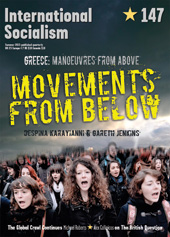
International Socialism #147 out now


The latest issue of International Socialism is out now, with pieces including analysis of the British general election by Alex Callinicos, Gareth Jenkins and Despina Karayianni on Greece under Tsipras - highly topical given the recent impressive and inspiring No vote, and a host of other wide-ranging articles and goodies it is difficult to do justice to at the moment - given I am about to go off to protest myself at George Osbourne's Tory budget - and say 'Oxi to Osbourne!'


Labels: , ,

Tuesday, June 30, 2015

Marxism 2015 - Ideas for Revolution

Marxism 2015: Ideas for revolution
A five day political festival: 9-13 July 2015, Central London
www.marxismfestival.org.uk
Book up - Just over one week to go!
New meeting: Tackling the Racist Offensive
Sat 11th July, 7pm
Marxism Festival is very pleased to announce that Diane Abbott MP will speak alongside Sabby Dhalu and Weyman Bennett (Joint Secretaries of Unite Against Fascism, pc) at this new meeting at Marxism.
Meetings on Greece at Marxism 2015
The crisis in Greece poses sharp questions for the left.
Don’t miss our special debate:
Syriza in power: Whither Greece?
With Stathis Kouvelakis (Syriza Central Committee) and Alex Callinicos (SWP)
Sat 11th July, 2pm 
Plus
  • Greece: keeping the hope for change alive
With Panos Garganas (SEK)
Sunday 12 July, 2pm
  • The fight against Golden Dawn in Greece
With Petros Constantinou (Athens Councillor and co-ordinator of the Movement Against Racism and the Fascist Threat) and Kostas Papadakis (part of the legal team representing the victims of Nazi attacks at the trial of Golden Dawn)
Saturday 11th July, 11.45am
  • Fighting the Troika and austerity across Europe
Maria Styllou from Greece will peak alongside Richard Boyd Barrett from Ireland and Christine Buccholz from Germany
Sunday 12th July, 3.45pm
Plus Panos Garganas will join the Marxism opening rally on Thurs 9th July at 7pm

Other meetings at Marxism 2015
  • After Kobane and the general election: where now for Turkey and the Kurds
 Ron Marguilies will be joined by HDP MP Sebahat Tuncel
Sat 11th July, 7pm (the time of this meeting may change – please check our website)
  • Orgreave: the search for the truth
Gareth Peirce and Mike McColgan from the Orgreave Truth and Justice Campaign
Sun 12th July, 3.45pm
  • The story behind Pride
With Nicola Field and Gethin Roberts, original members of LGSM
Sun 12th July, 7pm.
And if you missed Pride at the cinemas there is chance to watch the film afterwards.
  • Darcus Howe, broadcaster and civil liberties campaigner discusses his political life with his biographers Robin Bunce and Paul Field

The final timetable for Marxism 2015 will be on line from tomorrow . . . to book tickets and for more information go to www.marxismfestival.org.uk or call us on 020 7819 1190

Labels: , , , , , , , , , , ,

Monday, February 23, 2015

Where is Syriza going?

From Panagiotis Sotiris via Alex Callinicos:

First major negative reaction against the Eurogroup agreement from inside SYRIZA comes from Manolis Glezos, Member or European Parliament of SYRIZA, and a living legend of the Resistance against fascism (in 1941 along with Lakis Santas they took down the German flag from the Acropolis)
Here is a rough translation of his statement

Statement by Manolis Glezos

Before it is too late
The fact that the Troika has been renamed ‘the institutions’, the Memorendum has been renamed the ‘Agreement’ and the Creditors have been renamed the ‘Partners’, in the same manner as baptizing meat as fish, does not change the previous situation.
And you can’t change the vote of the Greek People at the January 25 election.
The Greek people voted what SYRIZA promised: that we abolish the regime of austerity that is the strategy of not only the oligarchies of Germany and the other creditor countries but also of the Greek oligarchy; that we abrogate the Memoranda and the Troika and all the austerity legislation; That the next day with one law we abolish the Troika and its consequences.
A month has passed and this promise has yet to become action.
It is a pity indeed
From my part I APOLOGIZE to the Greeκ people for having assisted this illusion
Before the wrong direction continues
Before it is too late, let’s react
Above all the members, the friends and supporters of SYRIZA, in urgent meetings at all levels of the organization have to decide if they accept this situation
Some people say that in an agreement you must also make some concessions. By principle between the oppressor and the oppressed there can be no compromise, as there can be no compromise between the slave and the conqueror; Freedom is the only solution
But even if accept this absurdity, the concessions that have already been made by the previous pro-memoranda government with unemployment, poverty and suicide, are beyond any limit of concession...
Manolis Glezos, Brussels 22-2-2015

Labels: , , , , ,

Tuesday, February 10, 2015

Michael Roberts on Yanis Varoufakis

A good Marxist analysis of the thinking behind Greece's new finance minister, who believes that “it is the Left’s historical duty, at this particular juncture, to stabilise capitalism; to save European capitalism from itself and from the inane handlers of the Eurozone’s inevitable crisis”...

Labels: , , ,

Sunday, February 08, 2015

Debate: Syriza and Socialist Strategy

Hosted by International Socialism
 
Wednesday 25 February 2015, 7pm

With Stathis Kouvelakis, member of Syriza’s central committee and Alex Callinicos, editor, International Socialism

The victory of Syriza in the Greek elections has raised important debates about how to achieve fundamental social change. Can the new government overthrow austerity and, more fundamentally, is this confirmation of the method of “seizing power by elections, but combining that with social mobilisation” as Stathis Kouvelakis has written? Alex Callinicos has said that “revolutionary socialists should celebrate the new government’s victory and support the progressive measures it takes. But the entire Greek radical left will be judged by how successfully they promote working people’s self-organisation, confidence, and combativity. That is where the power to end austerity lies.”

Come and debate crucial issues of socialist strategy.

Wednesday 25 February 2015, 7pm @ Peel Centre, Percy Circus, King’s Cross, London, WC1X 9EY Venue is wheelchair accessible

 For more information call 0207 819 1177 or email isj@swp.org.uk - see also the ISJ Day School on China, World Capitalism and Workers' Resistance on 28 February 2015 in London.

Labels: , , ,

Monday, January 26, 2015

Revolutionaries and 'workers' governments'

The very nature of bourgeois government excludes the possibility of socialist class struggle. It’s not that we fear for socialists the dangers and the difficulties of ministerial activity; we must not back away from any danger or difficulty attached to the post in which the interests of the proletariat place us. But a ministry is not, in general, a field of action for a party of the struggle of the proletarian classes. 
 The character of a bourgeois government isn’t determined by the personal character of its members, but by its organic function in bourgeois society. The government of the modern state is essentially an organisation of class domination, the regular functioning of which is one of the conditions of existence of the class state. With the entry of a socialist into the government, and class domination continuing to exist, the bourgeois government doesn’t transform itself into a socialist government, but a socialist transforms himself into a bourgeois minister. 
 The social reforms that a minister who is a friend of the workers can realise have nothing, in themselves, of socialism; they are socialist only insofar as they are obtained through class struggle. But coming from a minister, social reforms can’t have the character of the proletarian class, but solely the character of the bourgeois class, for the minister, by the post he occupies, attaches himself to that class by all the functions of a bourgeois, militarist government. 
 While in parliament, or on the municipal council, we obtain useful reforms by combating the bourgeois government; while occupying a ministerial post we arrive at the same reforms by supporting the bourgeois state. The entry of a socialist into a bourgeois government is not, as is thought, a partial conquest of the bourgeois state by the socialists, but a partial conquest of the socialist party by the bourgeois state... 
 Within bourgeois society the role of social democracy [the socialist movement] as an opposition party is prescribed by its very essence. It can come forward as a ruling party only on the ruins of the bourgeois state
Rosa Luxemburg, 1899.

Although a left government cannot steer a path to socialism, revolutionaries are not indifferent as to whether such a government comes to power. Even though the bourgeoisie has only retreated from the front-line positions and still retains control of the economy and the state, immense possibilities can be opened up.


In both France and Italy, the entry into government of both communists and socialists for the first time since the late 1940s would lead to increased confidence and perhaps, militancy of the workers movement. To this extent the election of a left government provides the possibility of a major advance of the workers’ movement; if the masses take advantage of the temporary confusion of the bourgeoisie. But the advance is not inevitable, the government will be attempting to stabilise the situation, and the bourgeoisie will be regrouping. If the workers fall into the delusion that they have taken power, rather than crossed the first barrier, if, in other words, they rely on the government rather than their own activity, then their advance will be limited to reforms which can be clawed back by a resurgent bourgeoisie.
Hence the all-important paradox: the advent of a left government will only strengthen the workers’ movement inasmuch as the class, or at least its vanguard, do not have illusions in this government. The more independent and strong the workers’ movement is, the more reforms it will force from the government. The more it relies on its own forms of organisation, the more the way is open to a fundamental change in the balance of power between the workers and their allies and the bourgeoisie. But the more it is tied to the structures of state power, the greater is the possibility of bourgeois reaction.
This means that the role of revolutionaries is not to enter such a government ‘in order to accentuate the contradictions within it’, for to do this is to precisely tie the workers to the bourgeoisie.
Rather the job of revolutionaries is to break the illusions that the workers have in a ‘left’ government— and that means taking up all the partial limited struggles of workers, generalising them and leading them even if they conflict with the strategy of the government. In short, it is to organise a left opposition to the government, seeking to replace the reliance on the state with the self-organisation of workers.
Of course, tactically there are times when the revolutionary left defends the left government or perhaps particular measures; when it is open to attack from the right and the bourgeoisie trying to regain positions it has lost. But this should never obscure the fundamental positions that the revolutionary party has to adopt: the strategy of developing working class forms of power, which by definition will conflict with the bourgeois state power still in existence, in order to overthrow the government from the left and replace it with a workers state.
Otherwise, revolutionaries can find themselves in the same situation the Chilean left found itself in occasionally-appearing to defend unpopular governmental decisions against movements of the workers and petty bourgeoisie, so allowing the forces of the right to manipulate those movements.
Chris Harman and Tim Potter, 'The workers' government', SWP International Discussion Bulletin, No.4, 1977 - see also  Paul Blackledge, 'Left Reformism, the state and the problem of socialist politics today', International Socialism, 139 (2013)

Labels: , , , , , ,

Sunday, January 25, 2015

Stathis Kouvelakis on international solidarity with Greece

Greece has a very rich tradition of social struggle. What differentiates solidarity with Greece from previous forms of solidarity is that now it is not about expressing solidarity with countries that are geographically very far away and have major differences in terms of social structure and level of development...Greece is a periphery, if you like, but it is the periphery of Europe. Political processes happening in Greece have an expansive capacity, which is far superior and more direct in this part of world than the Latin American ones, because the Greek crisis is part of the bigger crisis of European capitalism. And Europe, despite its current position — which is very different from the position it held in the past — is still one of the major centers of the world capitalist system... What we need is some form of a new international, something more solid in terms of an international network. Without being megalomaniac, or hellenocentric, I think that with a Syriza government, Athens can become a center for political processes at a European and international level. What is needed in the case of a Syriza government would be a major political gathering in Athens — not just to support Syriza but to seriously discuss and to go beyond what we have now in terms of political tools, which is not much ...essentially what is necessary is to connect the fragmented forces of the radical left in each country and make progress on strategic and programmatic issues...
Read the full interview with Kouvelakis - a leading Syriza member - here, see also this eyewitness piece from Greece in the run up to the elections which features interviews with members of Antarsya

Labels: , , , , ,

Sunday, January 04, 2015

Panos Garganas on the looming struggles in Greece

As the Greek government falls, how can workers win?

Labels: , , , ,

Saturday, June 21, 2014

Euro-fascism - what it is and how to fight it


The latest issue of Socialist Review has among other things a good analysis of the Euro-elections, one very worrying feature of which was the rise of Euro-fascist parties such as the Front National in France, but also others such as the German neo-Nazi NPD, Golden Dawn in Greece and Jobbik in Hungary amidst the continuing economic crisis.   After the last European elections in 2009, I raised the question of whether it was time to dust off the old slogan about whether it was the 1930s in slow motion.  Given classical fascism turned Europe into a dark continent within the living memory of many people, the fact that a fascist party got the majority of votes in the European elections in France while in Germany, a member of the neo-Nazi NPD was elected to the European parliament means the left cannot afford to be complacent about the danger posed here.  Given this, it is perhaps timely that Chris Bambery's 1993 article from International Socialism on Euro-fascism: the lessons of the past and current tasks is now available online at the Marxists Internet Archive. Though obviously twenty years old and written at a time when Euro-fascism was just emerging as a political current - and though the author's own politics have shifted - some would say degenerated - somewhat since writing this article in 1993, the piece still repays reading and provides a useful introductory historical overview of how the left and trade union movement tragically failed to stop classical fascist formations coming to power in the inter-war period through a combination of sectarianism, ultra-leftism, and liberalism - and why the method of the united front and mass activity against the Nazis as articulated by Leon Trotsky (and put into practice in formations such as the Anti-Nazi League in the 1970s in Britain and its successor Unite Against Fascism today) - remains a critical weapon if the left across Europe are going to block their rise today.


Labels: , , , , ,

Thursday, March 14, 2013

Alexis Tsipras speaking in London

PUBLIC TALK ON FRIDAY 15 MARCH BY
-ALEXIS TSIPRAS-
INTRODUCED BY TONY BENN

SYRIZA London invites you to attend a public talk by the Leader of the Greek Opposition and head of the SYRIZA-USF parliamentary group, Alexis Tsipras, on Friday 15 March 2013, from 18:30 to 20:30 at Friends’ House, 173-177 Euston Rd, London NW1 2BJ.

Further details for the event and SYRIZA London:

We kindly ask for a voluntary contribution of £3 towards the costs of hiring the hall.

Edited to add: For more background on SYRIZA, see this recent piece on 'Greece, Politics and Marxist Strategy' by Thanasis Kampagiannis, who notes of SYRIZA 'it is now widely accepted that the Left of the party has little influence on its political trajectory, while it would be accurate to say that in SYRIZA’s economic think-tank the Left’s influence is nil. The main task of the party is now to prove its “ability to govern”, a strategy that has been pursued through trips by Tsipras to Latin America to meet with Lula (Brazil) and Kirchner (Argentina), a meeting with German Finance Minister Wolfgang Schäuble and most recently a trip to the USA to court the IMF and liberal think-tanks (including the Brookings Institution)...

Labels: , , ,

Wednesday, January 16, 2013

Shut Down the fascist Golden Dawn

When the neo-Nazi Golden Dawn in Greece first made its electoral breakthrough last year, the organisation seemed like a bad joke from  the film Die Hard.  Since then, the reality of what happens when fascists have the confidence to openly organise on the streets has become apparent in Greece, with racist attacks against migrant workers and violent intimidation of anti-capitalist and anti-racist activists.  This Saturday, it looks as if the message that 'Enough is Enough' will finally resonate loud and clear as Athens is going to see the biggest mass united anti-fascist mobilisation to date - with thousands marching.  As Javied Aslam, president of the Union of Immigrant Workers and chair of the Pakistani Community of Greece puts it, 'Athens will be full of marchers. This will break people’s fear'.  Those in the UK who can should join the global protests in solidarity with Greek anti-fascists set for Saturday 19 January.

Unite Against Fascism has called demonstrations at the Greek embassy in London and other cities.
  • London 12 noon, 1A Holland Park, Notting Hill, London W11 3TP (nearest tube Holland Park)
  • Bristol 2pm, The Fountains, Central Promenade, BS1 4XG
  • Edinburgh 12 noon, The Mound, in front of the National Gallery EH1 2LU
  • Glasgow 12 noon, Buchanan Street (corner of Gordon Street) G1 3HA
  • Leeds 12 noon, Briggate, LS1

Labels: ,

Thursday, October 11, 2012

International Socialism # 136

The new issue of International Socialism is now online, and includes Alex Callinicos, Alexander Anievas, Adam Fabry and Robert Knox on Obama, his foreign policy record and the upcoming US election, Panos Garganas and Richard Seymour on Greece, Donny Gluckstein on what real democracy looks like, Nicola Ginsburgh on Owen Jones's Chavs, Paul Blackledge on autonomist theorist John Holloway, Esme Choonara and Yuri Prasad on the crisis of black political leadership in Britain exposed by the 2011 riots, and Laura Vooke on the impact of the crisis on the working class in Britain, as well as other material on for example, debates in political economy, Paul Levi and the Bradford riots of 2001.

Labels: , , , , ,

Monday, May 07, 2012

On the Hans Gruber / Golden Dawn controversy

Richard Seymour has a fine analysis of the Greek elections, which together with the defeat of Sarkozy signify a large scale popular rejection of the politics of austerity across Europe (whether the electorates of France and Greece will now actually get any kind of end to such politics is another matter), but while I am here I may as well clear up one controversy that has emerged as a result of the class polarisation across Europe in the context of the crisis - the rise of the far right in France and Greece - and in particular the rise of the neo-Nazi group Golden Dawn in Greece. Namely didn't Alan Rickman's character Hans Gruber mention the Golden Dawn group in the classic action film Die Hard?


Hans: The following people are to be released from their captors: In Northern Ireland, the seven members of the New Provo Front. In Canada, the five imprisoned leaders of Liberte de Quebec. In Greece, the nine members of the Golden Dawn movement...


John McClane: [listening on the radio] What the fuck?


Karl: [mouthing silently] Golden Dawn?


Hans: [covers the radio] I read about them in Time magazine...

In fact, despite rumours to the contrary and the imagined dialogue above, in fact Hans Gruber refers to a Sri Lankan group 'Asian Dawn' in Die Hard. It is important to clear stuff like this up. The more important question of course is how can the radical left in Greece and France now build on their recent successes to ensure that the politics of hope triumph over the Nazis' politics of despair. Here perhaps the anti-racist and anti-fascist campaigning taken in Britain by groups like Unite Against Fascism might serve as some sort of inspiration...

Labels: , , ,

Wednesday, April 04, 2012

Capitalism Kills - Kill Capitalism

“[Greek] Pensions have been cut by around a quarter since the crisis first hit in 2008. And the government has pledged to cut pensions further this summer. This is what causes the levels of desperation that have led to this latest suicide. People are forced to rely on their families if they can. There has been a huge increase in those turning to the churches for food. Even the United Nations now describes the situation in Greece as a humanitarian crisis.”
Panos Garganas on the recent suicide of a Greek pensioner

“Don’t let capitalism kill us!”
—protest outside the Greek embassy in London, 6pm, Thursday 5 April, at Greek Embassy, 1A Holland Park, W11 3TP

Labels: , ,

Thursday, March 29, 2012

International Socialism # 134

The latest issue of International Socialism leads with an interview with Panos Garganas, editor of the Greek newspaper Workers Solidarity, about the latest developments in Greece - a country at the cutting edge of the European class struggle. There is also discussion of contemporary anti-capitalist movements. One debate in the US Occupy movement is clearly about the need for a new 'third party' to challenge the two pro-big business and pro-imperialist parties - though the experience of the New Anti-Capitalist Party (NPA) in France has sadly not been particularly auspiciously encouraging. In the upcoming French election, the glimmer of hope for the left has come from the campaign waged by Jean-Luc Mélenchon, candidate of the Left Front - an alliance of former Socialists and the French Communist Party rather than the NPA.
People should peruse the ISJ contents for themselves, as there are plenty of other articles which will be doubtless of interest, ranging from John Newsinger on the decline of the Murdoch empire, Neil Davidson on the politics of Scottish independence, Leo Zeilig on Frantz Fanon, Richard Seymour on Christopher Hitchens, Nicola Ginsburgh on David Roediger, to a review of blogger Scott Hamilton's recent study of EP Thompson - a work which has oddly stirred up a degree of controversy in some quarters. It is worth ending on an optimistic note, with a quote from Mike Davis from a recent New Left Review editorial, the conclusion of which is quoted in full in the round-up of other selected journal articles at the end of ISJ 34:

'Western post-Marxists—living in countries where the absolute or relative size of the manufacturing workforce has shrunk dramatically in the last generation—lazily ruminate on whether or not ‘proletarian agency’ is now obsolete, obliging us to think in terms of ‘multitudes’, horizontal spontaneities, whatever. But this is not a debate in the great industrialising society that Das Kapital describes even more accurately than Victorian Britain or New Deal America. Two hundred million Chinese factory workers, miners and construction labourers are the most dangerous class on the planet. (Just ask the State Council in Beijing.) Their full awakening from the bubble may yet determine whether or not a socialist Earth is still possible...'

Labels: , , , ,

Wednesday, April 14, 2010

Seminar on the Greek Crisis in Salford

University of Salford Centre for Democracy and Human Rights
SEMINAR SERIES IN RADICAL POLITICAL & SOCIAL THOUGHT

The Greek Crisis in Context:
De Te Fabula Narratur!


In his preface to the first volume of Capital, Karl Marx declares to his German readers that, although England is used as the main illustrative case, de te fabula narratur (the tale is told of you)! To think of England as some anomalous case would be to severely misread the global scale of the forces in play; England was, for Marx, a precursor of what the future held for Germans and many others.

This seminar takes the same position vis-à-vis the Greek crisis. To treat it as a product of forces unique to Greece itself, or even to the entirety of Southern Europe (the PIGS as those peoples are labelled by many), is to misread the significance of the crisis toward capitalism and liberal democracy more generally. Through a series of roundtable discussions, three key sets of questions will be examined: what the crisis reveals about the fragility and character of the European project as it is presently constituted; the class character and stakes of current developments and struggles in Greece and beyond; and, most centrally, the possibility that the Greek case is simply an early example of a much deeper and wider crisis of the capitalist state.

Participants will include:
Peter Bratsis (University of Salford)
Costas Douzinas (Birkbeck College, University of London)
Carlos Frade (University of Salford)
Bob Jessop (University of Lancaster)
Stathis Kouvelakis (Kings College, University of London)
Dimitris Papadimitriou (University of Manchester)
Spyros Sakellaropoulos (Panteion University)
Konstantinos Tsoukalas (University of Athens)

Tuesday May 4th, from 2-7pm
Clifford Whitworth Library, Conference Room
ALL ARE WELCOME
For further information please contact:
Dr Peter Bratsis (Tel. 0161 295 6555 or p.bratsis@salford.ac.uk)

Labels: , , ,

Tuesday, March 16, 2010

Greek Workers Solidarity Meetings

Fight for the Right to Work International Solidarity meeting

GREEK WORKERS RESIST AUSTERITY:
WHAT LESSONS FOR BRITAIN?


Speakers:
Vasilis Sylaidis of Greek trade union Intracom, will give an
eyewitness account of the recent general strike
PCS striker will report on the struggle of the civil service workers against attempts to cut redundancy pay and jobs
Jim Wolfreys President, King’s College, London, UCU, will report on the struggle against massive cuts in Higher Education

Tuesday 23 March, 6.30 pm
Room S –2.08, King’s College,
The Strand, London WC2
(Basement, through the main entrance, next to Somerset House).
Leaflet here Greece: Fresh Cuts, Further Resistance

Other meetings with Vasilis Sylaidis

Manchester Wednesday 24 March 7.30pm, Methodist Centre, Central Hall, Oldham Street , Manchester M1 1JT

Glasgow, Thursday 25 March, 7.30pm, Renfield St. Stephen's, 260 Bath Street , Glasgow , G2 4JP

Dundee, Friday 26 March, 7.30pm, Marriot Hall, City Square, Dundee DD1 3BB

Labels: , , ,

Saturday, January 24, 2009

A new 'European 1968'?

The wave of student occupations in Britain in solidarity with the Palestinian people after Israel's massacres in Gaza is unprecedented. Already, yesterday's excellent Student special of Socialist Worker is outdated, as last night further occupations took place, including at Cambridge, an occupation which forced the BBC to finally report that 'similar occupations were staged at other UK universities' as well.

Even though the BBC and British Govt are trying to ignore what is happening, coming after the events in Greece, French premier Sarkozy has already warned his fellow rulers of the dangers of a new 'European 1968'. What began at SOAS, has since spread to the LSE, Essex, Kings College London, Warwick, Birmingham, etc etc. Some of these occupations have already won, and as I write the current state of play is this:

Soas (day 2 victory), LSE (day 7 victory), Essex (day 2 victory), Birmingham(day 1 police eviction), Oxford (day 1 victory), King's (day 4), Sussex (day 4), Warwick (day 3), Newcastle (day 2), Manchester Met (day 2), Leeds (day 2), Kingston (day 1), Manchester (day 1), Salford (day 1), Bristol (day 1), Nottingham (day 1), Cambridge (day 1).

The size and scale of these British occupations are uneven, and we are certainly not anything like the levels of Greece or 1968 yet, but they help give the lie to the continuing myth about 'student apathy'. Solidarity with the occupations! Solidarity with Palestine!

Labels: , , ,