Histomat: Adventures in Historical Materialism

'Historical materialism is the theory of the proletarian revolution.' Georg Lukács

Sunday, April 29, 2018

International Socialism 158 and 159 now out


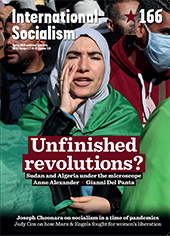
The latest issues of International Socialism is now out and also online - see here for more details and full contents, but highlights of issue 158 include Shirin Hirsch on Enoch Powell, Alex Callinicos on Karl Marx, Judy Cox on the fight for women's suffrage, Joseph Choonara on 'the political economy of a long depression', and material relating to 1968 on the fiftieth anniversary of 'the fire last time'...and highlights of issue 159 include a discussion of youth crime, class and capitalism, the recent UCU strikes, Prague 1968 among much else...

Labels: , , , ,

Friday, December 05, 2014

Open statement of solidarity with Warwick Students occupying against police brutality


Open statement of solidarity from the Student Assembly against Austerity

We support the student occupation and ongoing protests at Warwick University in response to police violence, for free education and against fees, cuts and debt. We send out solidarity to all the students concerned and condemn the escalating use of police violence on our campuses.   

On Wednesday 3 Dec 2014 students at Warwick University were holding a peaceful sit-in protest on campus as part of the national day of action for free education called by the National Campaign Against Fees and Cuts and the Student Assembly Against Austerity. They were sat in a circle discussing free education and the university community.


However, this was met with violence from police and who attacked them using CS spray and drawing tasers.  A number of students were assaulted and injured, and some arrested only to be released without charge later that evening. 


We support the demands of the students occupying their campus and echo their calls on the University of Warwick management to “support the right to protest and condemn any form of state violence including the use of CS gas and tasers on our campus.”


This attack on peaceful protesters at Warwick University represents a further ratcheting up of police violence used against student activists following the disgraceful scenes that followed a student occupation at Senate House in December 2013 and those at Birmingham University last year.

Students and staff should be able to protest against policies and practices with which they disagree. They should be able to take part in protests without fear of attack or the use of tasers or CS gas.  Universities are meant to be places of debate and discussion.  We condemn the actions of the University, the police and security. We support all those students involved and offer solidarity to protests and occupations now taking place. 

To sign please email info@thestudentassembly.org.uk 

Labels: , ,

Thursday, August 21, 2014

Marxism and Trade Union Struggle


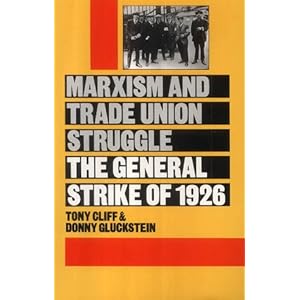
Marxism and Trade Union Struggle: The General Strike of 1926 (1986)by Tony Cliff and Donny Gluckstein is now online...

Labels: , , , , ,

Friday, December 06, 2013

Defend University of London Student's Right to Protest

Please sign this statement:

We, the undersigned, unreservedly condemn the escalating use of police against peaceful protests at the University of London.
On 4 December, students were violently evicted from Senate House, University of London (UoL), by private security and police. On 5 December, a protest march in Bloomsbury in their support, calling for 'cops off campus', was attacked and kettled by police, and over 30 staff and students were arrested.
We believe this marks an escalation in the level of force against student-led protests at the University of London which threatens the ethos of the University. It seems clear that UoL Management are not negotiating with students and staff who protest - including occupying students - but are simply attempting to suppress dissent. We condemn the blanket injunction brought by the UoL against demonstrations or occupations across their many campuses.
We call on all who care about the future of our Universities to object to this invited invasion of the police onto campuses. Police intimidation has no place in a seat of learning. Many staff and students have fled repressive regimes. We are horrified at supposedly 'liberal' university managements adopting these tactics.
We demand an immediate repudiation of the injunction by UoL Management, no more police on campus, and for UoL Management to engage with students and staff about the concerns that led to the protests in the first place.

Labels: , , ,

Saturday, November 02, 2013

Leon Trotsky - To the students of Edinburgh University

Dear Sirs,

I am indebted to you for your so unexpected and flattering proposal, to put me up as candidate for the rectorate of your university... The elections to the rectorate, you write, are conducted on a non-political basis and your letter itself is signed by representatives of every political tendency.  But I myself occupy too definite a political position; all my activity has been and remains devoted to the revolutionary liberation of the proletariat from the yoke of capital... I would ... consider it a crime toward the working class and a disloyalty toward you to appear on no matter what public tribune not under the Bolshevik banner.  You will find, I have no doubt, a candidate much more in conformity with the traditions of your university...

Leon Trotsky, 'To the Students of Edinburgh University' (7 June 1935) in Writings of Leon Trotsky, 1934-35, pp. 401-402, quoted in Gramsci and Trotsky in the Shadow of Stalinism by Emanuele Saccarelli.  

Labels: , , ,

Sunday, February 26, 2012

Justice for Alfie Meadows

From Defend the Right to Protest:

We’re writing to you on behalf of the Defend the Right to Protest and the campaign we’ve launched, Justice for Alfie Meadows:

Alfie Meadows was one of a number of students injured by police during the mass demonstration outside parliament against MPs voting through £9000 tuition fees. In Alfie's case he had to undergo emergency brain surgery to save his life after being hit over the head by a police baton. Jody McIntyre was also dragged out of his wheel chair and hit.

A Doctor present on the demonstration set up a field hospital in parliament square as thousands were kettled. The 34 year old doctor was later kettled on Westminster Bridge and recorded symptoms of severe crushing including respiratory problems and chest pains.

These scenes formed part of a wider pattern of attacks on students protesting in defence of education. Mass arrests followed and significant numbers of young have since people torn away from their families and friends to be jailed for up to 36 months. This includes Zenon Mitchell, a Sussex University student, who is in prison for 15 months after being filmed throwing one placard stick on the 10th November education demonstration.

It is absolutely paramount that we do not leave Alfie Meadows to a similar fate. He has since been charged with violent disorder -a charge which carries a sentence of up to 5 years and goes to trial on 26th March.

Alfie first became involved in campaigning during an occupation to save his philosophy department at Middlesex University. After it was closed and moved to another university, he then took part in the demonstrations against increasing fees - and nearly lost his life.

We are asking lecturers to support the Justice for Alfie Meadows Campaign in the lead up to his trial on Monday 26 March. The victimisation of students is an attack on all of us still fighting the governments attacks on education.

Thus far the campaign has the support of NUS, UCU, CWU, PCS and a wide range of academics, MPs and public figures.

There are a number of ways you can help:
1) Sign the Justice for Alfie Meadows on line petition.
Over 1200 people have signed, signatories include Tariq Ali, John McDonnell (MP), Gigi Ibrahim (Egyptian Activist and Blogger), Liam Burns (NUS President), Ken Loach (Film Director), Jody McIntyre (Journalist and Equality Movement) and Zita Holbourne (BARAC and PCS NEC). Circulate the petition widely through all networks. You should also include links to the website www.defendtherighttoprotest.org and an email contact point: info@defendtherighttoprotest.org .

2) Attend and publicize our Defend the Right to Protest Public Forum: Stand Up For Justice at Euston Friends Meeting House, Euston Road. Monday 5th March 7PM. Speakers include: John McDonnell (MP), Imran Khan (Campaigning Lawyer and Solicitor for Stephen Lawrence’s family), Alfie Meadows (Student Defendant), Liam Burns (NUS President), Marcia Rigg (Sean Rigg Justice and Change Campaign), Frank Fernie (Imprisoned protester, now free.) and Rob Evans (Guardian Journalist). Circulate and join the facebook event: http://www.facebook.com/#!/events/242723812474501/. You may also want to create your own event for a delegation.

3) Be part of supporting/organizing a delegation to attend the demonstration outside Kingston Crown Court on Monday 26th March at 9AM, when Alfie Meadows will attend the first day of his trial.

For more information, questions or queries, please email us on info@defendtherighttoprotest.org

Yours in Solidarity,

Defend the Right to Protest

Labels:

Wednesday, January 12, 2011

2011: Key Dates for Activists in Britain

January - The Student Struggle continues...anyone else who wants to join in most welcome!

Wednesday 19 January - Save the EMA

Saturday 29th January, National Demonstrations: London & Manchester
http://www.facebook.com/event.php?eid=186143168067779
Also supported by UCU, NCAFC and in Manchester by TUC and PCS youth network

February

Saturday 5 February: Unite Against Fascism Protest against the English Defence League in Luton - this is critical after Jack Straw played the race card yet again recently.

Saturday 12 February: People’s Convention to Build Resistance to Austerity, hosted by Right to Work and others, London

March in March

Saturday 26 March: “March for the Alternative”, organised by the TUC, 11am Victoria Embankment, London.

Labels: , , ,

Saturday, January 08, 2011

The Burston School Strike remembered

I have a backlog of stuff I have been meaning to highlight of late on Histomat - ranging from Tony Cliff on Clara Zetkin, CLR James on Che Guevara, Martin Glaberman on Martin Luther King, Brian Pearce on Trotsky as an historian, George Rawick on slavery in the US, Pat Stack on Wikileaks, and so on, but my pick of the crop comes from my good friend Paddington, whose excellent blog I really should try and link to more often and who has recently blended family history, local history, and socialist history with a topical blog about 'the longest running strike in British history', the Burston School strike. This was led by school students and lasted from 1914 to 1939, and took place in that heartland of industrial stuggle: er, Norfolk.

Labels: , , ,

Saturday, December 11, 2010

Histomat Exclusive: Inside the Royals' Rolls Royce


[Though Histomat cannot quite claim to be as dangerous to governments as Wikileaks, we are very proud to be first to bring people a transcript of the conversation between Prince Charles and Camilla in their Rolls Royce as it attempted to drive through the mass student protest on Thursday.]

Camilla: I am so looking forward to the Royal Variety show tonight...

Charles: Well at least that makes one of us. I'm sorry, I'm just in a bit of a foul mood. It's all the fault of that dreadful Terry Eagleton. His review of my book Harmony is just appalling. Let me read it out to you:

Never afraid to stick his ears above the parapet, Prince Charles has produced a book he proudly describes as "a call to revolution". Throwing moderation to the winds, he comes out in favour of happiness, sustainable development and cities fit to live in, while opposing greed, ugliness and environmental catastrophe. Has his old man got wind of this subversive stuff? Has the prince taken to selling Socialist Worker to the toilers of Clarence House?

Camilla: Darling, sorry to stop you in full flow. I have always wondered, what exactly is socialism?

Charles: Oh, nothing to worry your pretty little head about dear. It's a very old-fashioned thing now - something about collective democratic control of industry and society by the workers or something. It's long been something people feel has no relevance or purpose in the world we all live in today.

Camilla: Oh, jolly good. It sounds like a lot of Bolshy rubbish to me.

Charles: Well, quite. Anyway, enough of Eagleton and this talk of socialism - lets just try and enjoy this evening yes?

Chauffeur [interrupting]: Sorry to disturb, your Royal Highnesses, it appears there may be some trouble up ahead.

Charles: Yes?

Chauffeur: Well, it's the students you see. They are revolting.

Camilla: Yes, yes, we know that students are revolting. Bloody parasitic layabouts and wasters. What's that got to do with us?

Chauffeur: Sorry, your Royal Highness, I mean it appears that the students are protesting in central London today and we have been advised to take a detour around their protest.

Camilla: Oh, bloody hell - we are running late as it is. Charles, darling, what are the students protesting about again?

Charles: Well, I think the government has decided to raise the level of tuition fees or something. Up to £9,000.

Camilla: £9,000 a day? That does sound a little bit steep.

Charles: No, sorry darling, £9,000 a year I think.

Camilla: That's nothing! Why I spend that amount a week on making myself look beautiful. Bloody students! Drive on! Drive on! We'll be late!

Chauffeur: Very good, Your Royal Highness.

Charles: These student protests are partly the fault of the idiocy of that silly little man Nick Clegg.

Camilla: Nick who?

Charles: You know darling, the leader of the Liberal Democrats.
One of my valets, Waterson, told me that he rang up Liberal Democrat central office last week and asked for a copy of their election manifesto. The woman answering the phone said she was very sorry but they had sold out. You know what Waterson said?

Camilla: I have absolutely not the faintest idea.

Charles: He said: 'I know you have sold out, but I was actually wondering about maybe getting hold of a copy of the election manifesto!' Ha! Ha! Get it?

Camilla: If its meant to be a joke, I'm afraid I don't understand it all.

[The car soon runs into student protesters and has to slow down. One protester shouts 'All right Charlie, how's it going boy?']

Charles: I think they want to talk to us. I'll wind down my window and have a word with them.

Camilla: Do you think that's wise, darling?

Charles: Well, my father found himself in the middle of a march by firefighters a couple of weeks ago. They just looked amazed to see him, the Duke of Edinburgh, just sitting there and wanted to take his picture and things. This lot are only students for heavens sake. Listen, I think I can hear them chanting my name. 'We hail Prince Charles, we hail Prince Charles'. See the people all love us - and this is something we should begin to get more used to now given the wonderful news about Wills and Kate...

[Charles winds down window.]

Camilla: Oh god Charles - listen! They don't love us at all. They are chanting 'We hate Prince Charles, We hate Prince Charles'. Its so...ghastly.

Charles: Oh. So they are. Bugger. Bloody students. Drive on man! Drive on! The sooner we are through all this the better.

Camilla: These protests are all the fault of your bloody mother's fifth cousin twice removed...

Charles: You mean David? Oh, yes, I see. It's all a mess. A very regrettable mess.

[The students start chanting: 'Off with their heads! Off with their heads!']

Camilla: Oh, Charles. Do you think this is it? Are they going to... kill us?

Chauffeur: Your Royal Highnesses! Please wind the window back up - now!

[Here the recording becomes muffled and tails off due to loud noise of chanting. It is possible to just about make out a woman's voice - probably Camilla's - shouting to one policeman 'Shoot the students! Bloody just shoot them!' You can also hear students chants in the background 'David Cameron we know you, we f*cked up your HQ' and 'Prince Charles, we know you, we just f*cked up your roller too']

Labels:

Thursday, December 09, 2010

This Is What Democracy Looks Like

'Mounted police are charging into the crowd. Other police are lashing out with truncheons to push protesters back into Parliament Square from Victoria Street. One demonstrator has been seriously injured. The police are endangering lives. This is what democracy under the coalition looks like—a deeply unpopular policy, which Lib Dems had pledged explicitly not to carry out, is voted on while police try to smash those who want to make their voice heard.'

Follow coverage of the student protests outside Parliament here

Whatever the outcome of today's vote in parliament, the events of today have once again showed how the hypocrisy of the Liberal Democrats and the bloody tyranny of police violence and intimidation of student protesters - many under 18 who have no vote and so no other way of making their views heard other than to take to the streets - exposes the real nature of the liberal parliamentary system in British society. The contrast between the votes and debate in parliament and the democratic self-organisation which has been the hallmark of the 30 or so student occupations in Britain over the last few weeks could not be greater - and the mass student activism has shown a glimpse of what a real democratic society could be like.

Such a vision has never been more needed - not least since what the neo-liberal Con-Dem coalition are attempting to do by cutting away at public services and the principle of education as a social good is to bring out the systematic disenfranchisement and disempowerment of people as a collective force - to turn us into a fragmented multitude of atomised individuals who identify themselves only as consumers, objects of history rather than its subjects.

Yet the issue of tuition fees has created huge political and ideological turmoil at the top of society - not least threatening to split apart the Con-Dem coalition government itself - and the thin official media managed 'consensus' that exists about the necessity for cuts as well as fees has begun to unravel. As Gary Younge noted in an excellent article on the revolt of students and youth spreading across Europe,

'it can never be pointed out too often – if only because it is so frequently ignored – that this situation was not created by excessive public spending but by an international banking crisis brought about by an unregulated binge in the private sector. In a sordid redistribution of wealth from poor to rich, working-class kids will be denied the possibility of a university education because wealthy traders were in denial about economic reality.

So while it's true that others have it worse than students, it also entirely misses the point. Protesting against tuition fees is not a sectional interest. For most, student years mark a transition from youth to adulthood, which means the burden for these increases do not just fall on individuals but families – who will already be suffering from the crisis in others ways. Thatcher's cuts blighted isolated communities, whether they were pit villages or northern cities. These attacks are not just deeper but broader. Clearly, how students' resistance to these cuts pans out will have ramifications for successful opposition to the entire austerity programme. That is reason enough to deserve our support.


Younge concludes by noting that just as 'the French students in 1968 bolstered the confidence of factory workers', 'the threat British students pose – much like the financial crisis bringing them on to the streets – is of contagion. That their energy, enthusiasm, militancy, rage and raucousness might burn in us all.' The dream of a repetition of France in May 1968 today - on which see
this excellent short article
by Ian Birchall - as well as this longer essay, with its slogans 'Students of the World Ignite!' and 'All Power to the Imagination!' (as well as slightly odder ones like 'Beware the Pedagogic Gerontocracy') has to be our dream. Yet as John Rose - who was at the LSE during 1968 pointed out at a teach-in organised by the Education Activist Network at the LSE last Sunday, there are important differences as well as as similarities between the student revolt now and then. As well as the Cold War structures which shaped the whole revolt and led to 1968 being about as much about an attempt to bring new understanding and new meaning to terms such as 'socialism' and 'communism' in the face of Stalinist state repression, above all in Czechoslovakia - the crushing of the Prague spring was the lowest point of 1968 - the student revolt in Western capitalist countries in 1968 came about as a crisis of expansion in higher education, while today we face a crisis of contraction.

Moreover, unlike then, the student revolt takes place amidst a very real crisis of capitalism itself. At times like this, and especially in Britain where the organised working class movement remains a kind of 'sleeping beauty' - the stakes are incredibly high for the student movement. It remains worth reiterating the potential that student's political action could help spark a wider 'economic' fightback. The critical importance of such a fightback taking place does not need to be elaborated upon here.

Labels: ,

Wednesday, December 01, 2010

Teach-In: Education for the People, Not the Market

From the Education Activist Network
Teach-in: Education for the People, Not the Market
Sunday 5th December, 12noon-4pm, King’s College London

Speakers include journalists George Monbiot and Laurie Penny, King’s College lecturer Stathis Kouvelakis and veteran of the 1968 student movement John Rose.

According to The Independent the student movement has broken through the ‘cuts consensus’. Now we have an opportunity to challenge a vision of education that is dominated by the market – where private companies are gaining the power to award degrees and young people are to be priced out of our colleges and universities. In the university occupations of May 1968 students took control of their curriculum from the authorities – thousands attended lectures by Sartre, Genet and others. At the national Teach-in, students, academics, artists, musicians, writers, precarious workers and trade unionists will be debating the alternatives for education. There will also be forums for HE and FE/school students to coordinate the next steps in the struggle.

Labels: , , , ,

Saturday, November 27, 2010

We Shall Fight, We Shall Win - Paris, London, Athens, Dublin


It is not everyday one gets the honour and privilege of being invited to do a Socialist Worker Student Society meeting on 'May 1968 - The Fire Last Time' amidst an actual student occupation (see also here), still less one amidst one of the largest and most significant waves of student revolt to hit University and College campuses in Britain in my living memory - see here and here. Admittedly, it would have been nice to have had more than 10 minutes notice before being asked to do the aforementioned meeting - and it would have been a bonus if the meeting had then happened at the time agreed (10pm) rather than er, just after midnight - but I guess this is the glorious messiness of real life struggle - and if twenty or so students after about 30 hours of maintaining an occupation are still up for a discussion about revolutionary politics from about half twelve until half one in the morning then who am I to refuse them such an opportunity?

Whether the student revolt in Britain has had its 'Grosvenor Square' moment - when 80,000 students protesting against the Vietnam War in March 1968 clashed with riot police outside the US Embassy yet or not is debatable, but certainly the demonstration of 50,000 students which ended with the trashing of the Tory HQ at Millbank - followed up with Day X's display of civil disobedience and mass direct action in which students were charged by the London Met's mounted police division has certainly brought student protest to the attention of the mass media - and their revolutionary spirit has acted as a beacon of inspiration and hope to millions of working people up and down the country in the face of the Tory onslaught of cuts and attacks. Britain is now well and truly part of the wave of resistance to austerity that has already been witnessed across the rest of Europe.

Theoretically, according to bourgeois social science, at least in its postmodern forms - the student revolt just shouldn't be happening. The marketisation and commodification of higher education that tuition fees represents should mean that students have lost any sense of collective identity and are now just individual consumers, buying a 'product' from The University Plc. The revolt shows students aren't prepared to just accept commodification passively, but are active agents of their own destiny - capable of raising the argument that 'another education and another world is possible'.

Just as the student revolt in 1968 detonated a wave of working class struggle, so the student revolt in Britain today is already making a political impact - what with the National Union of Teachers and the UCU lecturers union balloting for strike action in the new year, and public sector trade union leaders are making increasingly militant and fiery speeches against the government at a mushrooming number of anti-cuts meetings. Even Labour leader Ed Miliband is now, wait for it, 'listening' to the students sympathetically and, get this, is ''tempted' to maybe, possibly, even one day actually support them. The students are set to walk about again next Tuesday and again on the day the proposed massacre of higher education is voted on in Parliament. The task for socialists is to make sure that the students are not now left to fight on alone - which would see their struggle rise heroically and spectacularly like a rocket but then come down miserably like a little stick - but that when they next walk out, increasing numbers of workers are encouraged to also walk out, and stand and fight alongside the students - and ever growing numbers of networks of solidarity between students and workers are built. Building such networks would not only begin to encourage the kind of mass strike action British society so desperately needs if the Con-Dem led capitalist juggernaut is to be stopped in its tracks and British society shifted to the left politically - but such direct action by workers at the point of production can also begin to paralyse and undermine capital itself. As the great revolutionary Marxist Rosa Luxemburg put it - 'where the chains of capitalism are forged, there they must be broken'.

Labels: , , , ,

Saturday, November 13, 2010

Sous les pavés, la plage

'Let's say a Conservative government announced, in that sort of macho way: 'We're gonna slash public spending by a third, we'll slash this, we'll slash this, we'll do it tomorrow. We have to take early, tough action...I think if we want to go the direction of Greece, where you get real social and industrial unrest, that's the guaranteed way of doing it.'
Nick Clegg, March 2010

Probably the only thing I have ever agreed with the duplicitous Nick Clegg on was his pre-election prediction that savage cuts in social spending would lead to 'Greek style riots' in Britain. This week - and thanks largely to Nick Clegg's support for the Tories savage cuts in higher education spending - we saw the closest thing in Britain for twenty years to a 'Greek or French style riot' when a National Union of Students and University and College lecturers Union demonstration entitled 'Demo-lition' actually lived up to its name and saw, er, the demolition of part of the Tory HQ at Millbank.

Those on the 'demolition demonstration' deserve to be heartily congratulated for such a heroic and inspiring and much needed manifestation of civil disobedience and resistance - and solidarity has to now be built as the state machine seeks to exact its bitter revenge - urged on by hypocritical Tory politicians.

'A riot', Martin Luther King once said, 'is at bottom the language of the unheard'. Zack de la Rocha of Rage Against the Machine once poetically riffed off this, noting that 'the riot be the rhyme of the unheard'. The point is I guess that riots are not something that are organised at will by tiny minorities of 'Middle Class Braindead Anarchists' (copyright - the Daily Mail) - rather as Chris Harman once noted, they tend to come about in rather more unexpected and spontaneous fashion:

'Those without hope are capable suddenly, virtually out of nowhere, of shifting from apathy to anger. And that anger can break through all the restraints that education within capitalist society is supposed to build into people’s consciousness. The local streets suddenly take on the aspect of a revolutionary battleground, with barricades and burning cars and instant solidarity against the state.'

It is true that have not yet got to the levels of the 1981 Riots or the Poll Tax Riots of twenty years ago, though the mass militant direct action of students - and particularly young school and college students - this week certainly marked a turning point in British politics and showed beyond any doubt that the raw class anger on the European continent against austerity cuts exists here as well.

If the education cuts are going to be successfully resisted, the student and lecturers militancy now needs to be generalised across campuses in Britain - with occupations and the like - as seems to be beginning to happen already in some places. If the wider cuts are going to resisted, then the revolutionary spirit of the glorious Millbank occupation needs to find its way into workplaces up and down the country. To generalise this fightback and to win a new young generation to revolutionary socialist politics - that is the task of Marxists in Britain today.

Education Activist Network coordinating meeting: Where next after the national demo? Monday 15 November, 6pm, King’s College London.

The case for revolution. A London-wide meeting organised by the Socialist Worker Student Society. Mon 22 Nov, 6pm, Clement House, LSE, London. With Alex Callinicos (King’s College lecturer and author of the Revolutionary Ideas of Karl Marx), Mark Bergfeld (NUS NEC) and Fraser Anderson (Oxford University student)

Labels: , , ,

Thursday, March 18, 2010

Students fighting for Socialism

The remarkable recent events at Sussex University, where following the violent repression and victimisation of students protesting against cuts, lecturers are now also on strike today, naturally have a whiff of 1968 about them. However, those students protesting may also be interested in events at Oxford University way back in the early 1920s, which also seem to be a kind of precursor of many student protests to come. Brian Pearce once summarised the story which began when a group of students set up a publication, ‘Free Oxford’ from 1921-22 (a special May Day number (1922) which carried as its masthead a quotation from Trotsky: ‘To make the individual sacred we must destroy the social order which crucifies him.’):

When the arch-reactionary Tory Minister Lord Curzon of Kedleston was Chancellor, there darted across the Oxford firmament a comet called ‘Free Oxford’. This was ‘an independent socialist review of politics and literature’ (later: ‘a communist journal of youth’), which came out in six numbers in 1921 and 1922 and achieved an amazing success, with a circulation of at least double that of other university papers. Contributors included Louis Golding, A. E. Coppard, Edgell Rickword, Richard Hughes and other bright young writers, together with Edward Carpenter, of the older generation, and also E. Varga and K. Radek, who sent their articles from Moscow.

‘Free Oxford’ found purchasers in every university and aimed to become a regular inter-university paper reflecting and promoting the work of the University Socialist Federation. Already before it was closed down it was publishing a regular ‘Cambridge Letter’ from the youthful Maurice Dobb.

Towards the end of 1921 the Vice-Chancellor of Oxford, one Lewis Farnell, sent for the editors, told them: ‘I will not have Bolsheviks at Oxford’, and expelled them. ‘Free Oxford’ went down with all guns firing. In particular, the following headlines caught public attention: ‘Editors Sent Down. Curzon’s Campaign Against “Free Oxford.” Foolish Foreign Minister Forces Feeble Farnell to Fight Free Speech.’

Reaction in the university world and in the press to Farnell’s action was generally unfavourable (‘Farnellism and Crime’, and ‘Academic Pogrom by Modern Canute’, were typical newspaper headlines) and Curzon, being a politician, sought to dissociate himself from his Vice-Chancellor. This he did, in a letter to The Times. Farnell was stung to reply to it, and a great deal of unpleasantness was created for the University. The more Farnell and his supporters tried to justify themselves, the bigger fools they made of themselves. ‘The crux of the matter was whether it was wrong to advocate the use of force as a means of attaining political ends, and it was pointed out, with reason, that if this ruling held in the university the Officers’ Training Corps should be abolished’ (Maurice Ashley and Christopher Saunders, ‘Red Oxford’).

Labels: , ,

Monday, February 08, 2010

Take Back Education

Join the teach-in to build the Resistance - King's College London 27th Feb 11am-4pm - see here for more details:

Education is under attack. Up to a third of university funding - £2.5bn - is to be cut, 30 universities could shut down and over 14,000 lecturers may lose their jobs. Big businesses exert more and more control over the university system. Cuts in student places and higher fees could exclude many people from higher education altogether.

But it doesn't have to be this way. Education workers are lobbying for strike action, following the victory at Tower Hamlets College. Students are protesting across Europe, organising occupations to stop neo-liberal reforms - and taking control of campuses for another kind of education. This February we will be hosting a day of alternative lectures and tutorials in King's College London to bring together staff and students to celebrate what education could be - and to prepare for the battles ahead.

Initial line up includes:

literary critic Terry Eagleton + poet and education campaigner Michael Rosen + Jeremy Corbyn MP + lecturer and radical theorist Alex Callinicos + Justice for Cleaners Juan Carlos Piedra + activists from Ireland and Austria + education workers who have led successful strikes + voices from students and campaigns around the country + other speakers to be announced.

Alternative lectures and tutorials include:

The crisis in our universities and the battle for education + Education for liberation - what could our education look like? + The corporate takeover of our universities + How do we fight for free education? + Building fighting unions + Education for all - challenging Islamophobia, racism and the points based immigration system + The tasks ahead - building resistance that can win.

On the final point, people might like to note the recent vote for action by lecturers at Leeds University - messages of support can be sent here

Labels: ,

Saturday, January 24, 2009

A new 'European 1968'?

The wave of student occupations in Britain in solidarity with the Palestinian people after Israel's massacres in Gaza is unprecedented. Already, yesterday's excellent Student special of Socialist Worker is outdated, as last night further occupations took place, including at Cambridge, an occupation which forced the BBC to finally report that 'similar occupations were staged at other UK universities' as well.

Even though the BBC and British Govt are trying to ignore what is happening, coming after the events in Greece, French premier Sarkozy has already warned his fellow rulers of the dangers of a new 'European 1968'. What began at SOAS, has since spread to the LSE, Essex, Kings College London, Warwick, Birmingham, etc etc. Some of these occupations have already won, and as I write the current state of play is this:

Soas (day 2 victory), LSE (day 7 victory), Essex (day 2 victory), Birmingham(day 1 police eviction), Oxford (day 1 victory), King's (day 4), Sussex (day 4), Warwick (day 3), Newcastle (day 2), Manchester Met (day 2), Leeds (day 2), Kingston (day 1), Manchester (day 1), Salford (day 1), Bristol (day 1), Nottingham (day 1), Cambridge (day 1).

The size and scale of these British occupations are uneven, and we are certainly not anything like the levels of Greece or 1968 yet, but they help give the lie to the continuing myth about 'student apathy'. Solidarity with the occupations! Solidarity with Palestine!

Labels: , , ,

Saturday, April 05, 2008

Paul Foot on 1968: The Fire Last Time

[Hidden away on its 'archive' section, the New Statesman this week decided to publish a superb article from 22 April 1988 on the twentieth anniversary of 1968 by Paul Foot, which I have decided to republish on this blog, mainly because it saves me writing anything]

A considerable industry has been at work for months to celebrate the twentieth anniversary of 1968. Numerous books have already been published, and the television interest reaches its climax soon with an extravaganza on Channel 4. The popular theme is that 1968 was an aberration, a momentary delirium which seduced the youth of the time, but out of which that youth have grown up into sensible middle age. The books and programmes tend to concentrate on the cultural obsessions of the 1968 students, their incantations, promiscuities, drugs. Like an eclipse on a 29 February in Leap Year, such a strange and rather disturbing Happening is unlikely ever to occur again. (Sighs of relief all round.)

Most of this is entirely trivial, and suits the prevailing reactionary mood. No important person today wants to dredge up too much about what really happened in 1968 — a revolutionary tremor which threatened an earthquake to bring the entire Old Order crashing down.

Why did it happen, what were its effects, when did it stop, and will it happen again? No one on the official left will even ask the questions. It takes an active revolutionary in what will unquestionably be the least-reviewed book in the pack to answer them.

Chris Harman locates the cause of the 1968 upheavals in the "long boom" in which the postwar industrialised economies basked. The boom, however, was a creature of capitalism every bit as much as the slumps of the 1930s. Its fruits were not shared either by workers or by the growing body of students it required and regimented. During the "long boom", workers and students developed at the same time a collective confidence and a collective frustration. These burst out all over the world in 1968. The triggers were different — America’s monstrous war in Vietnam, the meanness of the universities in France, religious discrimination in Northern Ireland. But the fundamental causes were the same everywhere.

For a moment, the 1968 revolutions rubbed out the contours of world politics. The "Cold War", the "Iron Curtain" were irrelevant to the new insurgents. Just as Mayor Daley was ordering troops to beat up demonstrators against a rigged Democratic Party convention in Chicago, the Russian government sent its tanks into Prague. The aims were the same: to quash revolts — revolts which for a moment revealed that the "socialism of the ‘socialist world’ was as phoney as the freedom of the ‘free world’." The absurd slogans and antagonisms with which governments and ideologues East and West had bamboozled their peoples were suddenly ripped up as effectively as were the Paris paving stones by the students of the Sorbonne. The thrilling message of emancipation in the Czech manifesto "2000 words" was written with the same inspiration (though in more exciting prose) as were thousands of manifestos issued by demonstrating students in Warsaw, London, Paris, Rome, Berlin, Chicago.

The second crucial characterisation of the time was that students’ revolt set off workers’ revolt. The most convulsive example was in France, which, in sharp contrast to the predictions of every known political scientist, left and right, experienced that May the largest general strike in the history of the world.

The revolutionary impact of 1968 went on long after the calendar year — through the "hot autumn" in Italy in 1969, to the miners’ and dockers’ strikes in Britain in 1972 (which changed the Tory government’s entire strategy and eventually kicked them out), to the Portuguese revolution in 1974, to the overthrow of the Greek colonels in 1975. Right across Europe, and beyond it, the revolutionary upheavals of 1968 went on until 1976, and threatened the very existence of "society as we know it".

How was order restored — how are we now back with "society as we know it", even more ugly, cruel and complacent than it was before? At times (in Britain at the end of 1973, for instance, or in France in May 1968) the ruling class, even with all its troops and policemen, were weak (in France the police went on strike). By themselves they could not restore their own laws and orders. Their chief allies in that business were the Old Order of the left, whether of the communist or Labour variety. Communist tanks in Prague broke up the revolution there, and, by the same token, Communist-led trade unions in France persuaded public service workers back to work, and so broke up the general strike. In the United States, the politicians of the Democratic Party, in Britain the politicians of the Labour Party laid their "historic" claim to the loyalty of workers and students, and called them to order. This was known at the time in different languages as the: "social contract" (Britain) the Pact of Moncloa (Spain), or the Historic Compromise (Italy). It took the sting out of the 1968 revolution and its aftermath. Once the sting was out, the right wing lost interest in the Old Order of the left which had done its work so well. The political pendulum swung to the right, to the "free market", against the welfare state — to the fattening of the rich and the slimming of the poor; to Thatcher in Britain, to Reagan in the United States, to Kohl in West Germany, to Chirac in France. The office-hunters of the left, who helped lose the revolutions, lost office as well.

The revolutions of 1968-1976 threw up new revolutionary ideas and organisations which could not see any fundamental difference between the social orders on either side of the Iron Curtain, and which doubted that society could be changed by electing new governments, while industry, finance, law, media, all the other big institutions of society remained in the (wholly undemocratic) hands of the wealthy. Chris Harman traces the history of these organisations, many of which disappeared in frantic gestures of individual terrorism or in incantations to the "Third World". He argues, however, and he is right, that the spirit of 1968 and the small organisations which it inspired were and are the only real hope for socialist change.

The steady drift of former socialists to the right (for a wonderful example read Paul Johnson’s "conversion" to the Revolution — in the New Statesman of course), the fashion for "new realism", the obsession with parliamentary politics, all these are creatures of the prevailing reaction, not enemies of it. Nor is that reaction half so secure as it pretends. The slump of the eighties is not as deep as the slump of the thirties, but it is every bit as intractable. The first was ended in a world war, but a world war now is out of the question, even for the generals.

The mix which gave rise to 1968 is still bubbling in the pot. It will explode in a "fire next time" which will engulf the world just as unexpectedly as it did last time, and the politics of the traditional left will be just as useless and just as hostile.

Labels: , , ,

Tuesday, March 11, 2008

Students of the world ignite!

STUDENTS OF THE WORLD IGNITE 1968-2008!

Celebrating the 40th anniversary of the 1968 'May events'.

40 years ago students were on the march against the US war on Vietnam but also against injustice and inequality everywhere. Then, in May, workers in France occupied their factories as students occupied their universities. Suddenly the world seemed on the brink of revolutionary change...Could it happen again?

LSE Students' Union invites you to a 40th anniversary conference:
Speakers include
Tariq Ali (writer, broadcaster & author of 'Street Fighting Years')
Chris Harman (LSE student '68 & author of '1968 The Fire Last Time)
Pierre Rousset (French Revolutionary)
And LSE student activists from 2008

PLUS A unique selection of 1968 short films
Saturday May 3rd from 2pm, LSE Old Theatre.

See also this conference on May 1968 in London

Labels: , , ,