Histomat: Adventures in Historical Materialism

'Historical materialism is the theory of the proletarian revolution.' Georg Lukács

Saturday, March 30, 2019

Race, Class and Identity / Marxism 2019


Race, Class and Identity - A one-day conference hosted by International Socialism
Saturday 18 May, 11am – 5pm, Friends Meeting House, London 
Questions of identity and their relation to racism and oppression are centre stage in these divided and dangerous times.
This conference will look at the impact of renewed ‘identity politics’ on those who want to fight for genuine liberation and get rid of capitalism
For more details and how to register - see here

-----------------------


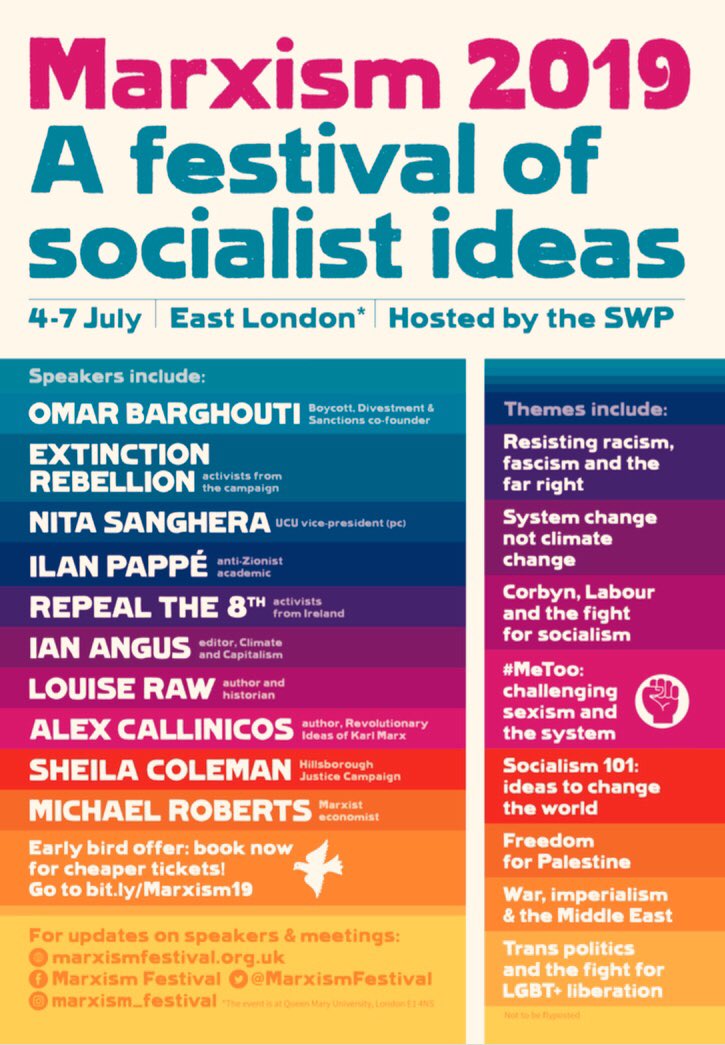
 Marxism 2019 - A festival of socialist ideas - 4-7 July, London 

 Capitalism is in crisis. Society is rapidly polarising between Left and Right. Marxism Festival 2019 is the place to debate how we can beat back the rise of racism, fascism & the far right. But thousands of people from around the world will also be discussing the alternative to the system that means chaos.

 Speakers include: Omar Barghouti • Extinction Rebellion • Ilan Pappé • Louise Raw • Ian Angus & more!

For more information and how to book see here

Labels: , , , , , , , ,

Monday, July 03, 2017

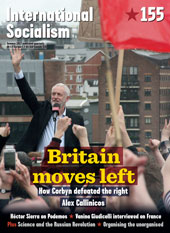
International Socialism #155 out now


The latest issue of International Socialism is out now, with analysis of the glorious general election of 2017 in Britain and also an interview with a French activist regarding 'the meaning of Macron'.  Other topics discussed include Podemos in Spain, the Russian Revolution at its centenary, and the state of the class struggle in Egypt and China - check out the full contents list anyway and consider subscribing if you do not currently... 

Labels: , , , , , , ,

Thursday, November 03, 2016

Buildin Fighting Unions in the Era of Jeremy Corbyn

Unite the Resistance conference with speakers including Shadow Chancellor John McDonnell, Megan Charlton from the Durham TA’s dispute and Dave Smith from the Blacklist Support Group - Saturday 12 November, London

Labels:

Wednesday, June 22, 2016

Paul Foot on why socialists oppose the EU

[In his last posthumously published book, The Vote (2005), the campaigning socialist journalist Paul Foot stressed that the EU was part of the infrastructure of international capitalism like the IMF and World Trade Organisation, just another a 'capitalist bureaucracy' counter-posed and quite hostile to 'popular democracy' from below. As Foot wrote, 'The bureaucrats who put together the Treaty of Rome were at best uninterested, at worst downright hostile to extending democracy’, as the new political structure enshrined ‘an appointed Commission, with a huge supporting bureaucracy far out of the reach of any electorate’. ‘The plain fact [was] that membership of the European Community meant a transfer of power from elected Parliaments to the unelected European Commission’ while the European Parliament was actually completely powerless and open to corruption, as ‘the MEPs power and authority went down almost as fast as their salaries and expenses went up’. Writing in the Guardian on the EU in 2004, in what must have been one of his very final pieces of writing, Paul Foot re-emphasised why socialists stand against the EU. The essential truth of his argument, that while 'Another Europe is possible, another EU is not', it seems shines through as clearly and cogently as it did then - which is arguably why those socialists who rallied around the independent banner of a left exit - or #Lexit - this time around were right to do so]: 

I voted no in the 1975 referendum on EEC entry and will do so again in the European constitution referendum - whenever that finally happens. In 1975, I was uneasy about some of the company I was keeping. Very rightwing Little Englander Tories for instance, not to mention fascists. But the class lines were clearly drawn. The rich, almost without exception, were for a yes, the workers and the poor for a no. The Labour party and the TUC were for no on two solid grounds. First, the EEC was a capitalist club designed to cut down the influence of the workers. Second, its institutions were created by capitalists for capitalists and were therefore less democratic and more corrupt even than the parliamentary democracies of its member states. Those objections seem just as powerful today.

The basic class issues may be the same, but the party lines have shifted. The bulk of the Tory party, which, under Thatcher, called for a yes vote, now calls for a no. So does its new lunatic and xenophobic fringe, Ukip. In 1975, the yes campaign spent much more than the no. That may not happen again. All sorts of millionaires are throwing their ill-gotten gains at the no campaign. On the left, the bulk of the parliamentary Labour party (better known as the war party) is for a yes. Some trades unions are still doubtful, but the TUC general council is already starting to bow and scrape to Blair on the issue, and will probably end up snivelling surreptitiously for a yes.
In these circumstances it is vitally important that those of us on the left who want to vote no keep our distance from the rightwing campaign. Internationalists, socialists and greens who oppose the European constitution because it will drag us further down into the corporate whirlpool, emasculate trade unions and further deregulate an already rampant private enterprise, are a million miles away from the narrow nationalism of Michael Howard or Robert Jingo-Silk. We cover a wide spectrum. Even those who favour the mildest Keynesian economics, or the right to organise and strike against capital, or the right to speak out and vote for social democratic policies, will find themselves in opposition to the proposed constitution.
We must not allow our voices to be confused with the clamour of the Murdoch press. Our votes may end up in the same place, but the reasons for those votes need to be spelled out independently and separately...

Labels: , , ,

Wednesday, August 12, 2015

Miners Shot Down - commemorating the Marikana massacre


Remembering Marikana - Friday 14 August 2015

On 16 August 2012 South African police opened fire with live ammunition on thousands of striking platinum miners at Lonmin’s Marikana mine in the North West Province of South Africa. One hundred and twelve miners were shot and of those 34 died. The actions of police at Marikana were reminiscent of the apartheid era - Sharpeville in 1960 and Soweto in 1976 - where black people were shot for protesting. The Farlam Commission of Enquiry which was set up to investigate these killings ...largely absolved the police, the state, and Lonmin of any responsibility for this event. To date the families of the miners killed at Marikana have received no compensation.

What made the events at Marikana so shocking is that these killings took place under the auspices of a democratic, post-apartheid state with one of the most progressive constitution and bill of rights in the world. These killings are part of a growing trend of violence by the state toward non-violent protest and dissent in South Africa. The increasingly authoritarian tendencies of the South African state are retrogressive. These tendencies are undemocratic and threaten the right to free expression and legitimate protest.

The struggle to end Apartheid was long and hard. Many people gave their lives to this struggle. Don’t let the deaths of the Marikana mine workers be in vain. Join War on Want to remember the miners and their families
Programme:
  • 19:00 Opening Address by War on Want and representative from UNITE the Union
  • 19:10 Screening of Miners Shot Down
  • 20:10 Marikana: The Aftermath by James Nichol
  • 20:30 Q&A with film maker, Rehad Desai
Book your tickets here

Read Ken Olende's piece about the cover up of the South African state here

Labels: , , , ,

Tuesday, June 30, 2015

Marxism 2015 - Ideas for Revolution

Marxism 2015: Ideas for revolution
A five day political festival: 9-13 July 2015, Central London
www.marxismfestival.org.uk
Book up - Just over one week to go!
New meeting: Tackling the Racist Offensive
Sat 11th July, 7pm
Marxism Festival is very pleased to announce that Diane Abbott MP will speak alongside Sabby Dhalu and Weyman Bennett (Joint Secretaries of Unite Against Fascism, pc) at this new meeting at Marxism.
Meetings on Greece at Marxism 2015
The crisis in Greece poses sharp questions for the left.
Don’t miss our special debate:
Syriza in power: Whither Greece?
With Stathis Kouvelakis (Syriza Central Committee) and Alex Callinicos (SWP)
Sat 11th July, 2pm 
Plus
  • Greece: keeping the hope for change alive
With Panos Garganas (SEK)
Sunday 12 July, 2pm
  • The fight against Golden Dawn in Greece
With Petros Constantinou (Athens Councillor and co-ordinator of the Movement Against Racism and the Fascist Threat) and Kostas Papadakis (part of the legal team representing the victims of Nazi attacks at the trial of Golden Dawn)
Saturday 11th July, 11.45am
  • Fighting the Troika and austerity across Europe
Maria Styllou from Greece will peak alongside Richard Boyd Barrett from Ireland and Christine Buccholz from Germany
Sunday 12th July, 3.45pm
Plus Panos Garganas will join the Marxism opening rally on Thurs 9th July at 7pm

Other meetings at Marxism 2015
  • After Kobane and the general election: where now for Turkey and the Kurds
 Ron Marguilies will be joined by HDP MP Sebahat Tuncel
Sat 11th July, 7pm (the time of this meeting may change – please check our website)
  • Orgreave: the search for the truth
Gareth Peirce and Mike McColgan from the Orgreave Truth and Justice Campaign
Sun 12th July, 3.45pm
  • The story behind Pride
With Nicola Field and Gethin Roberts, original members of LGSM
Sun 12th July, 7pm.
And if you missed Pride at the cinemas there is chance to watch the film afterwards.
  • Darcus Howe, broadcaster and civil liberties campaigner discusses his political life with his biographers Robin Bunce and Paul Field

The final timetable for Marxism 2015 will be on line from tomorrow . . . to book tickets and for more information go to www.marxismfestival.org.uk or call us on 020 7819 1190

Labels: , , , , , , , , , , ,

Friday, May 08, 2015

La Lutte Continue


After the generally disastrous general election, the struggle continues...

Labels: , , , , , , , , , ,

Monday, February 23, 2015

Where is Syriza going?

From Panagiotis Sotiris via Alex Callinicos:

First major negative reaction against the Eurogroup agreement from inside SYRIZA comes from Manolis Glezos, Member or European Parliament of SYRIZA, and a living legend of the Resistance against fascism (in 1941 along with Lakis Santas they took down the German flag from the Acropolis)
Here is a rough translation of his statement

Statement by Manolis Glezos

Before it is too late
The fact that the Troika has been renamed ‘the institutions’, the Memorendum has been renamed the ‘Agreement’ and the Creditors have been renamed the ‘Partners’, in the same manner as baptizing meat as fish, does not change the previous situation.
And you can’t change the vote of the Greek People at the January 25 election.
The Greek people voted what SYRIZA promised: that we abolish the regime of austerity that is the strategy of not only the oligarchies of Germany and the other creditor countries but also of the Greek oligarchy; that we abrogate the Memoranda and the Troika and all the austerity legislation; That the next day with one law we abolish the Troika and its consequences.
A month has passed and this promise has yet to become action.
It is a pity indeed
From my part I APOLOGIZE to the Greeκ people for having assisted this illusion
Before the wrong direction continues
Before it is too late, let’s react
Above all the members, the friends and supporters of SYRIZA, in urgent meetings at all levels of the organization have to decide if they accept this situation
Some people say that in an agreement you must also make some concessions. By principle between the oppressor and the oppressed there can be no compromise, as there can be no compromise between the slave and the conqueror; Freedom is the only solution
But even if accept this absurdity, the concessions that have already been made by the previous pro-memoranda government with unemployment, poverty and suicide, are beyond any limit of concession...
Manolis Glezos, Brussels 22-2-2015

Labels: , , , , ,

Friday, February 06, 2015

Defend victimised PCS rep Candy Udwin

No to privatisation at the National Gallery - sign the petition to reinstate victimised PCS rep Candy Udwin

Labels: , , ,

Saturday, January 31, 2015

Geoff Ellen on the Attlee Government and strike-breaking

'The principles of our policy are based on the brotherhood of man.'
Clement Attlee, July 26, 1945.

 2015 marks among other things the 70th anniversary of the election of the 1945 Labour Government under Clement Attlee - considered the high point of British socialism by many in the Labour Party - and even by socialists outside the Labour Party - the zeitgeist of collectivism which led to the victory of the 1945 election for example was celebrated recently in the documentary 'The Spirit of '45' by the socialist film-director Ken Loach.  Yet as Geoff Ellen showed in a classic 1984 article in International Socialism journal, Labour and strike-breaking 1945-51, the 'socialism' of this Labour government was highly questionable, to put it mildly:

At the hands of what many workers believed to be ‘their’ government, striking dockers, gas workers, miners and lorry drivers were denounced, spied upon and prosecuted. Two States of Emergency were proclaimed against them and two more were narrowly averted. Above all, the government used blacklegs against these strikes, often with the connivance of the strikers’ own trade union leaders. On 18 different occasions between 1945 and 1951, the government sent troops, sometimes 20,000 of them, across picket lines to take over strikers’ jobs. By 1948 ... ‘strike-breaking had become almost second nature to the Cabinet’...

This year there are lots of conferences and events being held to discuss the legacy of the Attlee Government, such as the one being organised by the London Socialist Historians Group on 28 February - and Ellen's article remains relevant and repays re-reading today. As Ellen concluded,

Attlee’s government has left its mark ... Nuclear weapons, NATO, American bases such as Greenham Common, peace-time wage controls, even attacks on the National Health Service – most of our current nightmares, in fact – can be traced back to the 1945 Labour government. Are these the legacies of a socialist government? Even its record of full employment, a Welfare State, improving standards of living and nationalisation, on which its claim to socialism rested, continued throughout the 1950s under the Tories. No-one has yet claimed that Winston Churchill and Harold Macmillan were socialists! 

 Attlee’s Cabinet did what all Labour governments have done – it managed capitalism while using the rhetoric in a way that made reforms both possible and even desirable. But once the post-war boom petered out, the bottom fell out of this strategy. Under the Wilson and Callaghan governments, the carrot gave way to the stick: theirs was reformism without reforms. 

 In other words, the difference between the Labour Party in Attlee’s day and in the 1980s is not one of policies but of circumstances. Capitalism’s greatest boom had given way to its present, protracted slump, but Labour’s commitment to managing the capitalist system is as strong as ever. So is its commitment to parliament, and its hostility to working class struggle as a means of change. The strikebreaking record of the 1945 Labour government shows what Labour’s politics meant when capitalism was relatively healthy. With recession making working class struggle more crucial than ever, we can imagine what it will mean in the future.

 Incidentally, who was Geoff Ellen, one might ask? Well, in the preface to what was to be his last work, The Vote: How it was won and how it was undermined (2005) Paul Foot gave us some sense of this socialist activist:

 In 1972, I joined the staff of Socialist Worker and worked there full-time until 1978. It was, and is, sold as widely as possible by a small handful of agitators. The few full-time journalists on the paper were all my friends, all exceptionally able and engaging people. 

The gentlest and most dedicated of them was a professional sub-editor called Geoff Ellen. He came from Chelmsford in Essex and was, among other things, an absurdly devoted West Ham supporter. He spent pretty well all his spare time organising for socialism. There was not a trade unionist in Essex he had not tried to push or pull into some form of revolt. On Tuesday nights we were kept late at work by the printing of the last few pages, and indulged ourselves in takeaway kebabs and long, heart-searching conversations. 

As the great industrial climax of the early 1970s, to our astonishment, fell back, I began privately to worry that the entire revolutionary project, and the ideas that gave rise to it, were misconceived. One evening, as we waited for the proofs, I blurted out my apprehensions to Geoff. I had joined the staff in the autumn of 1972, at a time of huge convulsions and great hope for the future. If anyone had asked me, I would have said at once that I was hoping for, and confidently expecting, a revolution. By late 1975, however, I complained to Geoff, that change had not come. It was obviously not going to come from Harold Wilson or Dennis Healey, but we had always known that. In the decline of the movement, the issue seemed to have changed. Was the revolution going to come at all? And if not, what was to become of us if our grand aim in life was to be frustrated and even ridiculed? 

 To my enormous relief, Geoff cheered me up with his speciality: a huge all-enveloping grin. "If the revolution doesn't come," he said, "there is nothing much we can do about that. Whether it comes or not, there is nothing for us to do but what we are doing now: fight for it, fight for the workers and the poor." 

 Some years later, Geoff, still a young man, went to bed one night with a headache and died from a brain haemorrhage. All his adult life, he stuck firmly by his advice to me that dark winter evening in 1975. And so, I hope, have I.

Labels: , , ,

C.L.R. James on Winston Churchill - Tory War-dog


Winston Churchill - a reactionary prize-fighter for the British ruling class

...Long before 1939, when the outbreak of war saved his career, Winston Churchill had established himself as the most discredited, the most untrustworthy, and the most irresponsible of all the senior politicians in England. The rulers of Britain did not take him seriously on the politics of war because, except for his capabilities as a war minister, they did not take him seriously on anything except his capacity to make a serious nuisance of himself.

Churchill was born the son of Lord Randolph Churchill, a brilliant young nobleman who reached the post of Chancellor of the Exchequer and seemed headed for the premiership but wrecked his career by his erratic political behavior. His character was adequately summed up in the phrase “the boy who would not grow up.” It was the kind of heritage that a careful politician would take care to live down. It is characteristic of Winston Churchill that he lived up to it.

He joined the army as a cavalry officer and thus began his lifelong and passionate interest in war. He became a war correspondent, was captured by the Boers and escaped. When he lectured in New York in 1906, at the age of twenty-six, he was billed as “the hero of five wars.” He was already actively interested in politics. In the early years of the century, liberalism seemed in the ascendancy in Britain. Churchill made a spectacular break with the Tory Party and joined the Liberals.

He became Home Secretary and distinguished himself by what is derisively known as the Battle of Sidney Street.  A group of foreign anarchists well supplied with arms refused to give themselves up to the police. Churchill converted a police operation into a battle. He went down himself to take charge of the “struggle” (or as privileged observer), was nearly killed and created a scandal among his colleagues and the sober-minded British people. In 1911 he went over to the Admiralty and there did his best work, preparing the fleet for 1914.

But the war of 1914 had no sooner begun than Churchill was at it again. A critical situation at Antwerp found Churchill, still head of the Admiralty, persuading the reluctant Sir Edward Grey to let him go to Belgium in person. He found himself as usual under fire. The battle stimulated him to offer, from Antwerp, his resignation from the Admiralty to take command of the British land forces at Antwerp. The transfer was not made but as one of his biographers (Philip Guedalla) says of the unsatisfactory outcome: “There was a vague feeling that Mr. Churchill’s restlessness might be to blame ... that it was Sidney Street over again ...”

By 1915, despite his competence, he had lost his post at the Admiralty. He held other posts, but it is related of him that at one time while a minister in London he did most of the work in a chateau in France so as to be near the firing line. After World War I he was the moving spirit in the military intervention against Russia. It is known that in 1944 to keep Churchill from joining the cross-channel expedition the present king had to threaten that he would also join it if Churchill insisted on going; baffled here, nevertheless Churchill turned up with the invading army in the last stages of the victory against Germany.

That is the man. Every British politician knew him and his Napoleonic complex, his preoccupation with war and war preparations, his extraordinary capacity for making a fool of himself on critical occasions. Asquith, Prime Minister in 1914, wrote of him “Winston, who has got on all his war-paint, is longing for a sea-fight in the early hours of the morning to result in the sinking of the Goeben.” Someone who saw him at the beginning of the 1914 war remarked on his “happy face”...

In the cabinet reshuffle of 1936, everyone expected him to be included because of his audacity as a war minister. Baldwin left him out. Churchill writes: "He thought no doubt, that he had given me a politically fatal stroke, and I felt he might well be right.” He says too, “There was much mockery in the press about my exclusion.” Exactly. His career was always in danger. His adventures were the subject of perpetual mockery. We can now judge with a little more sense of proportion Churchill’s claim that on a question vital to the world he was the purveyor of wisdom to fatuous idiots and fouls. If the words idiot and fatuity, etc., were to be applied up to 1936, the chief candidate would have been Churchill himself.

Never at any time did he behave like a man who had a serious point of view, knew what was at stake and fought seriously for it. These erratic habits of his were intimately connected with the failure of his supposedly correct policy on the war. It was precisely during the time that he was supposed to be fighting this life-and-death struggle to prevent the unnecessary war, that Churchill showed that age had not withered nor custom staled the infinite variety of what the novelist, Arnold Bennett, called his “incurable foolishness” ... it is clear that to this day he is not fully aware of the folly of his procedure in relation to his war policy...

In 1931, British imperialism began the colossal, and as it has proved, the impossible task of reconciling India to British rule by binding the Indian bourgeoisie and the feudal lords to the British system. After Hitler’s accession to power in Germany this was an urgent task precisely because of the uncertain world situation. Churchill, however, for years rallied the worst of the Daily Mail type of Conservatives and led a struggle against Baldwin which for intemperance and unscrupulousness even he has rarely surpassed. He was ignominiously defeated as he was bound to be ... any level-headed capitalist politician could not but see that some sort of settlement and pacification of India was necessary for any British government that contemplated war.

 By the end of his battle of India, the Conservative Party had no use whatever for him. However by 1936 he had built around himself a little group around a policy he called “Arms and the Covenant,” the Covenant being the League of Nations. The sharpening international situation was giving weight to their attacks upon the policy of the Baldwin government. Nothing is more illuminating of what Britain’s rulers thought of Churchill than his account of how, all through his years of political exile, every British Prime Minister saw to it that he was well informed of the latest military and scientific developments; he was even placed on some of the most secret war committees. This explains his place in British politics. He was a kind of national strong-arm man who was kept well trained and in shape, for the day when blows were needed. Until then nobody wanted to have anything to do with him. And this book shows that no one had worked more assiduously to build this reputation than himself.

But perhaps, it may be said, that despite all his follies Churchill was right in his consistent opposition on the war issue. His book explodes that fable. Churchill’s opposition on the actual issue of the war was no different from his shrill opposition on other issues. He spoke with more authority perhaps on this, and he certainly impressed outsiders and the general public. But he did not impress the politicians and for one very good reason. They knew that they could have shut up his mouth at any time by giving him office. The measure of their contempt for him can be judged by the fact that eloquent and active as he was they refused to do this.

History is full of men who felt that a certain policy was essential to the life of their country or their class and fought for it to the end, reckless of victory, defeat or their personal fate. Such for instance was the uncompromising struggle of Clemenceau for leadership of France in the days of 1914-18 when the government was in such a crisis that at one lime his attacks upon the government sounded like treason to the bourgeoisie. No such mantle can be hung on Winston Churchill despite all the assiduous tailoring of Henry Luce. Churchill knows better than to make any great claims for himself on this matter. There are too many men alive who could tear him to bits if he tried to do this. It was not principled opposition which kept him out of the ministry in 1936 and thus saved him from getting himself as thoroughly compromised as Baldwin and Chamberlain. It was his bad reputation and habits...

Until the war came Churchill was nobody, played no heroic role, opposed the government but was always ready to enter it...But maybe Churchill did have the correct policy, if even he did not make any heroic battle for it. Now this is precisely what was in dispute all the time and is still in dispute. And here, above all, Churchill’s policy, in so far as he had a policy, seemed to his colleagues the quintessence and crown of his irresponsibility.

Let us try to get clear exactly what Churchill’s policy was not. First of all Churchill was not and today is no enemy of either dictatorship or fascism. He is an enemy of all who threaten the British Empire and the “pleasant life” he leads and refers to so often. That is all.

On January 30, 1939, this stern opponent of Chamberlain’s policy of appeasing the dictators wrote as follows:

“Up till a few years ago many people in Britain admired the work which the extraordinary man Signor Mussolini had done for his country. He had brought it out of incipient anarchy into a position of dignity and order which was admired even by those who regretted the suspension of Italian freedom.” (Step by Step, 1936-1939, by Winston Churchill, p. 285.)

On February 23, 1939 he wrote of Franco:

 “He now has the opportunity of becoming a great Spaniard of whom it may be written a hundred years hence: ‘He united his country and rebuilt its greatness. Apart from that he reconciled the past with the present, and broadened the life of the working people while preserving the faith and structure of the Spanish nation.’ Such an achievement would rank in history with the work of Ferdinand and Isabella and the glories of Charles V.”(Ibid, p.285.)

As far as the record goes in this book he makes an extraordinarily good case for himself on the question of the air-race with Germany. But that is not enough to build the pedestal for his statue. And beyond this it is difficult to find out exactly what at any precise moment, he concretely stood for....

From all this it must not be considered that Churchill is a negligible person. That would be stupidity. Put him in a war department, or give him a war to lead, and from all the evidence he is far above his colleagues, in energy, in knowledge, in attention to business and curiously enough, in tempering his audacity with sobriety of judgment. He has also developed another valuable gift. His famous sense of history is famous nonsense. He has none, as I shall show in a moment. What he does have in his head is the writings of the great British historians and the speeches of the great British orators. This and his single-mindedness, his operatic consciousness of playing a great role in historic conflicts, enable him at times to rise to great heights of rhetoric.

At times his words can be singularly effective, especially when people are frightened and bewildered by the complex class, national and international currents of modern war. Churchill has no doubts, as a bull in a China shop has no doubts. He has a great gift of phrase, and long training as a journalist gives him an eye for the salient facts in a military or political situation. At all points he is equipped for war, to shout for war, to glamorize past wars, to explain a war that is going on, to make new ones look like a defense of civilization.

Politically he is as stupid a reactionary as ever. The war was no sooner over than he aroused universal execration in Britain by saying on the radio that the victory of the Labour Party would mean a Gestapo for Britain. He himself lost thousands of votes in his own constituency.... It is a measure of the degeneration of our society that such a man should be its most notable spokesman; above all it is a scandal that he should be represented ... as a defender of democracy and civilization. In reality the evidence is thick ... that Churchill is not merely a conservative, but is today as ever a vicious reactionary.

A few examples will suffice... writing about Hitler in 1932 he uses these sentences: “I admire men who stand up for their country in defeat, even though I am on the other side. He had a perfect right, to be a patriotic German if he chose. I always wanted England, Germany, and France to be friends.” Hitler attacked Britain. That is all that concerned Churchill. But for that he would have admired him to this day... 

Admiration for dictatorship and military and feudal elements, racial arrogance, anti-Semitism, these and much more stare you in the face as soon as you shake yourself free of bourgeois propaganda ... It is one of the urgent tasks of the struggle against war to expose ... the pretensions of this reactionary prize-fighter to be a defender of democracy and civilization.

C.L.R. James, 'Winston Churchill - Tory war-dog', Fourth International, 10, no. 2 (February 1949), pp.41-46
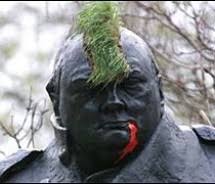


See also this poem, Great Britain's Greatest Beast by Heathcote Williams and this piece - Winston Churchill: The Imperial Monster  

Labels: , , , , , ,

Monday, January 26, 2015

Revolutionaries and 'workers' governments'

The very nature of bourgeois government excludes the possibility of socialist class struggle. It’s not that we fear for socialists the dangers and the difficulties of ministerial activity; we must not back away from any danger or difficulty attached to the post in which the interests of the proletariat place us. But a ministry is not, in general, a field of action for a party of the struggle of the proletarian classes. 
 The character of a bourgeois government isn’t determined by the personal character of its members, but by its organic function in bourgeois society. The government of the modern state is essentially an organisation of class domination, the regular functioning of which is one of the conditions of existence of the class state. With the entry of a socialist into the government, and class domination continuing to exist, the bourgeois government doesn’t transform itself into a socialist government, but a socialist transforms himself into a bourgeois minister. 
 The social reforms that a minister who is a friend of the workers can realise have nothing, in themselves, of socialism; they are socialist only insofar as they are obtained through class struggle. But coming from a minister, social reforms can’t have the character of the proletarian class, but solely the character of the bourgeois class, for the minister, by the post he occupies, attaches himself to that class by all the functions of a bourgeois, militarist government. 
 While in parliament, or on the municipal council, we obtain useful reforms by combating the bourgeois government; while occupying a ministerial post we arrive at the same reforms by supporting the bourgeois state. The entry of a socialist into a bourgeois government is not, as is thought, a partial conquest of the bourgeois state by the socialists, but a partial conquest of the socialist party by the bourgeois state... 
 Within bourgeois society the role of social democracy [the socialist movement] as an opposition party is prescribed by its very essence. It can come forward as a ruling party only on the ruins of the bourgeois state
Rosa Luxemburg, 1899.

Although a left government cannot steer a path to socialism, revolutionaries are not indifferent as to whether such a government comes to power. Even though the bourgeoisie has only retreated from the front-line positions and still retains control of the economy and the state, immense possibilities can be opened up.


In both France and Italy, the entry into government of both communists and socialists for the first time since the late 1940s would lead to increased confidence and perhaps, militancy of the workers movement. To this extent the election of a left government provides the possibility of a major advance of the workers’ movement; if the masses take advantage of the temporary confusion of the bourgeoisie. But the advance is not inevitable, the government will be attempting to stabilise the situation, and the bourgeoisie will be regrouping. If the workers fall into the delusion that they have taken power, rather than crossed the first barrier, if, in other words, they rely on the government rather than their own activity, then their advance will be limited to reforms which can be clawed back by a resurgent bourgeoisie.
Hence the all-important paradox: the advent of a left government will only strengthen the workers’ movement inasmuch as the class, or at least its vanguard, do not have illusions in this government. The more independent and strong the workers’ movement is, the more reforms it will force from the government. The more it relies on its own forms of organisation, the more the way is open to a fundamental change in the balance of power between the workers and their allies and the bourgeoisie. But the more it is tied to the structures of state power, the greater is the possibility of bourgeois reaction.
This means that the role of revolutionaries is not to enter such a government ‘in order to accentuate the contradictions within it’, for to do this is to precisely tie the workers to the bourgeoisie.
Rather the job of revolutionaries is to break the illusions that the workers have in a ‘left’ government— and that means taking up all the partial limited struggles of workers, generalising them and leading them even if they conflict with the strategy of the government. In short, it is to organise a left opposition to the government, seeking to replace the reliance on the state with the self-organisation of workers.
Of course, tactically there are times when the revolutionary left defends the left government or perhaps particular measures; when it is open to attack from the right and the bourgeoisie trying to regain positions it has lost. But this should never obscure the fundamental positions that the revolutionary party has to adopt: the strategy of developing working class forms of power, which by definition will conflict with the bourgeois state power still in existence, in order to overthrow the government from the left and replace it with a workers state.
Otherwise, revolutionaries can find themselves in the same situation the Chilean left found itself in occasionally-appearing to defend unpopular governmental decisions against movements of the workers and petty bourgeoisie, so allowing the forces of the right to manipulate those movements.
Chris Harman and Tim Potter, 'The workers' government', SWP International Discussion Bulletin, No.4, 1977 - see also  Paul Blackledge, 'Left Reformism, the state and the problem of socialist politics today', International Socialism, 139 (2013)

Labels: , , , , , ,

Sunday, January 25, 2015

Stathis Kouvelakis on international solidarity with Greece

Greece has a very rich tradition of social struggle. What differentiates solidarity with Greece from previous forms of solidarity is that now it is not about expressing solidarity with countries that are geographically very far away and have major differences in terms of social structure and level of development...Greece is a periphery, if you like, but it is the periphery of Europe. Political processes happening in Greece have an expansive capacity, which is far superior and more direct in this part of world than the Latin American ones, because the Greek crisis is part of the bigger crisis of European capitalism. And Europe, despite its current position — which is very different from the position it held in the past — is still one of the major centers of the world capitalist system... What we need is some form of a new international, something more solid in terms of an international network. Without being megalomaniac, or hellenocentric, I think that with a Syriza government, Athens can become a center for political processes at a European and international level. What is needed in the case of a Syriza government would be a major political gathering in Athens — not just to support Syriza but to seriously discuss and to go beyond what we have now in terms of political tools, which is not much ...essentially what is necessary is to connect the fragmented forces of the radical left in each country and make progress on strategic and programmatic issues...
Read the full interview with Kouvelakis - a leading Syriza member - here, see also this eyewitness piece from Greece in the run up to the elections which features interviews with members of Antarsya

Labels: , , , , ,

Sunday, January 04, 2015

Panos Garganas on the looming struggles in Greece

As the Greek government falls, how can workers win?

Labels: , , , ,

Wednesday, December 17, 2014

Day School: China, World Capitalism and Workers' Resistance

Saturday 28 February 2015
10.30am – 5pm
Central London
Sessions on:
  • The Political Economy of China Today
  • China in the World
  • Labour struggles, the umbrella protests and new movements for democracy
Speakers include:

  • Tim Pringle, lecturer at SOAS and author of Trade Unions in China: The Challenge of Labour Unrest 
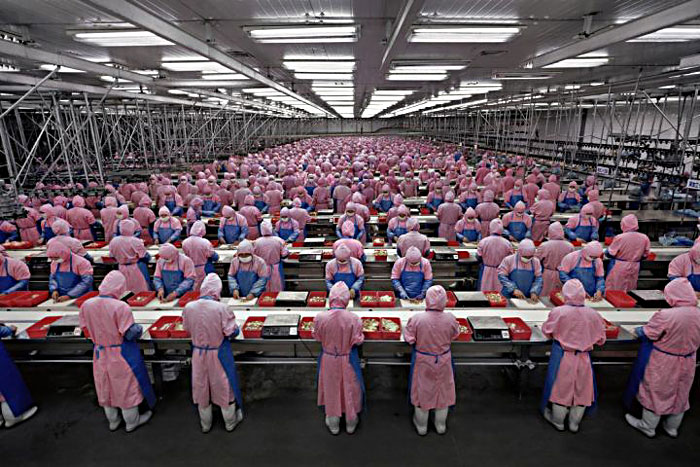
  • Jenny Chan, lecturer at Oxford and expert on labour in China and the workers at Foxconn in particular. 
  • Jane Hardy, professor of political economy at University of Hertfordshire and author of Poland’s New Capitalism 
  • Adrian Budd, lecturer in politics at London South Bank University and author of Class, States and International Relations: a critical appraisal of Robert Cox and neo-Gramscian theory
  • For more details and how to book see here
  • Labels: , , , , , , ,

    Wednesday, November 26, 2014

    Still the Enemy Within

    STEW DVD Spe Ed for website

    Short of ideas for Xmas presents?  Why not pre-order the Still the Enemy Within film about the Great Miners' Strike of 1984-85 on DVD?

    Labels: , , , , ,

    Sunday, November 02, 2014

    1640: The First English Revolution


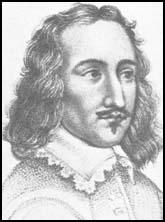
    John Lilburne - calling for a spiritual revolution in England about 350 years before Russell Brand...

    Russell Brand may have played his part in helping the word 'revolution' return to a degree of fashionability recently, but even in sleepy England revolutionary ideas have not simply been widely circulated long before him, but have actually been put into practice.   That Norah Carlin's pamphlet on 1640, The First English Revolution (1983) is now online is therefore most timely - for those wanting more on the historiography of revolution in England, see her earlier analysis of Marxism and the English Civil War.

    Edited to add: The John Lilburne 400 anniversary conference

    Labels: , , ,

    Monday, October 06, 2014

    New Book: Bread, Freedom, Social Justice


    Bread, Freedom, Social Justice: Workers and the Egyptian Revolution
    By Anne Alexander and Mostafa Bassiouny
    Published on 9 October by Zed books.

    Accounts of the Arab Spring often focus on the role of youth coalitions, the use of social media, and the tactics of the Tahrir Square occupation. This authoritative and original book argues that collective action by organised workers played a fundamental role in the Egyptian revolution, which erupted after years of strikes and social protests. 
    Drawing on the authors' decade-long experience of reporting on and researching the Egyptian labour movement, the book provides the first in-depth account of the emergence of independent trade unions and workers' militancy during Mubarak's last years in power, and and their destabilising impact on the post-revolutionary regimes.

    Table of Contents

    Introduction: From the Republic of Tahrir to the Republic of Fear? Theorising revolution and counter-revolution in Egypt 2011-2014
    1.From Nasserism to Neoliberalism: a new amalgam of state and private capital
    2.The changing structure of the Egyptian working class in the neoliberal era
    3.Strikes, protests and the development of a revolutionary crisis
    4. Organisation in the workplace before the revolution: the Nasserist model in crisis
    5. From strike committee to independent union
    6.The revolution’s social soul: workers and the January Revolution
    7. Workers’ organisations since the revolution
    8.The crisis of representation: workers and elections
    9. Tathir: the struggle to cleanse the state
    Conclusion: Beyond ‘the Republic of Dreams’: revolutionary organisation, democracy and the question of the state

    Book Launch: 28 October @ Khalili Lecture Theatre, SOAS, Russell Square, WC1HOXG
    With Gilbert Achcar, Alain Gresh, Mostafa Bassiouny and Anne Alexander

    There will be a collection held at this book launch for Bassem Chit, the Lebanese revolutionary socialist who tragically passed away a few days ago.  This is from one of Chit's last articles, How did the sectarian nightmare come true in Iraq and Syria?, discussing the likely consequences of Obama and Cameron's new war:

    The US is on the defensive and trying to protect its own interests in Iraq. An intervention will inflame the situation and prolong the conflict.  The Islamic State exists because of a lack of revolutionary politics. A movement from below which fends off the regime and fills the vacuum the Islamic State is currently filling could win people away from it. You can point to Isis as being part of the counter-revolutionary forces which criminalise revolution. The line of struggle against both the regime and against these reactionaries becomes clearer. But when imperialists intervene it gives structures like Isis more favourable conditions.It galvanises regional rivalries which allows the further spreading of factional conflicts. This fragments the masses and besieges the working class in a war-driven economy. And it limits the possibility of building political movements and mass mobilisations which offer the only real alternative against these sectarian forces.


    Labels: , ,

    Thursday, August 21, 2014

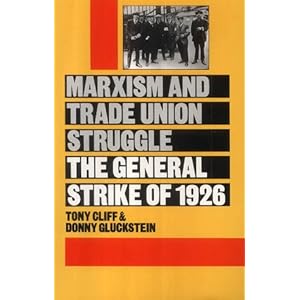
    Marxism and Trade Union Struggle


    Marxism and Trade Union Struggle: The General Strike of 1926 (1986)by Tony Cliff and Donny Gluckstein is now online...

    Labels: , , , , ,

    Wednesday, June 25, 2014

    Rachel Holmes to speak on Eleanor Marx at Marxism 2014

    From the Marxism 2014 office:

    Marxism 2014 starts in just over two weeks time . . . don't miss out - make sure you book your ticket if you have not already done so!
    New speaker for Marxism 2014
    We are very pleased to announce that Rachel Holmes, author of the new book “Eleanor Marx, a Life”, will be speaking at Marxism 2014.
    The daughter of Karl Marx, Eleanor Marx was exceptional in her own right. She was a socialist organiser and campaigner, massively involved in the explosion of strikes and militancy known as “New Unionism”. The Great Dock Strike in 1889 signalled a massive expansion of the trade union movement among thousands of previously unorganised, unskilled workers.
    Eleanor was a highly experienced agitator. She was one of the key speakers at the 100,000-strong mass rally in Hyde Park, during the third week of Great Dock Strike. She formed the first women’s branch of the National Union of Gasworkers and General Labourers.
    Rachel Holmes will explore these aspects of her life and others in her meeting at Marxism.
    Eleanor Marx: A Life will take place at Marxism 2014 on Friday 11th July at 2pm.
    Day and session tickets are available. Booking in advance is cheaper and will save you queuing at the Box Office. All tickets booked before Friday 4th July will be sent out in the post.
    For the full provisional timetable for Marxism 2014 go to www.marxismfestival.org.uk
    You can book on line or call 020 7819 1190
    Please note that the deadline for the creche is this Friday 27th June. If you need accommodation and have specific needs please let us know by Friday 4th July. Any accommodation requested after this date will be in a community centre.
    Hope to see you at Marxism 2014!

    Labels: , , ,