Histomat: Adventures in Historical Materialism

'Historical materialism is the theory of the proletarian revolution.' Georg Lukács

Sunday, April 05, 2020

Arise, Sir Keir!

 
Leaving Coronavirus and its consequences to one side, let us register that in terms of official British politics once again there is stillness and calm after the recent disturbance of the force.  Order has been restored to the British political galaxy.  The Labour Party - an avowedly democratic socialist party - has ended its experiment with having a sincere democratic socialist for leader and moved on from 'Corbynism'.   Trying to change the system in piecemeal Fabian fashion, boring from within in the most boring fashion imaginable, can recommence with Sir Keir Starmer at the helm, picking up from where Ed Miliband left off.  The bosses of the CBI and media barons can relax and breathe easy, as Labour no longer offers the threat to profit margins they once feared it might.  

When Jeremy Corbyn was first elected Labour leader back in 2015, I wrote a piece, 'The Spectre of Corbynism'.  Sadly - tragically given the hopes, energy and time invested by so many in so few - it only remained a spectre - not a reality.  On the day of the 2019 general election itself - 12 December 2019 - before the result was known - I wrote the following notes to myself as part of a meeting I spoke at earlier that evening:

'A spectre is haunting British politics — the spectre of Corbynism.  All the powers of the old order have entered into a holy alliance to exorcise this spectre:  Republican American President Donald Trump and former Labour Prime Minister Tony Blair, from Rupert Murdoch to the BBC, from the Archbishop of Canterbury to serving generals who would consider mutiny if necessary to Sir Richard Dearlove, the former head of MI6 who has declared Corbyn a threat to national security who is not suitable to be Prime Minister.

Two things result from these facts:

1 Corbyn is the most left-wing leader of the Labour Party ever – there are some parallels with George Lansbury in the 1930s but unlike even Lansbury Jeremy Corbyn has remained on the radical left of the party throughout his whole career and has not had previous experience of government office.  Corbyn unlike Lansbury has managed to survive the attempts by the Labour right to remove him before he has had the chance of fighting not one but now two general elections.

2 He has a chance of actually becoming Prime Minister – and the prospect of a socialist as prime minister terrifies the British and international ruling class – just as it gives hopes to millions suffering under austerity and wanting another more sustainable, just and humane world.  


He represents not the spectre of Communism as such – but merely of social democracy – which was supposed to have been killed off and left for dead amidst the triumph of Thatcherism ('There is no alternative') and then Thatcher's greatest achievement -  Blairism – now its suddenly back from the dead thanks Jeremy Corbyn MP and the movement around him.

I first saw Corbyn speak at a tuition fee demo organised by NUS in the late 1990s – warning that once fees were introduced by the Blair government they would go up as happened in Australia.  His record of anti-war activism, anti-imperialist activism and anti-racist activism speaks for itself.

But there is a problem of base and superstructure – politically and intellectually Corbynism was in many ways great and put the principles of working class struggle and the ideas of socialism out there into the mainsteam - but it lacked an 'economic base' underpinning things - there was just not a socialist movement (or wider mass movements on the streets fighting in defence of the NHS or housing, or mass movements against racism and war and for Palestine and so on)  – nor a sense of a working class confident of acting for itself – but instead just a sense that we could get change by passively voting for Corbyn - reflecting the decades of defeat the British working class have suffered since Thatcherism.

It took 17 general strikes in Greece to elect an anti-austerity government in Syriza – the recent UCU strikes in higher education for 8 days were something but not quite this.

The Labour right have repeatedly tried to grind him down and crush Corbyn - 'Project Anaconda' – it was dubbed – he fought this off to some extent but compromised with the right – eg over Trident nuclear submarines  / Brexit / Palestine / and so on - and so by 2019 he is a much weakened leader....'

That was some of what I felt back in December 2019 - but I felt Labour would do better than expected because of the working class anger that is out there and goes unrecognised by the middle class Guardian commentariat  -and so I thought perhaps Labour would get enought to ensure a hung parliament and form a coalition with the SNP or something - it was as we know not to be.  Charlie Kimber has written a long piece for International Socialism  on why Labour lost that terrible night in December 2019 - and how that working class anger managed to be tapped into by Boris Johnson's Tories as a result of Labour's liberal and elitist position on Brexit - so I am not going to repeat this general argument.

What it means now though is that the so called 'parliamentary road to socialism' is firmly closed.  Sir Keir Starmer - with the support of the Labour right and some useful liberal idiots on the Labour left - played his part in helping close that road above all by leading the charge for Labour to adopt a pro-EU position and disregard the referendum of 2016.  The Labour right and Starmer knew that Labour taking a remain position would either work electorally - in which case they have helped Labour once again become a party that loyally serves the interests of British big business by getting Britain back into the EU - or if it didn't work electorally - which anyone could have guessed would have been the more likely option - then Corbynism would be finished and the period where the hard Left were in control of the commanding heights of the Labour Party would be over.   The latter proved the case - and now the right will let the Starmerite soft left do their work disciplining the hard left, making Labour more 'electable and respectable' and making the party safe for Blairism and capital and empire once again - and then when Starmer fails in the next election - the Labour right will be in prime position to ensure a Blairite retakes the leadership.

That the revolutionary road to socialism still remains open for those willing to embark on it is no doubt small comfort right now for the tens of thousands of socialists in Britain who have seen their dreams and hopes of a Jeremy Corbyn government dashed and now smashed.  But we should take an international perspective at moments of defeat - and look at the recent revolutionary movements across the Middle East and elsewhere - as well as the mass strikes and protests that have rocked Macron's neo liberal government in France over the last couple of years - to see how hope lies not with trying to win internal battles inside the Labour Party anymore - real power lies outside parliament - and building the kind of social solidarity that we are seeing emerge amid the Coronavirus pandemic - and the wider fightback and working class resistance against Johnson's useless and disastrous Tory government.

Labels: , , , , , ,

Monday, November 04, 2019

Tories out - Corbyn in

If I get more time to write something before the election I will do so - but in case I don't basically lets make history by electing a socialist prime minister and give hope to those around the world - kick the Tories out and get Corbyn in by Christmas!

Labels: ,

Saturday, December 02, 2017

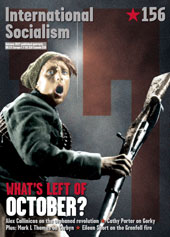
International Socialism Journal #156


The latest issue of International Socialism is out, with articles on the centenary of the Russian Revolution including 'The orphaned revolution: the meaning of October 1917' by Alex Callinicos, 'Maxim Gorky and the fellow travellers' by Cathy Porter, 'The Russian Revolution and the British working class' by Pete Jackson, and a review article by the historian Steve Smith. There are also other pieces on Corbynism, racism in 19th century America and Marx’s Capital at 150 among other things - well worth checking out...

Labels: , , , ,

Monday, July 03, 2017

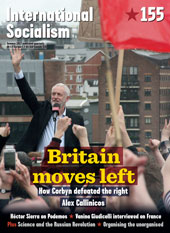
International Socialism #155 out now


The latest issue of International Socialism is out now, with analysis of the glorious general election of 2017 in Britain and also an interview with a French activist regarding 'the meaning of Macron'.  Other topics discussed include Podemos in Spain, the Russian Revolution at its centenary, and the state of the class struggle in Egypt and China - check out the full contents list anyway and consider subscribing if you do not currently... 

Labels: , , , , , , ,

Tuesday, May 02, 2017

Ten things everyone should know about the Labour Party - Paul Foot

  1. Labour, which is linked to organised workers, is better at any time than the Tories, who are linked to organised capital.
     
  2. ‘Without struggle there is no progress’: everything worth winning by the workers and the dispossessed has to be fought for.
     
  3. The less Labour fights the Tories, the less it is likely to beat them at the polls or anywhere else.
     
  4. The more Labour compromises and prevaricates, the more the fighting spirit of the people who vote Labour is dampened.
     
  5. The more that fighting spirit is dampened, the stronger and more confident grow employers, racialists and reactionaries of every description.
     
  6. The power of the elected parliament is all the time frustrated by the power of the undemocratic banks, corporations, judges and the media.
     
  7. The more a Labour government tries to be fair to the banks, corporations, judges or media, the more it becomes their captive.
     
  8. The more it becomes their captive, the more it attacks the people who vote Labour, thus ensuring a Labour defeat next time.
     
  9. This vicious circle is written into the history of the whole century. Clement Attlee and Harold Wilson couldn’t avoid it. There’s no chance that Blair and Co, further to the right even than Attlee and Wilson, will avoid it either.
     
  10. (Conclusion) Vote Labour, but keep up the fight down below to build the resistance into a force which is strong enough to dictate to the undemocratic elite at the top of society – and put an end to their interminable dictatorship.  
  11. Paul Foot, 'Ten things everyone should know about the Labour Party', Socialist Review, 179, (October 1994)

Labels: , , , , ,

Thursday, August 11, 2016

Is there a future for the Labour Left?

A historic pamphlet from just after the defeat of the 1983 election, written by Pete Goodwin, Is there a future for the Labour Left? A Socialist Workers' Party Pamphlet, is now online at the Marxist Internet Archive.  Wags might say, today a more appropriate pamphlet to read would be 'Is there a future for the SWP? A Labour Left pamphlet', given the massive rise of Corbynism over the past year or so.  However, for those Corbynites willing to defy Tom Watson's edicts and interested in what a 'Trotskyist' analysis of the Labour Party might look like, this little SWP pamphlet is not a bad place to start...  the conclusion however - that a revolutionary socialist organisation independent of the Labour Party needs to be built - may come as somewhat of a shock to those who believe Tom Watson's dossier on hard left entrism...  and may even convince some Corbynites to read some more Trotsky for themselves ... and who knows where that could lead? 

Labels: , , , ,

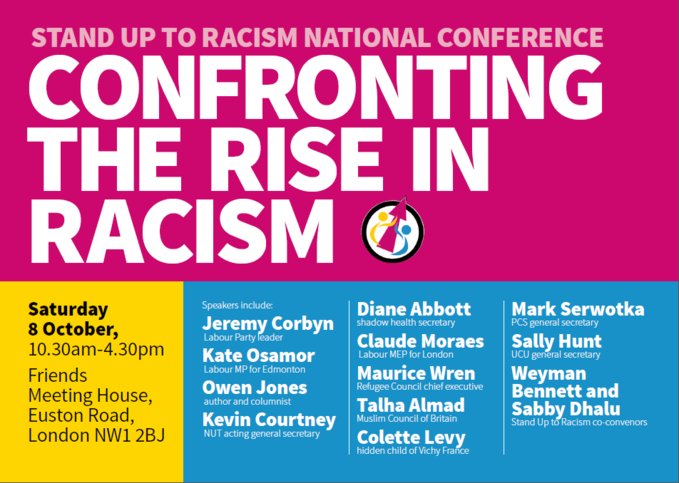
Stand Up to Racism national conference - 8 October London


Book your ticket here

Labels: , ,

Sunday, February 21, 2016

The internationalist case against the EU

Alex Callinicos on why socialists and trade unionists should support a vote to leave the EU - in the upcoming EU Referendum but obviously not sharing a platform with the likes of 'poundshop Enoch Powell' Nigel Farage while doing so... see also the debates and other pieces collected together at the bottom of this page. As Charlie Kimber of the SWP notes, We hope others will join us in a campaign that is rooted in anti-capitalism, support for workers’ struggles and anti-racism. It is not too late for Labour’s Jeremy Corbyn to shrug off the pressure from the right and launch a left-wing leave campaign. It would condemn Cameron to defeat. Our campaign will say, “No to racism, open the borders, leave the EU”, and “Yes to workers’ unity everywhere, solidarity against neoliberalism and capitalism, leave the EU”. It will also say “No to Ukip and TTIP and the other neoliberal treaties, fight the bosses, leave the EU” and “Yes to real action over climate change, no trust in the bosses’ solutions, leave the EU”.

Labels: , , , , , , , ,

Saturday, January 09, 2016

International Socialism #149 out now


The latest issue of International Socialism is now online, and while there is a host of material relating to Marxist theory and history, from debates about the level of class struggle in Britain to the struggle for climate justice, and discussion of figures from Erich Fromm to Leon Trotsky and E.P. Thompson, it leads with Mark L Thomas on the Labour Party under Jeremy Corbyn, while Jane Hardy looks at debates in radical and Marxist economics. Other key pieces include Anne Alexander writes on ISIS, imperialism and the war in Syria, and Alex Callinicos analyses the strategy and tactics for anti-imperialists in the West as they set about resisting the long war on 'terror' underway, in Britain through re-building the Stop the War Coalition. As he concludes:

One thing is clear, amid the chaos, confusion and bloodshed in the Middle East: imperialism is a key part of the problem there. The US, Britain, France, Russia and the rest, can do no good there. They should get out of the Middle East and leave its peoples to find their own way to the goals of democracy and social justice that inspired the revolutions of 2011. In the meantime, the task of the Western left is to rebuild the anti-war movement, and mobilise as many people as possible in a campaign to force our governments finally to end the long war.

Labels: , , , , , , ,

Saturday, October 10, 2015

International Socialism # 148 out now

The latest issue of International Socialism is now out, highlights include Panos Garganas on the failure of Syriza, Alex Callinicos on the victory of Jeremy Corbyn) and pieces by Callinicos and John Palmer debating how British socialists should respond the upcoming EU referendum, Fran Cetti on Fortress Europe, Susanne Jeffrey's on capitalism and climate change, Joseph Choonara on Paul Mason's Postcapitalism, and John Newsinger on British counter-insurgency violence and state terror. The ISJ has also grouped together a useful set of theoretical articles for Black History Month - see here.

Labels: , , ,

Tuesday, September 22, 2015

Defend Corbyn's anti-austerity policies

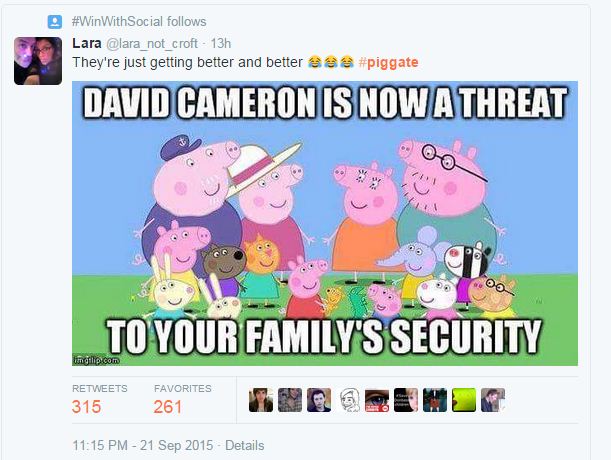
 http://en.protothema.gr/wp-content/uploads/2015/09/piggate-6.jpg


Please add your name to this statement initiated by Unite the Resistance

The overwhelming election of Jeremy Corbyn as leader of the Labour Party is a hugely welcome development for everyone who opposes austerity, racism and war.
The thousands who packed into halls across Britain to hear Jeremy are clearly looking for a new kind of politics that breaks with the pro-austerity consensus. Some were established activists but many were young people from a generation that have faced the assault on EMA, spiralling tuition fees and the rise of zero hours contracts.
They have been inspired by the campaign’s message. After years where the Labour leadership often aped Tory policies the party now has a leader who is a socialist with a proven track record of standing in solidarity with those fighting against injustice and for peace.
His first act on being elected was to join the demonstration in support of refugees in London and to speak out in defence of the trade union movement and against the Tory Trade Union Bill.
He won in an election where over 400,000 voted and he won almost 60 percent of the vote. This gives him a clear democratic mandate to carry out the polices that he put forward during the leadership contest.
Any attempt by the media, or politicians from either inside or outside Labour Party to undermine Jeremy Corbyn and the policies he represents flies in the face of what is clearly an overwhelming democratic mandate.
Jeremy Corbyn’s victory has already sent shock waves through an establishment that for years has had the luxury of a political leadership on both sides of the House of Commons prepared to back austerity.
In Corbyn they see someone who stands for resistance to year after year of privatisation, cuts, and war. In short – policies that make the 99 percent pay for a crisis created by the 1 percent.
We call on all those both inside and outside the Labour Party who support the pro-union, anti-austerity, anti-racist and anti-war policies that Jeremy Corbyn has put forward to stand up to any attempts to undermine his democratic right to lead the Labour Party and the programme he has supported.

Currently supported by:
Sean Vernell & Jane Aitchison (Joint Secretaries Unite the Resistance)
Len McCluskey (General Secretary Unite)
Mark Serwotka (General Secretary PCS)
Ronnie Draper (General Secretary BFAWU)
Matt Wrack (General Secretary FBU)
Christine Blower (General Secretary NUT)
Dave Prentis (General Secretary Unison)
Michelle Stanistreet (General Secretary NUJ)
Dave Ward (General Secretary CWU)
Sally Hunt (General Secretary UCU)
Mary Bousted (General Secretary ATL)
Kevin Courtney (Deputy General Secretary NUT)
Tony Kearns (Deputy General Secretary CWU)
Ian Hodson (National President BFAWU)
Liz Lawrence (President UCU)
Peter Pinkney (President RMT)
Andy Smith (President NUJ)
Rob Goodfellow (UCU President elect)
Kevin McHugh (Deputy President PCS)
Janice Godrich (President PCS)
Cheryl Gedling (Acting Vice President PCS)
Martin Kavanagh (PCS DWP Vice President)
Zita Holbourne (PCS exec & BARAC)
Ian Gawther (PCS RAC Group branch chair)
Gordon Rowntree (PCS Assistant group Secretary HMRC)
Mary Ferguson (PCS NEC & Northern Region Chair)
Sarah Wooley (BFAWU NEC)
Zita Holbourne (PCS exec & BARAC)
Kevin McHugh (Deputy President PCS)
Ian Gawther (PCS RAC Group branch chair)
Gordon Rowntree (PCS HMRC Assistant Group Secretary)
Mary Ferguson (PCS NEC & Northern Regional Chair)
Dave Muritu (UCU NEC & Chair Black members' standing committee)
Richard McEwan (UCU NEC & FEC vice chair)
George Atwell (BFAWU full time officer)
Sharon Holder (National Officer GMB)

Labels: , ,

Monday, September 14, 2015

I love the smell of Blairites crying in the morning...

Labels: , , , , , ,

Monday, August 24, 2015

Revolutionaries and the Labour Party


 Phil Evans on the Labour Party and socialism

In 1982, at the height of 'Bennism', the late, great Marxist Duncan Hallas (1925-2002) - author of among other things a pamphlet on The Labour Party: Myth and Reality, wrote an important article for International Socialism on 'Revolutionaries and the Labour Party'.  As Hallas put it, 'the aim of this article is a modest one. It is to clarify the attitudes revolutionaries have taken towards the Labour Party, to review the experience and to assess the situation of today. In particular, the problem of what is called entrism – revolutionary organisations operating inside the Labour Party – is considered in some detail'.  Amidst the exciting rise of 'Corbynism', it may well repay re-reading by revolutionaries again today, not least as his conclusion retains its relevance:  'The task of revolutionary socialists is to face reality, to recognise things as they are, to fight very hard in support of all the struggles that do occur, to seek to increase their numbers and influence on that basis, to apply the united-front approach systematically and untiringly. It is also to patiently explain, to clarify what is and what is not revolutionary work. Both these tasks require a revolutionary party, operating openly under its own banner...'

Labels: , , , ,

Wednesday, August 19, 2015

Leon Trotsky's relevance today


Leon Trotsky speaking in Copenhagen in 1932 (photo: Robert Capa)

As the Jeremy Corbyn campaign continues to strike fear into the hearts of the Labour Party grandees and bureaucracy, who have in characteristic Stalinist fashion prosecuted what has been dubbed 'Operation Icepick' to purge the lists of those eligible to vote in the Labour Party leadership election of 'Trotskyists', it is perhaps worth revisiting the political thought of the original victim of 'Operation Icepick', Leon Trotsky himself, given this week marks the 75th anniversary of his murder at the hands of a Stalinist agent. Sue Caldwell, who incidentally once wrote a wonderful introductory guide to chess which taught me the little I know about strategy and tactics in that game, has written a timely short piece - online here in this week's Socialist Worker which does just that.  It is important to pay tribute to Trotsky, who was not only the heroic sword of the Russian Revolution and the shield against the Stalinist counter-revolution until his tragic murder, but also a revolutionary whose political and intellectual thought as a Marxist was so original and outstanding it retains relevance in the 21st century.  And as Caldwell rightly notes,
'It’s never easy to get the correct balance right between working with and against reformists and their leaders.
Revolutionaries have to stand with them to defend working class organisation against the bosses and fascists. But it’s also crucial that revolutionaries argue against them sowing illusions in reformism and build a revolutionary alternative. For example, we welcome left reformist parties such as Syriza, Podemos and the momentum around the Jeremy Corbyn campaign.  These can push politics to the left. But only the working class has the power to transform society. '

Some suggested further reading on Trotsky:

A Rebel's Guide to Trotsky - Esme Choonara

Trotsky's Marxism - Duncan Hallas

Tony Cliff's four volume biography of Trotsky is also now online - see here.

Edited to add: Speaking of Trotsky and today, what would he have made of the contemporary Black Lives Matter' in the US?  Well, we know he was a more profound thinker about race in the US than he is often given credit for, but Paul Buhle (for a recent interview with Buhle by the way, see here) has also recently suggested that, via the writings of the then Trotskyist C.L.R. James and with the help of the Harlem lawyer and also then a Trotskyist Conrade Lynn Malcolm X read and studied 'The Revolutionary Answer to the Negro Problem in the United States' (1948) which represented the best analysis of the American Trotskyist movement on race at that time,while Malcolm was in prison in the early 1950s.  So not only would Trotsky have welcomed the new Black Lives Matter movement, but perhaps the intellectual origins of the Black Lives Matter movement - via Malcolm X and C.L.R. James - may owe something to the inspiring life and work of Trotsky...

Labels: , , , , ,

Tuesday, August 04, 2015

The Spectre of Corbynism


Is #JeremyCorbynforLabourLeader the way forward for the Left?

 A spectre is haunting British politics – the spectre of Corbynism.  Not the spectre of Communism as such – but merely of social democracy – which was supposed to have been killed off and left for dead amidst the triumph of Thatcherism ('There is no alternative') and then Thatcher's greatest achievement -  Blairism – now its suddenly back from the dead thanks to the campaign for Labour leader of Jeremy Corbyn MP.

 No wonder Blair and the Blairites are so angry and taking this so personally – his whole project and that of his supporters looks as if it is heading towards the 'dustbin of history'. Ironically it was Ed Miliband’s changes to way of electing the Labour leadership – which was supposed to have been about reducing trade union influence in the party – the same influence which saw Ed Miliband triumph unexpectedly against the odds over his brother – that is making the Corbyn victory seem possible.  Ed Miliband's idea here was essentially a Blairite one – be more like US Democratic Party – sign up lots of supporters – the thinking is these supporters will be ‘ordinary people’ who are not left wing troublemakers but believe the everyday common sense views of the bourgeois Daily Mail – and so Labour will ensure it gets a more ‘electable’ leader –one more acceptable to the right wing owners of the corporate media.

 This strategy almost worked out fine for the Blairites, as in the immediate aftermath of the election the discourse of the corporate media was highly depressing – hammering Miliband's Labour for somehow being too 'left wing' – and there was a narrative and consensus in play about the need for Labour and British politics in general to move further to the right.  Andy Burnham made his first major tactical mistake here in the run for Labour leader - he could have tacked a little Left at this point (instead he tacked right appointing the Blairite Rachel Reeves to a key position in his team), so opening the door for the unexpected triumph that was Jeremy Corbyn getting onto the ballot paper representing a clear voice against austerity, racism and war.  As Corbyn put it in a recent interview:

 'And my strong view is that we lost in 2015 particularly, but also in 2010, because essentially we were offering people slightly less hardship than the other side was offering people. It wasn’t very attractive to a lot of Labour voters. Compounded by the vote on the welfare bill, this has put Labour on the wrong side of the feelings not just of the people on benefits or who might be on benefits but a lot of other people who think, ‘Actually, there’s a lot of poverty in our society, which the Labour Party should be concerned about.’”

 So many bourgeois commentators (and those supposedly on the pseudo left - the Guardian / New Statesman types) have written off the material experience of the working class – the poverty and inequality and insecurity affecting the vast majority of British society - the working class  – they just can’t explain the popularity of the Corbyn phenomenon at all – its all a bit like the Bob Dylan song – Ballad of a Thin Man - ‘Something is happening here/ But you don't know what it is/ Do you, Mr. Jones?’

 Instead they just give repeated patronising lectures like Labour members and supporters are little children - get sober, get realistic, get a heart transplant etc etc - but for those on the receiving end of the austerity and billion pound cuts of the Tories – and with working class struggle so low and so people not feeling confident about fighting back themselves through strike action etc - it is not surprising that Corbyn's campaign is seen as source of hope. Hence the incredible and exciting level of support for Corbyn among trade unionists (and even more  reluctant trade union leaders)- winning the backing of UNITE – UNISON – CWU – and most constituency Labour parties etc.  The huge swell of support for Corbyn - seen at the mass rallies he is currently speaking at around the country - is potentially the most exciting thing to happen to the Left in Britain for about 30 years –and opens up all sorts of fascinating questions about possible realignments on the Left – will everyone on the Left flood back to the Labour party now if he wins (as George Galloway predicts) – even in Scotland, does a Corbyn win mean Labour will have the chance to rebuild?

 Remember - according to some on the Left, for example Richard Seymour - Labour is supposed to be dead, 'Pasokified' etc - and we are all supposed to be at our most miserable and pessimistic about things right now - yet everyone you meet on the Left is at the moment more optimistic and excited about the prospects of a Corbyn victory than they have been for ages.  This is partly of course because of the personal Corbyn factor – without the charisma and oratorical powers of a Galloway or a Benn, but with consistency, courage and a lack of egotism which is very refreshing - and his tireless activism together with the fact he is one of the most principled socialist Labour MPs means everyone on the Left should hope for his win, which would be inspiration and symbol of hope and resistance for many millions of people.

 At a time when David Cameron's racist scapegoating of the ‘swarm’ of refugees at Calais is sickening anti-racists everywhere - see Frankie Boyle's brilliant recent column about this in the Guardian - , you know that Corbyn's record of not only anti-imperialism but also anti-racism means that he will always stand out against such filthy rhetoric and defend the rights of refugees. Electing Corbyn - the current president of the Stop the War Coalition - leader would be just about the only thing Labour could do to wash off all the blood stains left because of Blair’s warmongering – at one fell swoop they could win back millions of voters who could never stomach voting Labour again because of their war crimes.  And indeed what we are seeing primarily with the Corbyn campaign is the five million Labour voters and 200,000 odd Labour members which Blair and Brown lost from 1997 to 2010 with their privatisations and warmongering coming back around Labour. Andy Burnham, a former Blairite who described Blair as ‘my mate’ in 2006 is trying to pretend he is some sort of Left wing figure now, but as Tony Benn once said of Jack Straw, 'he is like a little weather-cock – he blows with every wind’.   Burnham’s possibly fatal error for someone who was supposedly somehow left recently was to follow Harriet Harman’s call for abstention in the fact of the Tories attack on welfare – redistricuting wealth from very poorest in society to their rich friends – followed by the other two Yvette Cooper and Liz Kendall and four fifths of Labour MPs.

 So the battle is now on as it were for the ‘soul’ of the Labour party – and the possibility of civil war inside of Labour if Corbyn does win.  Labour has 232 MPs, and only nine are members of the Socialist Campaign Group to which Corbyn belongs.  Corbyn only got onto the ballot paper with help of right-wingers, many of whom now regret giving their support to him.  The weakness of Labour Left - compared to what it was in the late 1970s and early 1980s around Bennism is palpable.  Only 9 Labour MPs in Ed Miliband's Labour Party opposed his Libya war – even less than the 12 under Brown who called for an inquiry into the Iraq war.  Only 7 Labour MPs I think voted for Diane Abbott for Labour leader last time around. So should socialists - like myself, a member of the SWP - who are currently outside the Labour party now join or rejoin to play their part in the struggle to 'reclaim Labour'?

I think there are some basic points to make:

 1) Only a sectarian idiot would not welcome the mass Corbyn campaign as a sign of support for left ideas and the potential for resistance – and the revival of the Labour Left as an organised force again -  even if this means things are in a sense more difficult for those of us on the revolutionary left trying to build a socialist alternative to Labour in things like TUSC and Left Unity.

 2)  But we have to say some other things as well, which hopefully explain why SWP members like myself are not going to join the Labour party now to vote for Corbyn ourselves. Without wanting to 'pre-write' history (which is what I may will be accused of doing anyway), as Marxists - who aim to theorise and generalise from the historic experience of the working class - we can it seems safely make some points of warning here, given the Labour Party has been around for over 100 years. There are incidentally some clear parallels here - when thinking about reform or revolution - with the situation in Greece around Syriza - we in the SWP were denounced for stressing the importance of maintaining organisational independence from Syriza in things like Antarsya (I was personally denounced for writing 'stark morality fables' by Seymour for not cheerleading the Syriza leadership's every twist and turn), only to be vindicated somewhat when the reformist strategy of trying to work within the neoliberal capitalist prison of the EU failed and Syriza's leadership ended up implementing austerity and cuts despite being officially 'anti-austerity'.  Given this - the main problem it seems to me around Corbynism is the question:

3) How would Corbyn actually implement his moderate programme of social reform and end austerity? Already just by his being ahead in the leadership polls, he has increasingly come under pressure from the right inside the parliamentary Labour party- and in the face of this pressure his strategy at the moment is to compromise and equivocate rather than offer resistance.  For example over the EU where Corbyn was initially ambivalent but is now more clearly situating himself in the 'Yes' camp to stay and try and reform it (ala Syriza) rather than arguing for a 'Left Brexit' (which would worry the big sections of the British capitalist class even more than his campaign is already doing).  He has also called for Labour Party Unity and offered to give Blairites positions in his Shadow Cabinet to try and avoid the danger of (perhaps inevitable) internal civil war.  All this he has done - and he has not yet even won the position of Labour leader yet!

 If he won, these pressures to be ‘electable’ – moderate his programme - would grow and become more intense – as would the general pressures to compromise – and to not have a fight and try and clear the Blairite bureaucrats out of the party apparatus or reselect etc not have campaign to try and reselect the worst of the right wing Labour MPs.  Perhaps he will try to 'reclaim Labour' in his own way, and try to challenge the right inside Labour - but ultimately Corbyn is a Labour Party man – that’s his party – and I think ideally he would want to be a 'unifier' as leader – not someone who went on the offensive and tried to drive out the Blairites in the ruthless manner that they would need to be purged. Incidentally, there has never been a mass purge of the right wing of the Labour Party in any organised fashion in its history - only ever expulsions of the Left.

For Corbyn to resist the right and stay on track would need a counter-veiling pressure to his Left which is as strong or stronger than that on his right (the Blairites and corporate media).  Only mass collective struggle on the streets and more importantly in the workplaces could provide such pressure.   The student revolt of 2010 and the mass strikes and marches of 2011 gave momentum to an anti-Tory mood in Britain. Workers’ sense of solidarity and confidence grew.  But the choking off of the strikes by trade union and Labour leaders eroded the feeling of collective revolt, and in its place came the pressures of individualism and hesitation about following a Labour Party that seemed scared of any real change – that ultimately was a large part I think of why Labour lost earlier this year.

But even say that Corbyn victory triggered a rise in confidence and militancy on the streets and at work - and every socialist has to sincerely passionately hope that it does, which would help to make the TUC demonstration in Manchester on Sunday 4 October at Tory Party conference mammoth – and the trade union leaders can no longer hold back the latent anger at what the Tories are doing that they had to lead and organise a serious fight back – and then a Corbyn–led Labour did win in 2020 – what then?

 Here we return to the main problem with all forms of left reformism – putting parliament – or as the Labour Left MP Eric Heffer once put it – the 'class struggle in parliament' – first – and the class struggle at the point of production, or the movement on the streets, below that somewhere.  Corbyn himself is of course an activist – but remember when the anti-war movement was at its height – he could have left Blair's Labour Party and joined with Respect and Galloway, then stood for his old seat as a socialist with much more room for manoeuvre to build the extraparliamentary movement and freedom to criticise the Blairites – but he didn’t do this.  I don't know why not, but my guess is that there was always the chance that by doing this he would lose – so he put being MP and being in parliament first.  That’s fine and respectable in its own way – that’s because his vision of change is socialism coming through parliament from above - fine, but lets not try to pretend he is some sort of revolutionary.  As he himself made it clear on the Andrew Marr show, the Labour Party is not a 'revolutionary party'.

Still, a Corbyn led government on the face of it now would still be amazing – it would be the best chance of breaking the cycle of every Labour government since 1945 being worse than last one because of their commitment to imperialism abroad and making cuts at home - and making ordinary people pay for the wider crisis of British capitalism. The problem of course is, if he won, Corbyn would be in office as PM – but not in power, because power does not lie in parliament - and he would still have the wider capitalist crisis to content with. As Charlie Kimber pointed out in Socialist Worker recently, 'The state structures of the police, army, judges, prisons and spies are wholly insulated from democracy. They exist to thwart change, not enable it.  The unelected and unaccountable owners of capital will use their financial and social power to block reforms that threaten business. They will use global institutions to bully governments, they will engineer currency panics, choke off credit and funds or withdraw investment and close factories. And if none of that works [and it usually does – look at Syriza in Greece] they will use violence to defend their rule. Only by tackling the system at its roots can such blackmail be defeated.  The history of Labour is a history of betrayed hope because the party seeks change without challenging capitalism or the state.'

The dilemma was well summed up by the German trade union leader Fritz Tarnow at the height of the Great Depression in 1931:

 ‘Are we sitting at the sick-bed of capitalism, not only as doctors who want to cure their patient, but as prospective heirs who cannot wait for the end or would like to hasten it by administering poison? We are condemned, I think, to be doctors who seriously wish a cure, and yet we have to retain the feeling that we are heirs who wish to receive the entire legacy of the capitalist system today rather than tomorrow. This double role, doctor and heir, is a damned difficult task.' 

As Tarnow makes clear, Labour governments and their counterparts elsewhere have always resolved this dilemma by acting as doctors of capitalism, trying to rescue it at the expense of their working class supporters.  As Tony Benn used to put it, 'the Labour Party is not a socialist party – but it always had socialists in it - like there are some Christians in the Church of England' - instead, it is as Lenin put it, a ‘capitalist workers’ party’, which emerged as a political expression of the trade union bureaucracy, and which pursues workers’ interests so long as they are compatible with the well-being of capitalism.   As Lenin once put it, Labour is tied by a thousand threads to capitalism.

 Even if Corbyn cut some of these threads- or threatened to do so - he could not change the fundamental nature of the party as a whole, and would in all likelihood end up a prisoner of it - trapped and unable to manouevre by the Labour right (who may also split off to form a new SDP type party to try and stop him ever become elected).

 Ed Miliband's dad Ralph Miliband – the great Marxist thinker and author of the classic work Parliamentary Socialism – analysed and dissected the resulting ideology of Labourism – which he noted was something distinct from socialism.  As Ralph noted in Parliamentary Socialism (1961),  -‘of political parties claiming socialism to be their aim, the Labour Party has always been one of the most dogmatic – not about socialism, but about the parliamentary system.  Empirical and flexible about all else, its leaders have always made devotion to that system their fixed point of reference and the conditioning factor of the political behaviour.’

 In 1976 in his essay ‘Moving On’, Ralph Miliband stressed the need for building a socialist alternative to the Labour Party – as he wrote: ‘my own view, often reiterated, is that the belief in the effective transformation of the labour party into an instrument of socialist policies is the most crippling of all illusions to which socialists in Britain have been prone’ – Those who had hopes of capturing and reclaiming the Labour Party for socialism were to be disappointed – as he noted ‘the obverse phenomonen has very commonly occurred – namely the capturing of the militants by the labour party’  - ‘people on the left who have set out with the intention of transforming the labour party have more often than not ended up being transformed by it, in the sense that they have been caught up in its rituals and rhythms, in ineffectual resolution-mongering exercises, in the resigned habituation to the unacceptable, even in the cynical acceptance and even expectation of betrayal’.
 
There is a real danger that Corbyn’s campaign can turn people back to the worm-eaten project of transforming Labour, reminding one of the Leonard Cohen song First We Take Manhattan, ‘they sentenced me to twenty years of boredom – for trying to change the system from within’.  The reformist road ultimately does not lead to socialism, albeit at a slower and more genteel pace, but it leads somewhere else entirely - trying to defend and manage a failing bankrupt capitalist system. 

Again Ralph Miliband, in his 1972 postscript Parliamentary Socialism, with which I shall conclude: 'The Labour Party … is a party of modest social reform in a capitalist system within whose confines it is ever more firmly and by now irrevocably rooted.  The system badly needs such a party, since it plays a major role in the management of discontent and helps to keep it within safe bounds; and the fact that the Labour Party proclaims itself at least once every five years but much more often as well to be committed not merely to the modest amelioation of capitalist society but to its wholesale transformation, to a just social order, to a classless society, to a new Britain, and whatever not, does not make it less but more useful in the preservation of the existing social order.  The absence of a viable socialist alternative is no reason for resigned acceptance or for the perpetuation of hopes which have no basis in political reality.  On the contrary, what it requires is to begin preparing the ground for the coming into being of such an alternative: and one of the indispensable elements of that process is the dissipation of paralysing illusions about the true purpose and role of the Labour Party’.

We need to build an alternative to Labour - and a mass revolutionary socialist party.  This is how Ralph Miliband put it in his Socialist Advance in Britain (1983):

 ''Socialist work means something different for a socialist party than the kind of political activity inscribed in the perspectives of labourism. I have noted earlier that political work, for labourism, essentially means short periods of great political activity for local and parliamentary elections, with long periods of more or less routine party activity in between. Socialist work means intervention in all the many different areas of life in which class struggle occurs: for class struggle must be taken to mean not only the permanent struggle between capital and labour, crucial though that remains, but the struggle against racial and sex discrimination, the struggle against arbitrary state and police power, the struggle against the ideological hegemony of the conservative forces, and the struggle for new and radically different defence and foreign policies.  The slogan of the first Marxist organisation in Britain, the Social Democratic Federation, founded in 1884, was ‘Educate, Agitate, Organise’. It is also a valid slogan for the 1980s and beyond. A socialist party could, in the coming years, give it more effective meaning than it has ever had in the past.''

 Edited to add: A recent interview with Jeremy Corbyn and a piece by Alex Callinicos on What will happen if Jeremy Corbyn does win?

Labels: , , , ,

Tuesday, June 30, 2015

Marxism 2015 - Ideas for Revolution

Marxism 2015: Ideas for revolution
A five day political festival: 9-13 July 2015, Central London
www.marxismfestival.org.uk
Book up - Just over one week to go!
New meeting: Tackling the Racist Offensive
Sat 11th July, 7pm
Marxism Festival is very pleased to announce that Diane Abbott MP will speak alongside Sabby Dhalu and Weyman Bennett (Joint Secretaries of Unite Against Fascism, pc) at this new meeting at Marxism.
Meetings on Greece at Marxism 2015
The crisis in Greece poses sharp questions for the left.
Don’t miss our special debate:
Syriza in power: Whither Greece?
With Stathis Kouvelakis (Syriza Central Committee) and Alex Callinicos (SWP)
Sat 11th July, 2pm 
Plus
  • Greece: keeping the hope for change alive
With Panos Garganas (SEK)
Sunday 12 July, 2pm
  • The fight against Golden Dawn in Greece
With Petros Constantinou (Athens Councillor and co-ordinator of the Movement Against Racism and the Fascist Threat) and Kostas Papadakis (part of the legal team representing the victims of Nazi attacks at the trial of Golden Dawn)
Saturday 11th July, 11.45am
  • Fighting the Troika and austerity across Europe
Maria Styllou from Greece will peak alongside Richard Boyd Barrett from Ireland and Christine Buccholz from Germany
Sunday 12th July, 3.45pm
Plus Panos Garganas will join the Marxism opening rally on Thurs 9th July at 7pm

Other meetings at Marxism 2015
  • After Kobane and the general election: where now for Turkey and the Kurds
 Ron Marguilies will be joined by HDP MP Sebahat Tuncel
Sat 11th July, 7pm (the time of this meeting may change – please check our website)
  • Orgreave: the search for the truth
Gareth Peirce and Mike McColgan from the Orgreave Truth and Justice Campaign
Sun 12th July, 3.45pm
  • The story behind Pride
With Nicola Field and Gethin Roberts, original members of LGSM
Sun 12th July, 7pm.
And if you missed Pride at the cinemas there is chance to watch the film afterwards.
  • Darcus Howe, broadcaster and civil liberties campaigner discusses his political life with his biographers Robin Bunce and Paul Field

The final timetable for Marxism 2015 will be on line from tomorrow . . . to book tickets and for more information go to www.marxismfestival.org.uk or call us on 020 7819 1190

Labels: , , , , , , , , , , ,

Saturday, June 13, 2015

New Labour or socialism?

While the late entry of veteran socialist Jeremy Corbyn into the race for the Labour Party leadership has been one of the most positive and welcome political developments in British politics of late, the fact that he has such a major struggle on his hands to even get onto the ballot paper tells you just how far removed from the values of working class solidarity and the principles of internationalism the modern Labour Party has become.  The fact that it is almost certain that the next leader of the Labour Party will be a Blairite (or in the case of Andy Burnham, a former Blairite) who will be even more right wing than Ed Miliband means that it is perhaps timely to reconsider a 1996 pamphlet that is now online by Alex Callinicos, New Labour or socialism? - its content is kind of self-explanatory from the title, but it explains well - as does a 1983 book by Callinicos which is also now online, The Revolutionary Road for Socialism, why the task ahead for socialists remains to build a socialist alternative to New Labour - a task that looks set to become more pressing than ever given the likely outcome of the ongoing leadership election.

Labels: , , , ,