Histomat: Adventures in Historical Materialism

'Historical materialism is the theory of the proletarian revolution.' Georg Lukács

Saturday, March 30, 2019

Race, Class and Identity / Marxism 2019


Race, Class and Identity - A one-day conference hosted by International Socialism
Saturday 18 May, 11am – 5pm, Friends Meeting House, London 
Questions of identity and their relation to racism and oppression are centre stage in these divided and dangerous times.
This conference will look at the impact of renewed ‘identity politics’ on those who want to fight for genuine liberation and get rid of capitalism
For more details and how to register - see here

-----------------------


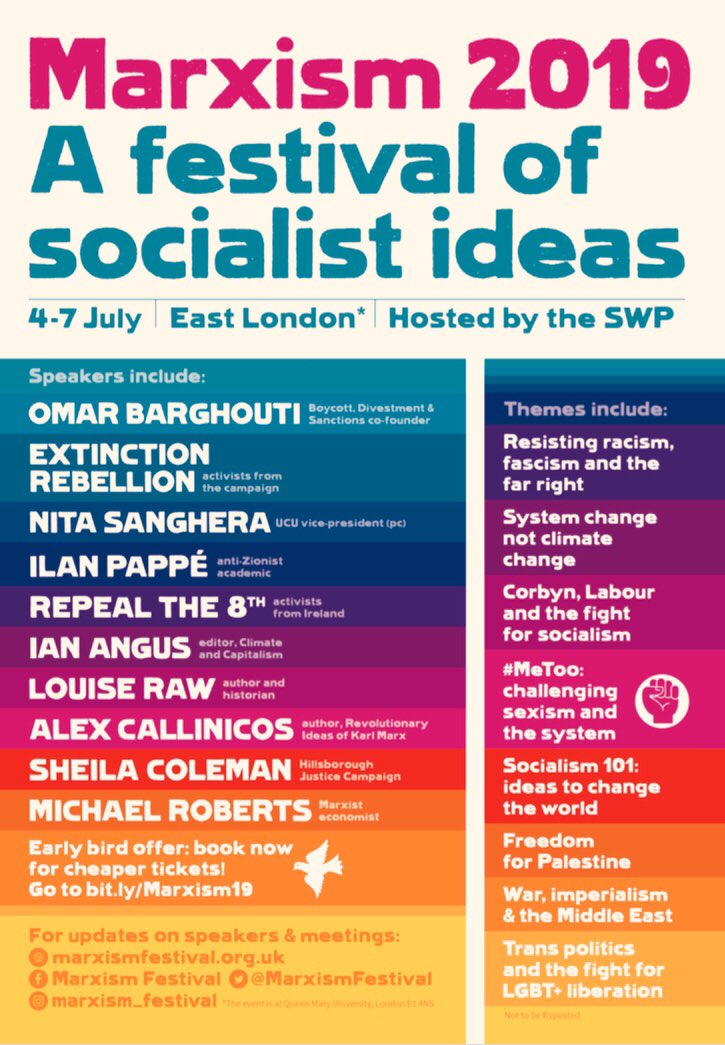
 Marxism 2019 - A festival of socialist ideas - 4-7 July, London 

 Capitalism is in crisis. Society is rapidly polarising between Left and Right. Marxism Festival 2019 is the place to debate how we can beat back the rise of racism, fascism & the far right. But thousands of people from around the world will also be discussing the alternative to the system that means chaos.

 Speakers include: Omar Barghouti • Extinction Rebellion • Ilan Pappé • Louise Raw • Ian Angus & more!

For more information and how to book see here

Labels: , , , , , , , ,

Friday, March 11, 2016

Refugees welcome here - Stand Up to Racism national demonstration


Refugees welcome here now! UN Anti-Racism Day national demonstration - Saturday 19 March - London, Glasgow, Cardiff

Labels: , , , , ,

Saturday, February 21, 2015

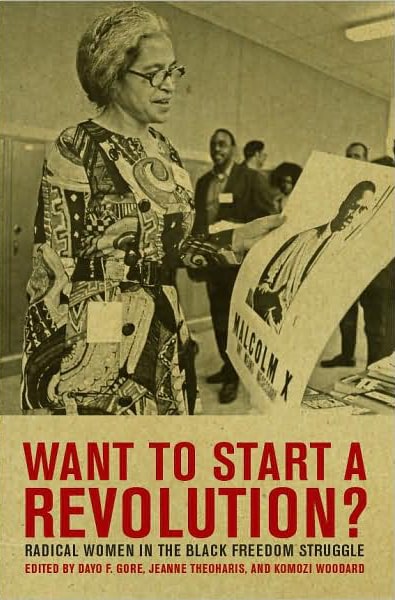
Remembering Malcolm X - Black Power, Anti-Capitalism and Revolution

Want to Start a Revolution?: Radical Women in the Black Freedom Struggle
Rosa Parks with a poster of Malcolm X

Malcolm X holding West Indian Gazette, Claudia Jones on cover 1964
Malcolm X paying tribute to Claudia Jones

'Anytime you live in a society supposedly based upon law and it doesn’t enforce its own laws because the color of a man’s skin happens to be wrong, then I say those people are justified to resort to any means necessary to bring about justice when the government can’t give them justice.’
Malcolm X at the Oxford Union

Malcolm X’s legacy on the 50th anniversary of his assassination is to recognise that the fight against racism must be a fight against the system that produces it. 
Anthony Hamilton on Malcolm's X's Road to Revolution 

See also Mike Davis on America's black shining prince, Lee Sustar on Malcolm's revolutionary politics, Brian Richardson on Manning Marable's biography of Malcolm X, Saladin Ambar on Malcolm X at the Oxford Union and Ken Olende and Avtar Singh Jouhl of the Indian Workers Association on when Malcolm X came to Smethwick just nine days before his assassination in February 1965.  For more on Malcolm X in Britain, see Marika Sherwood's study Malcolm X: Visits Abroad.

Labels: , , , , , ,

Friday, January 16, 2015

France: The Republic of Islamophobia

The persistent targeting of Muslims is preventing the effective management of diversity in French society. It is exacerbating tensions and obscuring the fundamental social and economic problems besetting France. It is encouraging the growth of the Front National. The only way to escape this vicious circle is to target and isolate the very real threat posed by the FN. The principal obstacle to this remains Islamophobia, in all its guises.
Jim Wolfreys, 'The Republic of Islamophobia', Critical Muslim, 13.

Edited to add: Tariq Ali on Charlie Hebdo, see also this and this - two good responses to an unconvincing attempt to defend the publication from the charge of racism.

Labels: , , , , ,

Tuesday, January 13, 2015

Resist the racist offensive against Muslims


As well as Hassan Mahamdallie on levels of Islamophobia before the horrific Paris attacks (in this month's Socialist Review), see this week's  Socialist Worker for the anti-racist arguments more necessary now than ever to challenge the rising racist backlash underway - while there is also some useful commentary on Charlie Hebdo itself here, here and for some essential historical background see Robert Fisk - while on a related point Jim House and Neil MacMaster's work, Paris 1961: Algerians, State Terror and Memory recovers some of hidden history of another Paris massacre - one which saw 200 Algerian protesters killed by the police in Paris.

Labels: , , , , , , , ,

Sunday, January 04, 2015

Conference - Unite against racism and fascism

9.30 – 4pm Saturday 21 Feb 2014, TUC Congress House, Great Russell St, London
Nearest tube: Tottenham Court Road
Speakers announced:
Diane Abbott MP,
Emily Thornberry MP,
Ken Livingstone,
Shahrar Ali Deputy Leader Green Party,
Lutfur Rahman, Mayor of Tower Hamlets
Dr. Shuja Shafi Secretary General MCB,
Billy Hayes General Secretary CWU,
Mark Serwotka General Secretary PCS
Sabby Dhalu and Weyman Bennett, Joint National Secretaries, Unite Against Fascism (UAF)
This year far right and fascist groups advanced across Europe. The whipping up of racism against immigrants, black communities, increased Islamophobia and Antisemitism has been its cutting edge. The racism of UKIP has been mainstreamed and looks set to worsen with major parties launching a war to outbid each other on attacking immigrant rights. The recent cuts to search and rescue operations for refugees in the Mediteranean epitomise how chilling this agenda has become. The revelations of spying on families of those murdered in racist attacks correlates with the injustice felt around the world following the deaths at the hands of the police of Mike Brown, Tamir Rice, Eric Garner and other black people in the US.
UAF played a leading role in electorally defeating Nick Griffin in his MEP seat this year but we cannot be complacent. The far right violent EDL continue to target the Muslim community and are mobilising around the country. This conference is a timely opportunity to discuss the way forward for challenging racism and fascism, bringing together the trade unions, faith and black communities, anti-racist and anti-fascist activists, LGBT representatives, students and young people for this major anti racist and anti fascist annual conference.
There will also be a workshop organised by Stand Up to UKIP at this conference, while see also the national Stand Up to Racism and Fascism demonstrations on UN Anti-Racism Day, Saturday 21 March  - in London, Cardiff and Glasgow.

Labels: , ,

Thursday, August 21, 2014

Hands Up! Don't Shoot! Justice for Michael Brown!

No more racist police killings!
Assemble: 5:30pm, Wednesday 27 August.
US Embassy, 24 Grosvenor Square, London W1A 2LQ

Called by: Stand Up to Racism.
Supported by: Unite Against Fascism, Love Music Hate Racism, Stand Up to UKIP, United Friends and Family Campaign, Justice Campaigns, Marcia Rigg, 

On Saturday 9 August, unarmed, black teenager, Michael Brown<á> was shot dead by police in Ferguson, Missouri.
People in the United States and around the world have rightly been outraged. Brown’s murder is the latest in a long line of killings by US police of black men. Five have been murdered in the past month alone. Protestors have taken to the streets of Ferguson, Missouri every night since the incident demanding justice for Michael and an end to police killings. The Police response to the demonstrations has harked back to the days prior to the Civil Rights Movement. They have used tear gas, dogs, automatic weapons and armoured cars on demonstrators. Michael’s murder highlights the deeply racist nature of US society today, however, deaths in police custody are not limited to America. As we have seen in the cases of Mark Duggan, Smiley Culture, Sean Rigg, and Christopher Alder to name but a few.

Show solidarity with the family of Michael Brown, and the Ferguson demonstrators.
Join the demonstration outside the US Embassy in London to demand an end to racist, police killings.
Assemble: 5:30pm, Wednesday 27 August. US Embassy, 24 Grosvenor Square, London W1A 2LQ

Also: Join us at Notting Hill Carnival to raise the issue of racist police killings! 11am - 2pm, Monday 25 August, Westbourne Park tube station (look for our Hands Up! Don’t Shoot! signs)

#JusticeforMikeBrown #Ferguson #DontShootLDN

www.standuptoracism.org.uk  @AntiRacismDay tel: 0208 9717 426

Judith Orr reports for Socialist Worker at Michael Brown's funeral 

Ferguson Movement website

Labels: , , ,

Saturday, January 18, 2014

League of Revolutionary Black Workers online

Material on the League of Revolutionary Black Workers at the Marxist Internet Archive - well worth checking out.

Labels: , , , ,

Monday, November 11, 2013

Reflections on HM conference 2013

Over the weekend I attended Historical Materialism conference in London, which was enjoyable enough (the chance to meet friends old and new, and pick up some of the latest Marxist literature - for example the new issue of Revolutionary History journal) but it was not - as ever - without its own internal contradictions. Back in 2008, five years ago, at the start of the economic crisis, I wrote a short piece on Histomat reflecting on that year's HM conference, noting it was an 'essentially academic Marxist affair'. It is this which largely explains its contradictory nature, for the latest academic fads and fashions as often clash with classical Marxist theory as add anything useful or valuable to it. Moreover, those latest academic fads and fashions are sometimes presented and discussed in a language which is so obtuse as to make it impossible for those without PhDs (and even many of those with PhDs) to understand. One can only have sympathy with Selma James, who noted after hearing three papers on the tensions between Marxism and postcolonial theory, 'I can understand Marx, but I have a problem understanding Marxists'.

 This will not be a full report of this years conference - I was only there over the weekend as I said, not the full four days - but I thought I may as well write up some brief impressions nonetheless. On the plus side, it was as big as ever (some 880 paid attendees apparently) and some of the sessions at HM one finds oneself in are genuinely stimulating and enlightening affairs, where - though often the time for discussion is necessarily limited - one has a chance to hear from those doing extremely important and worthwhile work both theoretically and practically. On the Sunday for example, I attended a session hosted by the Institute of Race Relations which included listening to a recording of a fascinating interview with the veteran anti-racist A Sivanandan as well as others from IRR talking about the dangerous and violent rise of racism and fascism across Europe, and the importance of for example, the Left standing in solidarity with, for example, the Roma people and their 'community of resistance'. This was then followed by an opportunity to hear Heide Gerstenberger, Robin Blackburn and Priyamvada Gopal on 'free labour and wage slavery', a great discussion which ranged from the meaning of freedom in both Marx's writings and in those ex-slaves in Jamaica who rose against British colonial dictatorship at Morant Bay in 1865.

 As well as such themes as 'race and capital' illustrated above, the overall theme of this years conference was 'the making of the world working class', given it was both the 75th anniversary of CLR James's classic history of the Haitian Revolution, The Black Jacobins as well as the fiftieth anniversary of EP Thompson's classic account of the revolutionary history of the resistance to capitalist industrialisation, The Making of the English Working Class. And many of the papers addressed themselves to thinking about either James, Thompson or the making and re-making of the international working class today. However - and here was for me perhaps the key contradiction about this years HM conference - the ideas about the centrality of the working class as the agency that will fundamentally change the world through the revolutionary overthrow of capitalism - ideas that were, more or less, at the heart of the intellectual project of both CLR James and EP Thompson themselves - have rarely been more unfashionable than they are currently, certainly among academics and to a large extent in the anti-capitalist movement at large. This is despite the fact that the Occupy movement's slogan about the 99% against the 1% spoke precisely to a wider popular feeling of class - of 'us' and 'them' - in society at large amidst austerity and welfare cuts.

The sheer unfashionable nature about thinking about class struggle in a classical Marxist sense in many academic and activist circles manifested itself at even HM conference - and came through strongly in the final plenary session, 'Labour, Race and Gender in the Making of the World Working Class', provoking almost an 'existential crisis' feeling about Marxism right at the end - which is surely a bit of an odd feeling for one to leave an ostensibly 'Marxist' conference with. This was not because of anything said by two of the three final plenary speakers. S'bu Zikode from the shack dwellers' social movement in South Africa talked movingly of the lost dream of Nelson Mandela amidst the brutality of post-apartheid neo-liberal capitalist South Africa - as he put it 'freedom has been privatised and we have a long way to go to get democracy'. The American labour historian David Roediger for his part built on WEB Du Bois's classic Black Reconstruction to give us a clear sense of the 'magnificent drama' involved in 'the self-emancipation of U.S. slaves' and how their victory gave confidence to and fed into other struggles for liberation among other oppressed groups in American society, above all women and their struggle for the vote.

The problematic nature of this years HM conference for me was epitomised by the paper of the third plenary speaker, Abbie Bakan, entitled 'When Class meets Race and Gender: Reflections on Method'. Given her years of activism as a revolutionary socialist and the fact she has written important works in the past on subjects ranging from class struggles in Jamaica to Marilyn Monroe, she was certainly an important enough figure to justify her place on the panel at the closing session of a conference like HM. I guess maybe in part I was just expecting too much from her. It was not so much anything she said in her main paper that was particularly that problematic, though she seemed to be saying that the traditional class analysis of Marxists needed revision as it was 'sociological' to focus on waged work. It was more what she did not say that was problematic. Indeed, the general thrust of her paper seemed to be arguing for 'inter-sectionality' and left one vaguely wondering how someone can speak at a Marxist conference for 20 minutes on the subject of race, class and gender and not at least quickly discuss how class for Marxists is related to exploitation, while race and gender are related to oppression - and therefore there is a material interest among the working class to unite collectively to resist that exploitation - and in the process of uniting there is a need for workers to link together in solidarity, to challenge the ideas of the ruling class that try to divide us according to oppression - racism, sexism, homophobia etc etc if they are going to be victorious. Bakan talked of how capital divides us along the lines of 'race, class and gender' without explaining how only the working class - because it is as Marx put it, a 'universal class' - has a clear interest in this division of our common humanity being overcome, and more importantly, because of its strategic location as the central creator of profits and wealth for the capitalist class, also happens to be a collective group in society with the collective power to bring the whole system to a stop. As Rosa Luxemburg famously put it, 'where the chains of capitalism are forged, there they must be broken'.

 Abbie Bakan's 'epistomologies of ignorance'

In the discussion, Bakan was challenged from many sides and many angles. One black guy noted that he kind of liked that Bakan had used the work of Jamaican scholar Charles Mills, but wondered why she needed to use his talk about 'epistomologies of ignorance' to discuss racism for example. It was a good point - as the guy seemed to be suggesting, Karl Marx had talked clearly and in language people could understand about how 'the ruling ideas of society are those of the ruling class' and that these ideas were necessarily therefore mythological, long before Mills's writing today. More critically, one SWP member challenged Bakan on her failure to identify class struggle as the key thing that can potentially unite all the oppressed groups into a common struggle through giving them a clear sense of their own power, and it was Bakan's response to this point that personally left me in a state of almost disbelief.

At this point, I should say that until earlier this year Abbie Bakan was for many years a leading member of the International Socialist Tendency, founded by Tony Cliff, of which as a member of the SWP I am also a member. I was aware that Bakan had already begun to move away from that tradition's ideas, particularly with respect to how that tradition understands the question of Marxism and women's liberation, so up to now I was not surprised by anything Bakan had said in her paper, though I thought she might have still alluded in some sense to how class was different from race and gender at least somewhere in the twenty minutes allotted to her. However, I was still shocked at how Bakan responded to criticism of her essentially inter-sectional analysis from a more classical Marxist perspective. I did not note down everything she said, so some of this is from memory - hopefully at some point if the debate was filmed a more accurate account of the debate may emerge - but these are some of the general points she made (do not take them as absolutely accurate quotes, but am trying to convey the general gist of Bakan's argument).

 1. 'I had been trained in a white, male, masculine, Eurocentric version of Marxism, and so as a woman I had to do additional reading and work to make sense of things'. 

 Now the idea that because Marx, Engels, Lenin and Trotsky were 'white', male and European intellectuals that Marxism is somehow incapable of explaining the oppression of women or people of colour is not a new one but a staple of feminist and black nationalist theory for decades. I think however Bakan here was trying to suggest that the particular tradition in which she was trained as a Marxist - the International Socialist tradition - trained her in a Eurocentric and masculinist reading of Marxism, which is a slightly new twist on an old familiar story. Of course before the rise of 'second wave feminism' in the 1970s, the IS tradition did not write a great deal on women's liberation, and no doubt women like Bakan had to do a lot of additional reading to catch up and engage with the new movement as Marxists in the 1970s. But isn't this what any and every Marxist has to do when faced with a new movement that emerges - or any new situation more generally - in order to relate to it effectively? Blaming the paucity of existing theorising on such a question is not a Marxist way of thinking - rather one has to return to the Marxist classics and try to apply them to make sense of a new situtation. This is surely what the likes of Abbie Bakan but also others, such as Lindsey German and of course Tony Cliff himself, did during the 1970s and afterwards as IS members in order to make sense of the relationship between 'sex, class and socialism', to quote Lindsey German's fine book on this question.

 2. 'I can't find anything about the struggle at the point of production in Marx himself'. Bakan noted that Marx had talked of production and the labour process in Capital, but seemed to be suggesting that nowhere did Marx stress the centrality of the class struggle at the point of production.

 3. 'The Communist International talked of political, social and economic resistance to capital' [ie. not about working class struggle]. Bakan here alluded to the work of John Riddell and his translations of the debates of the Communist International.

 4. 'I still dream of a government of workers' councils, but I have no prescription for how to get from here to there'.

 These three points can essentially be taken together - and nos. two and three of her argument certainly surprised even me. Karl Marx once said that 'the working class is revolutionary or it is nothing'. Marx meant that the working class was a revolutionary class. For Bakan, it seems that because the working class is not revolutionary now, it is therefore nothing now. Yet as Lenin noted, the Prussian Minister for Internal Affairs, Herr von Puttkammer, was right when he coined the famous phrase 'In every strike there lurks the hydra of revolution'. Now of course, strikes at the point of production are not the only way workers can be revolutionary or even just wage class struggle, but they are and remain the central way workers do this. No wonder if you move away from this that you can't connect how to move from the situation now - with a very low level of class struggle - with the future government of workers' councils every Marxist hopes for.

 As for Bakan's comment on the Communist International, I am still puzzled by what she meant here (clarification from anyone welcome), but needless to say it did not take ten seconds of a google search to find a quote like this, from a 'Resolution of the Second World Congress': ‘The Communist International decisively rejects the view that the proletariat can achieve its revolution without having an independent political party of its own. Every class struggle is a political struggle. The goal of this struggle, which is inevitably transformed into civil war, is the conquest of political power. Political power cannot be seized, organised and operated, except through a political party.’ Now maybe this is an old translation, and John Riddell's sterling work of translating Communist International documents mean this resolution actually did not talk of 'the proletariat' but 'the people', and not 'class struggle' but 'resistance', but somehow a tiny part of me  doubts it.

In conclusion, Abbie Bakan once wrote a nice little pamphlet about 'the great lie' that Stalinist Russia was a socialist country. She alluded in her talk to her learning from the IS tradition about how Russia was state capitalist, or as she put it, how 'capitalism comes in many forms'. Yet it seemed to me that Bakan was herself guilty of perpetuating a 'little lie' in her talk at HM conference in 2013 - namely that when she talked of the need to update our theoretical understanding about race and gender that she was concerned with a move from what she called 'analogue Marxism to digital Marxism'. Rather, it seemed to me she was engaged in a move away from classical Marxism towards something else (perhaps 'socialist feminism', though she did not use such a label to describe herself in her talk at HM). The audience at HM in the final plenary was noticeably quite young, and Bakan's talk went down well among a significant section of it. One speaker from the floor who was well received by the audience at HM was a young black guy who began by saying that 'he liked Marx, but did not call himself a Marxist'. Such a position given what he went on to say is actually quite honest and to be commended in a sense - and one can only feel that Bakan should face up to the logic of what she was arguing and admit the same, rather than maintain the pretence that she is somehow still a 'Marxist' when it is clear how far she has moved theoretically.

I do not mean to make this point as a personal attack on Bakan herself - if people want to move away from Marxism then that is their individual choice - though the fact that she has moved so far in less than a year after leaving the IS tendency does raise questions about whether she will even want to appear at a conference such as HM in future years. Yet that given she has moved so far already - and was still invited to address the final plenary at HM conference - does raise even more significant questions about HM itself, and those who organise it. At a time when class struggle is low it is not surprising that many Marxists like Bakan are looking around for short cuts to socialism that do not involve talking about the central and revolutionary role of the working class. Many in the final plenary talked of the disconnect between 'the Left' and various movements and struggles taking place. It is absolutely true that such a disconnect exists and the revolutionary Left is tiny internationally, way too tiny to significantly influence even great class struggles such as those taking place in Egypt and Greece. However, this problem will not be solved one iota - in fact it will be deepened and widened immeasurably - if Marxists, including the Marxists who organise HM conference, choose to fundamentally orientate themselves around what passes for political radicalism in academia instead of the needs, concerns and struggles of the working class.

Labels: , , , ,

Tuesday, August 06, 2013

Some Summer Reading for Revolutionaries

Though there are important looming strikes ahead, as well as protests such as that at Tory Party conference in Manchester on Sunday 29 September, and other events such as the Unite the Resistance conference in October on the horizon, August is a good time to catch up on some reading, and though I am aware that many revolutionaries are busy reading Lenin just now - including One Step Forward, Two Steps Back, I thought I would highlight a few other books that might be of interest to readers of Histomat.

First up, some black history (on which subject see this blog post for other suggestions on 'radical black reading')*. In the superb Quentin Tarantino film Django Unchained, Christoph Waltz's character - a German dentist turned bounty hunter called Dr. King Schultz challenges the Leonardo DiCaprio's slaveowner character Calvin Candie about the fate of one of his slaves, D'Artagnan while in Candie's private study: 

Candie: Are you brooding 'bout me getting the best of ya, huh?
Schultz: Actually, I was thinking of that poor devil you fed to the dogs today, D'Artagnan. And I was wondering what Dumas would make of all this.
Candie: Come again?
Schultz: Alexandre Dumas. He wrote The Three Musketeers. I figured you must be an admirer. You named your slave after his novel's lead character. If Alexandre Dumas had been there today, I wonder what he would have made of it?
Candie: You doubt he'd approve?
Schultz: Yes. His approval would be a dubious proposition at best.
Candie: Soft hearted Frenchy?
Schultz: Alexandre Dumas is black.

While it is always good to read the great Dumas himself, the author Tom Reiss has recently published a Putlizer prize winning book - The Black Count: Napoleon's Rival and the real Count of Monte Christo about General Alexandre Dumas, father of the famous novelist - and a heroic black general who was born in what became Haiti and rose to command revolutionary armies during the French Revolution and who inspired many of the stories of daring-do in Dumas's novels. The work has been widely reviewed - including here and here, but in short you will be hard put to find a more gripping page-turner of a biography relating to race and revolution this year. I really cannot recommend this book enough. 
 

On the subject of racism, I have already mentioned Brian Richardson's excellent edited collection Say it Loud! Marxism and the Fight Against Racism on my blog (it is also reviewed here), but another edited volume from Bookmarks also deserves attention, Capitalism and Sport: Politics, Protest, People and Play edited by Michael Lavalette.  Full of wide-ranging essays on all manner of sports, there really will be something for everyone here and the book is packed full of eye-opening facts from history that will come as a surprise to all but the most well-read socialist sports fan.


 I have been meaning to mention another edited volume Marxism and Social Movements, co-edited by Colin Barker, Laurence Cox, John Krinsky and Alf Gunvald Nilsen, which is at the moment a very expensive hardback with Brill only but next year will be appearing in a more affordable paperback with Haymarket.  Nonetheless, some of the contents of the collection are available online on one of the editors blogs here - worth checking out.  On the subject of Marxism and social movements, the meetings from Marxism 2013 are now online to either listen to  here while some are available to watch here.

Finally, I have just finally got around to reading The Great Gatsby which I thoroughly enjoyed (but have still to see the new film).  As F. Scott Fitzgerald  once commented to his daughter in a letter only days before his death in December 1940: “Sometime when you feel very brave and defiant and haven’t been invited to one particular college function, read the terrible chapter in [Marx’s] Das Kapital on ‘The Working Day,’ and see if you are ever quite the same.”  At a time of Tory austerity, where zero hour contracts afflict the lives of hundreds of thousands of workers, suggesting people read (or re-read) Marx himself seems as good a way as any to end this post. 

 
 * Edited to add: I forgot to mention Footprints, a collection of poems by the black Barbadian Communist Peter Blackman (1909-93), and edited by Chris Searle - whose introduction to the volume has been reprinted in the latest issue of Race and Class.  This is a very nice little collection by a forgotten activist - who clearly deserves to be remembered as a significant Caribbean poet.

Labels: , , , , , ,

Saturday, July 27, 2013

Debunking fascist myths # 94: Leon Trotsky and 'the invention of racism' myth

[I am grateful to Scott McLemee and his recent article on 'link rot' for alterting me to something called the Internet Archive Wayback machine, which can recover old internet links that have since rotted away once the original site becomes defunct.  Anyway, there used to be a decent enough blog - I am not sure who was behind it - called 'One Million United Against the [Nazi] BNP' - which carried a generally good mix of anti-fascist material, but in particular carried a useful section on the site debunking 'fascist myths'.  One such myth - that remains popular with racists and fascists internationally - see the recent post by Andrew Brons, the fascist MEP for Yorkshire and the Humber, here for example - is that 'Racism' was 'a word invented by Trotsky, in his 1930 work, The History of the Russian Revolution'.

The One Million United Blog once had a nice little short article on its site debunking this myth, but sadly this website is no more (presumably as the Nazi BNP itself became more or less a shadow of its former self thanks to relentless and tireless anti-fascist campaigning by groups such as Unite Against Fascism) and I - and everyone else on the anti-fascist left  it seems - failed to make a copy of this article at the time.  Anyway, the good news is that thanks to this 'Internet Archive' I can now reproduce the original article easily now on Histomat - with thanks to the anonymous original author, whoever he or she is - in the hope it will be useful / of interest to the wider anti-racist movement.  Trotsky himself of course was a pioneering analyst of the resistable rise of fascism in the interwar period, while for more on Trotsky's take on 'race' and racism, see here, and for more on Marxists and the fight against racism today - including discussion of how the roots of racism lie in the Atlantic slave trade and slavery, see the new book Say it loud ]

The 'Trotsky invented the concept of racism' myth [originally posted on the One Million United website]

The Myth

Nick Griffin [BNP leader]: No it’s because people like the BBC have demonised the word racist and have set about demonising us.
Gavin Esler: Demonised the word racist? There is somehow a good side to racism is there?
Nick Griffin: Ah, it’s a canned term. There’s no good side to racism. If you mean hating people, you’re doing it now. You’re not letting me explain for a start. Racism was a concept invented by Leon Trotsky, a Communist mass-murderer to demonise his opponents and stop people talking about certain issues.

Nick Griffin on BBC’s ‘Newsnight’ 25th May 2007.
on this video from 02:26 >
http://www.youtube.com/watch?v=tHRXGld0LkM

The Truth

The concept of scientific racial supremacy was invented by Gobineau before Trotsky was born. Trotsky used the term racism to describe it, but racism only became an epithet to describe racial prejudice after he died.

This is a very popular myth with neo-Nazis and other White Nationalists, who especially enjoy pointing out that Trotsky was born into a Jewish family. According to them a Judeo-Communist conspiracy is trying to destroy Western civilization and the white race, etc, etc, etc and invented that word to silence people… yawn. Funny that Nick Griffin should use a staple argument used by anti-Semites isn’t it? It can be found all over the Internet and Griffin was obviously defending his right to be racist by the looks of things. His argument, which is the general one, is that the concept of racism was invented by a Communist to stifle opposition and freedom of speech. But where did Trotsky use the word? There are two alleged sources, the first one is ‘What Is National Socialism?’, published on June 10th 1933.

“The theory of race, specially created, it seems, for some pretentious self-educated individual seeking a universal key to all the secrets of life, appears particularly melancholy in the light of the history of ideas. In order to create the religion of pure German blood, Hitler was obliged to borrow at second hand the ideas of racism from a Frenchman, Count Gobineau, a diplomat and a literary dilettante. Hitler found the political methodology ready-made in Italy, where Mussolini had borrowed largely from the Marxist theory of the class struggle. Marxism itself is the fruit of union among German philosophy, French history, and British economics. To investigate retrospectively the genealogy of ideas, even those most reactionary and muddleheaded, is to leave not a trace of racism standing.”

“On the plane of politics, racism is a vapid and bombastic variety of chauvinism in alliance with phrenology. As the ruined nobility sought solace in the gentility of its blood, so the pauperized petty bourgeoisie befuddles itself with fairy tales concerning the special superiorities of its race. Worthy of attention is the fact that the leaders of National Socialism are not native Germans but interlopers from Austria, like Hitler himself, from the former Baltic provinces of the Czar’s empire, like Rosenberg; and from colonial countries, like Hess, who is Hitler’s present alternate for the party leadership. A barbarous din of nationalisms on the frontiers of civilization was required in order to instill into its ‘leaders’ those ideas which later found response in the hearts of the most barbarous classes in Germany.”

“In the sphere of modern economy, international in its ties and anonymous in its methods, the principle of race seems unearthed from a medieval graveyard. The Nazis set out with concessions beforehand; the purity of race, which must be certified in the kingdom of the spirit by a passport must be demonstrated in the sphere of economy chiefly by efficiency. Under contemporary conditions this means competitive capacity. Through the back door, racism returns to economic liberalism, freed from political liberties.”
http://www.trotsky.org/archive/trotsky/germany/1933/330610.htm

The second reference is from The History of the Russian Revolution, written in 1930 and translated and published in 1932. In here the word ‘racism’ does not appear, but ‘racist’ does.

“Slavophilism, the messianism of backwardness, has based its philosophy upon the assumption that the Russian people and their church are democratic through and through, whereas official Russia is a German bureaucracy imposed upon them by Peter the Great. Mark remarked upon this theme: ‘In the same way the Teutonic jackasses blamed the despotism of Frederick the Second upon the French, as though backward slaves were not always in need of civilised slaves to train them.’ This brief comment completely finishes off not only the old philosophy of the Slavophiles, but also the latest revelations of the ‘Racists’.”
http://www.marxists.org/archive/trotsky/1930/hrr/ch01.htm

So what did Trotsky mean by racism and racist? In the first quotation Trotsky says, “In order to create the religion of pure German blood, Hitler was obliged to borrow at second hand the ideas of from a Frenchman, Count Gobineau”. Who was Gobineau and what were his ideas? Arthur de Gobineau (1816 – 1882) wrote a book entitled An Essay on the Inequality of the Human Races in which he proposes that the ‘white race’ is superior and that the Aryan branch of it in Northern Europe was the ‘Master Race’. He also believed race-mixing led to chaos. I bet you thought the Nazis invented all that didn’t you? Anyway, so Trotsky said Hitler created a ideology based on a pure German race and nicked ideas from Gobineau… err, well he did! Trotsky said the Nazis were practising an ideology based on race, which goes without saying is true. He was not trying to stop the Nazis talking about certain issues, he was criticising the concept of their race-based ideology. So if Griffin disagrees with Trotsky presumably he believes the Nazis didn’t have a racial ideology, or Trotsky was wrong to even mention it.

In the second quotation Trotsky says the Slavophiles believe Russians to be inherently democratic, an idea that he rubbishes. He says that also finishes off the claims of the racists. But again he is attacking the idea of racial differences not accusing the Slavophiles of saying racist things.
In both cases Trotsky is commenting on an existing ideology of racial superiority/difference, so he therefore did not invent the concept of racism. No more than the person who invented the word ‘cat’ was the inventor of cats!

Therefore what was the context was Trotsky using those words in, if he only is attacking the idea of inherent racial differences? In the 1930’s the word ‘racism’ meant according to the Oxford English Dictionary, “[t]he theory that distinctive human characteristics and abilities are determined by race”. Which sounds exactly like the way Trotsky was using it. No doubt that applies to his earlier usage of ‘racist’ too.

In fact in the 1930’s, also according to the OED, the word ‘racialism’ (dating from 1907) meant “belief in the superiority of a particular race; prejudice based on this”.

The current meaning of racism, that of prejudice, has only been attached to it since World War II. Prior to World War II it meant the difference between races. Conversely, ‘racialism’ no longer means racial superiority or prejudice. By the 1960’s it had been made redundant as ‘racism’ had replaced it, but William Du Bois redefined it to mean the belief that differences exist between human races. In other words what ‘racism’ meant before World War II when Trotsky was using the word in his writing. A complete reversal.

Therefore the current accusations of racism directed at the Far Right do not mean the same thing as racism did in Trotsky’s writings. The concept of racial superiority itself goes back before Trotsky was even born and he didn’t coin ‘racialism’, which meant in the 1930’s what ‘racism’ does today. Just as if Trotsky mentioned ‘gay’ in his writings he’d have meant happy or colourful, not a homosexual.
The International League against Racism and Anti-Semitism was founded as the The League Against Pogroms in 1927, later became the International League against Anti-Semitism and in 1932 it acquired its present name. Magnus Hirschfeld wrote his book Racism in 1933 (trans. into English in 1938) and is generally credited with inventing the word itself. As he was a gay Jew he isn’t too popular with the Far Right either. So there is doubt as to whether Trotsky did originate the word, but even if he did he was using it to describe something that no-one would dispute: that Nazi Germany had an ideology based on the racial differences between Germans and others.

Trotsky did not invent the concept of racism, it was Gobineau the grandfather of Nazi racial politics!

One last little thought: why would people like the BNP, who aren’t apparently racist, object to the very existence of the word? If they weren’t racist and neo-Nazis, why would they say the word has no legitimacy because a Communist invented it? If you did away with the words ‘racist’ and ‘racism’ that would significantly reduce the stigma of such behaviour. So why would the BNP want that if they aren’t racist? Presumably for the same reasons they want to abolish the Race Discrimination Act: they want to be able to be as racist as they like, with no legal or moral impediments.

Labels: , , , ,

Wednesday, June 26, 2013

Marxism 2013 - new meetings announced

From the Marxism 2013 office:

With revolt and resistance breaking out across the globe we are pleased to confirm these new meetings at Marxism 2013 (11-16 July, central London):

 ·'The Turkish Revolt' with Ron Margulies, from the DSIP socialist organisation in Istanbul. For his eyewitness accounts from Turkey go to here
· Alfredo Saad Filho on the recent explosions in Brazil
· 'How should socialists organise?' Panel debate with Gilbert Achcar, a founding signatory to Left Unity, Paul Le Blanc and Esme Choonara
 Plus ·Richard Boyd Barrett, Irish TD, People Before Profit will join Maria Stylou from Greece and Jesus Castillo from the Spanish State to discuss the 'Struggle against austerity in Europe'
  
New book out at Marxism 2013:

Say it loud! Marxism and the Fight against Racism
This important new book from Bookmarks will be launched at Marxism 2013 and could not be more timely. Twenty years on from the racist murder of Stephen Lawrence and yet more shocking revelations have been revealed. The disclosure that police spies attempted to smear the Lawrence family and discredit their campaign for justice raises many questions of police racism, corruption and the state. Hassan Mahamdallie covered the case for Socialist Worker at the time. He is one of the contributors to the new book and will be speaking at Marxism on 'A defining struggle: The Stephen Lawrence campaign 20 years on'. This is part of the Racism and Resistance course at Marxism 2013 which takes up the themes of the new book. These include:
- 'After Woolwich: How do we stop the BNP and EDL?' with Weyman Bennett
 · 'Where does racism come from?' with Ken Olende
 · 'From confrontation to compromise: Black politics in Britain today' with Brian Richardson
 · 'The Politics of Islamophobia' with Talat Ahmed

Bookmarks, the socialist bookshop, will be transferring their entire shop to Marxism for the full five days of the festival. They will be located in the Institute of Education. Make sure you get your copy of Say it loud! Marxism and the Fight against Racism there and check out all their other books - old and new!

Labels: , , , , ,

Wednesday, February 27, 2013

David Cameron - Tory slave driver

Mr Cameron, too, is revealed to have slave owners in his family background on his father's side. The compensation records show that General Sir James Duff, an army officer and MP for Banffshire in Scotland during the late 1700s, was Mr Cameron's first cousin six times removed. Sir James, who was the son of one of Mr Cameron's great-grand-uncle's, the second Earl of Fife, was awarded £4,101, equal to more than £3m today, to compensate him for the 202 slaves he forfeited on the Grange Sugar Estate in Jamaica. 

 Another illustrious political family that it appears still carries the name of a major slave owner is the Hogg dynasty, which includes the former cabinet minister Douglas Hogg. They are the descendants of Charles McGarel, a merchant who made a fortune from slave ownership. Between 1835 and 1837 he received £129,464, about £101m in today's terms, for the 2,489 slaves he owned. McGarel later went on to bring his younger brother-in-law Quintin Hogg into his hugely successful sugar firm, which still used indentured labour on plantations in British Guyana established under slavery. And it was Quintin's descendants that continued to keep the family name in the limelight, with both his son, Douglas McGarel Hogg, and his grandson, Quintin McGarel Hogg, becoming Lord Chancellor. 

Dr Draper said: "Seeing the names of the slave-owners repeated in 20th‑century family naming practices is a very stark reminder about where those families saw their origins being from. In this case I'm thinking about the Hogg family. To have two Lord Chancellors in Britain in the 20th century bearing the name of a slave-owner from British Guiana, who went penniless to British Guyana, came back a very wealthy man and contributed to the formation of this political dynasty, which incorporated his name into their children in recognition – it seems to me to be an illuminating story and a potent example." 

Mr Hogg refused to comment, saying he "didn't know anything about it". Mr Cameron declined to comment after a request was made to the No 10 press office.
Britain's colonial shame - see also this piece by historian Catherine Hall.

 Another reason then to detest Cameron - and a good time then for those fighting back against the Tories - whose workfare programme amounts to forced 'slave labour' for the poor - to remember figures from history such as Toussaint Louverture, leader of 'the only successful slave revolt in history'...


Edited to add: William Dalrymple on Cameron and the Amritsar massacre

Labels: , , , , , ,

Wednesday, January 23, 2013

Brian Kelly on the limitations of Spielberg's Lincoln

 Spielberg and Kushner marshal all the human and technical resources and cinematic expertise at Hollywood’s disposal in producing an elegantly rendered film.  Daniel Day-Lewis gives us an Abraham Lincoln that combines the wily, unaffected “plain folk” demeanour for which he was known and the intense brooding and deep pathos that marked his term in office. He is brilliantly supported by Sally Fields and Tommie Lee Jones in their roles as Mary Todd Lincoln and the Radical Republican tribune Thaddeus Stevens. Together the lowlight camerawork and precise attention to detail give the film a mid-nineteenth century, gas-lamp ambience, a sepia texture like glass-plate photographs. Some key scenes come off affected and overdone, but technically speaking Lincoln is a well-crafted and compelling film. 

It doesn’t do nearly as well, however, in offering viewers a nuanced portrait of the living Lincoln. This is a man who evolved under the pressure of events and the wider, revolutionary context from a middle-of-the-road lawyer and stump politician into his role as emancipator in a profound social upheaval. Against the current of much of the “new” history of emancipation—which acknowledges the centrality of slave self-activity to the war’s outcome—Spielberg’s Lincoln pushes slaves and northern free blacks to the very margins of the story, sailing close to an older and once dominant view of emancipation as an act of Yankee benevolence. In what amounts to a snapshot of high politics over a couple of weeks in late 1864 and 1865, the crucial relationship between the slaves’ desperate, persistent drive for freedom and the changing military conduct of the war is left on the cutting room floor...

Abraham Lincoln was a tentative revolutionary in a revolution aimed at consolidating bourgeois democracy in the face of an anti-democratic, slave owning ruling class willing to risk all for its survival. He was compelled by the force of events around him—and against his own inclinations—to lay his hand on the “thunderbolt of slavery” to win a desperate and otherwise unwinnable war.
However slow in coming round, ultimately Lincoln rose to the challenge, consummating the triumph of the American bourgeoisie over a regressive social order. But it was a triumph first conceived by slaves and their allies, and bought with the blood and sacrifice of hundreds of thousands of Union soldiers.

Read the full review here, and see also Kevin Anderson on Lincoln and Ken Olende on Tarantino's Django Unchained

Labels: , , , , ,

Wednesday, November 28, 2012

New Book: The Amistad Rebellion


THE AMISTAD REBELLION: An Atlantic Odyssey of Slavery and Freedom
By Marcus Rediker
ISBN: 9780670025046

On June 28, 1839, the Spanish slave schooner Amistad set sail from Havana on a routine delivery of human cargo. On a moonless night, after four days at sea, the captive Africans rose up, killed the captain, and seized control of the ship. They attempted to sail to a safe port, but were captured by the United States Navy and thrown into jail in Connecticut. Their legal battle for freedom eventually made its way to the Supreme Court, where their cause was argued by former President John Quincy Adams. In a landmark ruling, they were freed, and eventually returned to Africa. The rebellion became one of the best-known events in the history of American slavery, celebrated as a triumph of the legal system in films and books, all reflecting the elite perspective of the judges, politicians, and abolitionists involved in the case. In this powerful and highly original account, Marcus Rediker reclaims the rebellion for its true proponents: the African rebels who risked death to stake a claim for freedom.
Using newly discovered evidence, Rediker reframes the story to show how a small group of courageous men fought and won an epic battle against Spanish and American slaveholders and their governments. He reaches back to Africa to find the rebels’ roots, narrates their cataclysmic transatlantic journey, and unfolds a prison story of great drama and emotion. Featuring vividly drawn portraits of the Africans, their captors, and their abolitionist allies, he shows how the rebels captured the popular imagination and helped to inspire and build a movement that was part of a grand global struggle between slavery and freedom. The actions aboard the Amistad that July night and in the days and months that followed were pivotal events in American and Atlantic history, but not for the reasons we have always thought.
The successful Amistad rebellion changed the very nature of the struggle against slavery. As a handful of self-emancipated Africans steered their own course to freedom, they opened a way for millions to follow. This stunning book honors their achievement.

Labels: , , , , , ,

Monday, October 03, 2011

New Book: An Unfinished Revolution

NEW TITLE: AN UNFINISHED REVOLUTION: KARL MARX AND ABRAHAM LINCOLN
BY ROBIN BLACKBURN
OUT NOW

Karl Marx and Abraham Lincoln exchanged letters at the end of the Civil War. Although they were divided by far more than the Atlantic Ocean, they agreed on the cause of “free labor” and the urgent need to end slavery. In his introduction, Robin Blackburn argues that Lincoln’s response signaled the importance of the German American community and the role of the international communists in opposing European recognition of the Confederacy.

The ideals of communism, voiced through the International Working Men’s Association, attracted many thousands of supporters throughout the US, and helped spread the demand for an eight-hour day. Blackburn shows how the IWA in America—born out of the Civil War—sought to radicalize Lincoln’s unfinished revolution and to advance the rights of labor, uniting black and white, men and women, native and foreign-born. The International contributed to a profound critique of the capitalist robber barons who enriched themselves during and after the war, and it inspired an extraordinary series of strikes and class struggles in the postwar decades.

In addition to a range of key texts and letters by both Lincoln and Marx, this book includes articles from the radical New York-based journal WOODHULL AND CLAFLIN’S WEEKLY, an extract from Thomas Fortune’s classic work on racism BLACK AND WHITE, Frederick Engels on the progress of US labor in the 1880s, and Lucy Parson’s speech at the founding of the Industrial Workers of the World.

See also this EVENT:
October 12, 2011
Bishopsgate Institute

'Empire and Resistance': A special meeting with two leading socialist historians of imperialism, Robin Blackburn & Richard Gott

Socialist History Society Public Meeting, supported by the London Socialist Historians Group

For more information and to book: http://www.versobooks.com/events/201-empire-and-resistance-a-special-meeting-with-two-leading-socialist-historians-of-imperialism-robin-blackburn-amp-richard-gott

Labels: , , ,

Sunday, April 03, 2011

Mike Rosen on Interculturalism

With David Cameron's words on multiculturalism still reverberating round the gutters, now's a good time to take a second look at the word "culture".

The two main overlapping ways the word is used in everyday conversation are: (a) to cover artistic products we consume - plays, films, books, paintings and the like - and (b) to talk of "the way we do things in our everyday lives" - our kinship relations, what we eat, what kinds of dwellings, rituals, music, gestures we make and, significantly, what language(s), dialect(s) and accent(s) we speak with.

Underlying many discussions about the second usage is the notion that there is a "host" culture which is distinct, unified, ancient, virtuous and desirable and there are "other" cultures which at best are "interesting" or "lively" but should be made to "integrate" or be "assimilated".

As Marxists, we might reshape that and talk of a "dominant" or "hegemonic" culture and of "non-dominant" or "sub-cultures". Either way, this has its problems, because it presents cultures as if they are discrete, self-contained chunks. From the right, there has been an effort to claim some kind of pure English or British "way of life" or "set of values" which is "indigenous". Meanwhile, on our side, we quite rightly celebrate multicultural "diversity" and "minority cultures", claiming this as a form of cultural resistance. I think we have to go further and celebrate "interculturalism" - which is ultimately part of internationalism...

Read the rest of the article from this month's Socialist Review

Labels: , , , ,

Saturday, April 02, 2011

Homage to Manning Marable

'At Tuskegee [in 1976], I began to study the major works of Marxism. I gradually became convinced that racism by itself could not account for the oppressed conditions of black people in America and, for that matter, across the globe. Capitalism as an economic system was based on an unequal exchange between the owners of capital and those who worked for a wage. Capitalism as a social system fostered class stratification, extreme concentrations of wealth, and poverty and promoted race hatred as a means to divide workers. This basic analysis seemed to make sense, based on my own experiences growing up inside the United States, in the context of racial discrimination and social inequality. I came to Marxism not out of some abstract love for the white American working class, or out of faith in the power of the international proletariat, or out of respect for the models of Soviet and Chinese Communism, both of which I found equally problematic. I became a socialist because I believed in the struggles of black people, in their history and destiny, and because I believed that to eliminate racism and inequality decisively, a new democratic society would have to be constructed.'
Manning Marable, 'Introduction: Towards an Autobiography of the Politics of Race and Class', Speaking Truth to Power: Essays on Race, Resistance and Radicalism (1996)

Tragically, and at the age of only 60, the great black American Marxist intellectual Manning Marable (1950-2011), author of such pioneering works of black history such as How Capitalism Underdeveloped Black America and W.E.B. Du Bois: Black Radical Democrat, has died. This is a very sad loss - one gets a sense of the importance of his prolific writing and commentary on race and class in the US from his staff page at Columbia University, which lists his multiple works of scholarship and other accomplishments, and which culminated in his recent works Beyond Black and White: Transforming African-American Politics and a new biographical study of Malcolm X and The Malcolm X Project that he constructed online. To lose such a powerfully acute mind well before his time, and in a period when there are hopeful signs that the American working class is beginning to stir again, remains a terrible blow - my condolences to his friends and comrades. I will endeavour to add tributes and obituaries to this great thinker and activist whose many works will remain a tremendous resource of hope for the many struggles ahead.

Russell Rickford, A Eulogy for Manning Marable
Yuri Prasad on Manning Marable
Marable interviewed in the aftermath of Hurricane Katrina in 2005 by Kevin Ovenden
Manning Marable on Barack Obama
Marable interviewed in 2009 about Malcolm X

Labels: , , , , ,

Sunday, March 20, 2011

Regime Change Begins At Home

To come within the orbit of imperialist politics is to be debilitated by the stench, to be drowned in the morass of lies and hypocrisy...Now, as always, let us stand for independent organisation and independent action. We have to break our own chains. Who is the fool that expects our gaolers to break them?
CLR James, 1935

Sadly, there are one hell of a lot of such fools around at the moment, willing to suspend disbelief and hope against hope that a classic imperialist adventure in Libya can somehow bring liberation, even after the bloody criminal disasters of Iraq and Afghanistan. Those wars are now clearly to be consigned to the 'memory hole' as if they did not happen or are not still happening. It is as if a tidal wave of forced amnesia has swept over the British political elite and its allies in the corporate media. A Western intervention in the Middle East? Yes, fine, what could possibly go wrong? As the Guardian's Andrew Rawnsley - an ever loyal servant of power - observed of the House of Commons when David Cameron announced the UN was going to war:

After his Commons statement, Conservative MPs saluted their leader. Nick Clegg and Chris Huhne sat on the front bench, nodding approvingly. A Lib Dem member of the cabinet says proudly: "We have taken as forward a position as the Conservatives. We have argued the same way Paddy Ashdown did over Kosovo. To stand aside in this sort of situation would have been unconscionable." Iraq has left deep and still not entirely healed wounds in the Labour party. It would have been less risky for Ed Miliband and Douglas Alexander, the shadow foreign secretary, to sit on the sidelines. So they deserve some credit too for putting Labour on the right side when a fascistic dictator threatens slaughter on his own people. Mr Cameron will get a resounding endorsement for his position when MPs vote tomorrow.


The Guardian on Saturday reported just four out of 650 odd MPs supported the Stop the War Coalition's position on this. For all the talk about Gaddaffi as a 'fascistic dictator', it is almost as if we are the ones living in a totalitarian state - yet we are supposed to be the ones bringing 'democracy'. Moreoever, as Robert Fisk notes, 'there is a racist element in all this'.

The Middle East seems to produce these ravers [like Gaddaffi] – as opposed to Europe, which in the past 100 years has only produced Berlusconi, Mussolini, Stalin and the little chap who used to be a corporal in the 16th List Bavarian reserve infantry, but who went really crackers when he got elected in 1933 – but now we are cleaning up the Middle East again and can forget our own colonial past in this sandpit.


For Cameron, an old Etonion brought up on British imperial mythology and legend, this war is a classic means of trying to distract attention away from his failing and unpopular economic agenda of cuts and privatisation at home - in the finest traditions of Margaret Thatcher's 'Falkland's moment'. In trouble at home with lecturer's strikes and looming strikes over public sector pensions, facing a mass demonstration by trade unionists and students in London, what better timing for a war? And just like the British ruling class over a century ago predicted at the outbreak of the Boer War in South Africa that 'it would all be over by Christmas', so Cameron reassures us that this war will be speedy. Yet, just as the bloody Boer War was in reality about securing gold and diamond reserves - so this war is a classic imperialist adventure to do with securing Libya's oil.

The hapless Clegg's Liberal Democrats, in supporting the racist Tory warmonger Cameron, are following more than just the tradition of Paddy Ashdown - they are standing in the dishonourable traditions of the racist warmongering Liberal Lloyd George , who once noted in his diary in 1932 after an attempt by some in the League of Nations to outlaw aerial bombardment, that the British Empire 'reserves the right to bomb niggers'.

And as for Ed Miliband's parliamentary Labour Party - well, what does one expect now from such a party? Despite Ed Miliband's claims to have 'learnt lessons' from Iraq, it is now manifestly clear that he and his party have learnt next to nothing. The silence of the likes of Diane Abbott is thunderous - political power and patriotism before principle it seems is the order of the day. Even some ordinary Labour Party members who on any other day would proudly wave the red flag of socialism are now lining up under the likes of the Stars and Strikes and the Union Jack. So David Osler tells us that 'once in a while there is a more or less accidental coincidence between what the US wants to see happen in a country and the interests of working people that live there. Libya, here and now, is one of those times.'

History here goes out the window. Can he give us any previous examples of such halycon days when 'what the US wants to see happen in a country and the interests of working people that live there' coincided?

Instead Osler tells us that 'the stark fact is that without external support, the forces that have put their lives on the line in the current uprising against Gaddafi face certain defeat, and a reactionary regime will brutally and triumphantly consolidate its rule, perhaps bringing the revolution in North Africa and elsewhere in the Muslim world to a total halt.'

The 'certain defeat' of the Libyan Revolution was far from certain - Gaddaffi's forces would have found it almost impossible to take and hold a city like Benghazi - and would have faced guerrilla war across Libya even if they did - while it is not only Gaddaffi's regime but the US and its allies that have a material interest in 'bringing the revolution in North Africa and elsewhere in the Muslim world to a total halt'. As Tony Blair puts it, the Western ruling class 'cannot be a spectator to the Arab Revolutions' - what he means is that they have to get in there and stop this 'outbreak of democracy' spreading further across the region - which is why Blair is so proud of Cameron for embracing 'the principle of intervention'.

Socialists have to maintain our independence from such imperialist politics - soaked as they are in blood and oil - and stress instead that the No Fly Zone Is No Way to Free Libya - liberation and emancipation can only come from the mass actions of the oppressed and exploited themselves -as the Arab Revolutions in Tunisia and Egypt have so beautifully demonstrated up to now. For those of us in the West, Regime Change Begins At Home - and in Britain that process of transformation has to begin on March 26th - Turn Trafalgar Square into Tahrir Square!

Edited to add:
Richard Seymour: A Humanitarian Intervention?
Karl Sharro: 'The No-Fly Zone in Libya: Hijacking the Arab Uprisings'

Edited to add:
* Protest on Budget Day. This Wednesday March 23rd Stop the War and CND are participating in a protest outside Downing Street on budget day. We will be demanding David Cameron stops pouring money into yet another futile and destructive foreign war at a time when he is trying to force through the most drastic programme of spending cuts in generations. Welfare not Warfare - protest on Budget Day
Assemble 5pm Trafalgar Square and March to Downing Street.

* Come to the Public Rally - Hands off Libya, Hands off the Middle East. 7pm Wednesday March 30th.
Conway Hall, Red lion Square, London WC1
Speakers include Tony Benn, Lindsey German, Sami Ramadani, and Jeremy Corbyn MP.

Labels: , , , , , , ,

Sunday, March 06, 2011

Reasons to Hate the Daily Mail # 94: Hitler-worship

[With its notoriously right wing columnists - including now also Nick Cohen - aside, there are lots of well known reasons for democrats, radicals and socialists to despise the Daily Mail - a paper founded in 1896 as its founder Alfred Harmsworth (later Lord Northcliffe) stated to help foster 'the power, the supremacy and the greatness of the British Empire'. When Lord Northcliffe died in August, 1922, the Daily Mail 'newspaper' was taken over by Lord Rothermere, who in the 1930s famously gave support to Oswald Mosley and the British Union of Fascists - writing an infamous article, 'Hurrah for the Blackshirts', in January, 1934, in which he praised Mosley for his 'sound, commonsense, Conservative doctrine' - sort of a pre-runner to the Daily Star's recent love-in with the English Defence League. Yet less well known is Lord Rothermere's admiration for Adolf Hitler, who he met several times before his death in 1940 and described as 'a human being of great culture'. For a paper that is so obsessed with the personal lives of the rich and powerful it is odd that there was little on the Daily Mail's own website about this particular relationship - and so I thought I would bring it to wider attention here -hopefully to help cut the sales of the Daily Mail itself but also as it sheds light on the admiration shared by many in the British ruling class for Adolf Hitler and fascism more generally during the 1920s and 1930s - as well as Hitler's own admiration and respect for the white supremacy represented by the British Empire].


Lord Rothermere and Adolf Hitler - The Love That Dare Not Speak Its Name
Lord Rothermere and Adolf Hitler


Lord Rothermere used The Daily Mail to argue for Hitler's policies long before Hitler actually got to power - but abruptly withdrew his support in 1930. Later that year, Rothermere told Hitler that Jewish businessmen had withdrawn advertising from the newspaper and he had been forced to 'toe the line'. Hitler began to leave out anti-Semitic comments from his speeches during elections, but once in power Hitler began to express anti-Semitic ideas again.

In his 1939 book Warnings and Predictions, (only online on a pro-Nazi site so I won't link to it) Rothermere explained what he had first seen in Hitler:

When Herr Hitler took open power in the January of 1933, I realised that his psychology was very different from that of our own statesmen and very different from that of the men who had led the German republic. Here was a man whose life had been hard. In boyhood and youth he had been poor and thwarted. In early manhood he had been a serving soldier performing the most dangerous of front-line tasks, those of a battalion runner. He had been decorated for gallantry, had been wounded and gassed. In the years of later manhood he, with other ex-servicemen, had seen his country thrust down into the very mud of world disrepute. He had suffered from the ineptitude of those charged with the Government of his country. He had been affronted by the spectacle of members of an alien race flourishing in Germany and Austria while his own countrymen were in penury. He had attained power only by the use of force combined with a new application of rhetorical and propagandist powers.

With Hitler in power, Lord Rothermere publically declared his renewed support. Writing in The Daily Mail on 10th July, 1933, he praised Hitler's new regime which had stopped Germany 'rapidly falling under the control of its alien elements' - Jewish people - and urging 'all British young men and women to study closely the progress of the Nazi regime in Germany'. Adolf Hitler in a letter to Lord Rothermere on 7th December, 1933 relayed his thanks to Rothermere for 'the wise and beneficial public support' the Daily Mail had given him so far.

In his book, Lord Rothermere stressed that both himself and Hitler had a mutual hope for a deeper more meaningful relationship between not just themselves but between Britain and Nazi Germany. 'In an interchange of views about the possibility of Anglo-German friendship that I had with him [Hitler] not very long after his coming to power, he [Hitler] wrote:

"I have derived from fate the heavy task of giving back again to a great people and State by every means its natural honour. I see in this one of the most essential preparations for a real and lasting understanding, and I beg you, Lord Rothermere, never to regard my work from any other point of view. The feelings and views of Parliamentary demagogues are liable to rapid and unexpected changes. The world may, however, for what I care, reproach me with what it will. One reproach they certainly cannot level at me: that I have been vacillating in my views and unreliable in my work. If an unknown man with such weaknesses set out to win over a nation in fifteen years he would meet with no success. Herein resides, perhaps, the faith—exaggerated, as many believe—in my own personality. I believe, my dear Lord Rothermere, that in the end my unchanging standpoint, undeviating staunchness and my unalterable determination to render a historically great contribution to the restoration of a good and enduring understanding between both great Germanic peoples will be crowned with success. And believe me that this is the most decisive contribution to the pacification of the world. An Anglo-German understanding would form in Europe a force for peace and reason of 120,000,000 people of the highest type. The historically unique colonial ability and sea-power of England would be united to one of the greatest soldier-races of the world. Were this understanding extended by the joining-up of the American nation, then it would indeed be hard to see who in the world could disturb peace without wilfully and consciously neglecting the interests of the White race.'

However it was only in 1938 that the relationship advanced to a whole new level. In telegram to 'my dear Fuhrer' Adolf Hitler on 1st October, 1938, Lord Rothermere would declare:

My dear Fuhrer everyone in England is profoundly moved by the bloodless solution to the Czechoslovakian problem. People not so much concerned with territorial readjustment as with dread of another war with its accompanying bloodbath. Frederick the Great was a great popular figure. I salute your excellency's star which rises higher and higher.

As Lord Rothermere explains in his 1939 book about the changed mood in 1938:

'While I have always understood the British antipathy to the use of physical violence, I have equally understood the causes of its use in countries abroad of different circumstances from our own. I understand it there, just as I understand the causes of the violence shown to the rebels in India when the Sepoys were blown from the guns after the massacre of British women and children at Delhi. I deplore the use of concentration camps in Germany and Italy to-day, just as I deplored Kitchener's use of them in Africa at the beginning of the century, but in each case I have understood their evil necessity.

For this reason, and because I knew the man, I felt constrained, when Herr Hitler was being roundly abused by the English Left-wing Press, to tell the British public what I knew of him. In two issues of The Daily Mail in May 1938 I wrote of him what I now gladly put on more permanent record:

"Great numbers of people in England," I wrote, "regard Herr Hitler as an ogre, but I would like to tell them how I have found him. He exudes good-fellowship. He is simple, unaffected and obviously sincere. It is untrue that he habitually addresses private individuals as if they were public meetings.

"He is supremely intelligent. There are only two others I have known to whom I could apply this remark—Lord Northcliffe and Mr. Lloyd George. If you ask Herr Hitler a question, he makes an instant reply full of information and eminent good sense. There is no man living whose promise given in regard to something of real moment I would sooner take.

"He believes that Germany has a divine mission and that the German people are destined to save Europe from the designs of revolutionary Communism. He has a great sense of the sanctity of the family, to which Communism is antagonistic, and in Germany has stopped the publication of all indecent books, the production of suggestive plays and films, and has thoroughly cleaned up the moral life of the nation.

"Herr Hitler has a great liking for the English people. He regards the English and the Germans as being of one race. This liking he cherishes notwithstanding, as he says, that he has been sorely tried by malicious personal comments and cartoons in the English Press.

"I was talking with Herr Hitler some eighteen months ago when he said, 'Certain English circles in Europe speak of me as an adventurer. My reply is that adventurers made the British Empire.'"

To this I added some details of a conversation I had had with him about relative air strengths, and the following week, in response, as will be seen, to the interest my picture of the man had aroused, I wrote further:

"My remarks about Herr Hitler last week aroused a great deal of interest, apparently, among readers who hitherto have had to form their idea of him from newspaper comments and caricature.

"Herr Hitler is proud to call himself a man of the people, but, notwithstanding, the impression that has remained with me after every meeting with him is that of a great gentleman. He places a guest at his ease immediately. When you have been with him for five minutes, you feel that you have known him for a long time.

"His courtesy is beyond words, and men and women alike are captivated by his ready and disarming smile.

"He is a man of rare culture. His knowledge of music, painting and architecture is profound."

Many people seemed to find difficulty in reconciling the conception of a man of culture with a man of resolute action.

Why this should be so, I do not know. British 'Christian Generals' like Havelock and Gordon had the same mixture of traits. General John Nicholson, one of the heroes of the Indian Mutiny, was a man of great culture and personal piety, but he was relentless not only with the enemy but with his own colleagues if he esteemed them weak. Almost his dying words when he learnt that his successor in command was showing an unwise softness to the enemy were, "Thank God, I still have strength enough left to shoot him!"

...Whatever means the new regime in Germany found necessary to establish itself, it is undoubtedly true, as I wrote on May 20th 1938 in The Daily Mail that: "Herr Hitler's policy is achievement without bloodshed.''

Were I to make public some of the communications which I have had from Herr Hitler, in a correspondence bridging now several years, it would be apparent that one of his dearest hopes, cherished, as he himself has told me, long before his advent to power in Germany, is that Germany and Britain should stand side by side in amity.

One sentence I may quote, for it is in no way different from some of his public utterances. It is this: "Whatever may happen, I want to assure you at the conclusion of this letter that I firmly believe that a time will come in which England and Germany will be the solid pillars in a worried and unstable world."

On another occasion Herr Hitler said to me, "If to-day I stand for an Anglo-German understanding, this does not date from yesterday or the day before. During the last fifteen years I have spoken in Germany at least 4,000 to 5,000 times before small, large and immense mass audiences. There does not, however, exist a single speech of mine, nor a single line ever written by me, in which I have expressed myself contrary to this opinion against an Anglo-German understanding. On the contrary, I have during all this time fought for it by word and in writing."

Despite the necessity for subordinating nearly everything to the gigantic task of rearming his country, Herr Hitler has a reasoned, as well as a temperamental, aversion from war. Some six years ago he expressed to me the belief that a methodical, scientific examination of European history over the last three hundred years would show that nine-tenths of the blood-sacrifices of the battle-fields was shed entirely in vain—that is to say, in vain measured by the natural interests of the participating nations.

He made no exception in the case of Germany. On the contrary, he insisted that his people in those three hundred years had lost at least twenty to twenty-five million souls, probably even more, in wars which had been essentially profitless to the nation, measured not in terms of a questionable fame but of practical profit.

As I have said earlier, people have accused Herr Hitler of megalomania. That, of course, is always the charge levelled against a man who emerges from the ruck and takes and wields power. It was said of Caesar, it was said of Napoleon, it was said of Rhodes.

That Hitler has a great and even mystic faith in his destiny is true. It would be strange, in the light of his achievements, if he had not...

I know that when the Anglo-German Trade Agreement was reached, Herr Hitler's belief was that it might well pave the way to a wider and better understanding.

In one of his addresses to his own people, Herr Hitler declared that his true wish was to see Germany freed from the necessity of wrangling with her neighbours, that he might pursue his work of rebuilding the nation not only metaphorically but actually.

His plans for the replanning of the great German cities are very dear to his heart. It can never be for-gotten, when one enjoys his personal hospitality, that in the days of his extreme youth, and extreme poverty, his aspirations were purely artistic and architectural. Those aspirations were thwarted by circumstances, but the inner spirit which inspired them has not really changed.

He has in him something of the dual nature of our own General Wolfe, the conqueror of Canada, who, as all schoolboys know, said he would rather have written Grey's 'Elegy' than take Quebec. If ever, by the grace of God, Europe enters upon an era of dependable peace in his life-time, it is quite certain that he will show in sociology the same drive and vision that he has hitherto shown in international and internal politics.

This is a side of his character which is rarely shown to the British public by those who comment upon him. It is, probably, a side completely overlooked by our diplomats in their dealings with him.

In writing thus of Hitler, the man, I have no desire merely to 'glorify' him or to seem to condone some of the acts and measures which he has found necessary during the six years of his autocracy to bring his people from the slough of odium and distress to their old position as a great nation able to bargain on terms of equality with their neighbours. My only desire is to give a sound perspective to the portrait of him in British minds, and to show that the ogre is, as I wrote a year ago, a human being of great culture.


In early 1939 after Hitler invaded Czechoslovakia Rothermere wrote 'a very indiscreet letter to the Fuhrer congratulating him on his walk into Prague' and urged Hitler to follow up his coup with the invasion of Romania. In June 1939, with war clouds gathering, Lord Rothermere wrote to Hitler, 'My Dear Fuhrer', again - a final love letter as it were - before war and Lord Rothermere's death signalled the end of their relationship:


"My Dear Führer, I have watched with understanding and interest the progress of your great and superhuman work in regenerating your country...The British people, now like Germany strongly rearmed, regard the German people with admiration as valorous adversaries in the past, but I am sure that there is no problem between our two countries which cannot be settled by consultation and negotiation."

Labels: , , ,