Histomat: Adventures in Historical Materialism

'Historical materialism is the theory of the proletarian revolution.' Georg Lukács

Wednesday, February 27, 2013

David Cameron - Tory slave driver

Mr Cameron, too, is revealed to have slave owners in his family background on his father's side. The compensation records show that General Sir James Duff, an army officer and MP for Banffshire in Scotland during the late 1700s, was Mr Cameron's first cousin six times removed. Sir James, who was the son of one of Mr Cameron's great-grand-uncle's, the second Earl of Fife, was awarded £4,101, equal to more than £3m today, to compensate him for the 202 slaves he forfeited on the Grange Sugar Estate in Jamaica. 

 Another illustrious political family that it appears still carries the name of a major slave owner is the Hogg dynasty, which includes the former cabinet minister Douglas Hogg. They are the descendants of Charles McGarel, a merchant who made a fortune from slave ownership. Between 1835 and 1837 he received £129,464, about £101m in today's terms, for the 2,489 slaves he owned. McGarel later went on to bring his younger brother-in-law Quintin Hogg into his hugely successful sugar firm, which still used indentured labour on plantations in British Guyana established under slavery. And it was Quintin's descendants that continued to keep the family name in the limelight, with both his son, Douglas McGarel Hogg, and his grandson, Quintin McGarel Hogg, becoming Lord Chancellor. 

Dr Draper said: "Seeing the names of the slave-owners repeated in 20th‑century family naming practices is a very stark reminder about where those families saw their origins being from. In this case I'm thinking about the Hogg family. To have two Lord Chancellors in Britain in the 20th century bearing the name of a slave-owner from British Guiana, who went penniless to British Guyana, came back a very wealthy man and contributed to the formation of this political dynasty, which incorporated his name into their children in recognition – it seems to me to be an illuminating story and a potent example." 

Mr Hogg refused to comment, saying he "didn't know anything about it". Mr Cameron declined to comment after a request was made to the No 10 press office.
Britain's colonial shame - see also this piece by historian Catherine Hall.

 Another reason then to detest Cameron - and a good time then for those fighting back against the Tories - whose workfare programme amounts to forced 'slave labour' for the poor - to remember figures from history such as Toussaint Louverture, leader of 'the only successful slave revolt in history'...


Edited to add: William Dalrymple on Cameron and the Amritsar massacre

Labels: , , , , , ,

Wednesday, January 23, 2013

Brian Kelly on the limitations of Spielberg's Lincoln

 Spielberg and Kushner marshal all the human and technical resources and cinematic expertise at Hollywood’s disposal in producing an elegantly rendered film.  Daniel Day-Lewis gives us an Abraham Lincoln that combines the wily, unaffected “plain folk” demeanour for which he was known and the intense brooding and deep pathos that marked his term in office. He is brilliantly supported by Sally Fields and Tommie Lee Jones in their roles as Mary Todd Lincoln and the Radical Republican tribune Thaddeus Stevens. Together the lowlight camerawork and precise attention to detail give the film a mid-nineteenth century, gas-lamp ambience, a sepia texture like glass-plate photographs. Some key scenes come off affected and overdone, but technically speaking Lincoln is a well-crafted and compelling film. 

It doesn’t do nearly as well, however, in offering viewers a nuanced portrait of the living Lincoln. This is a man who evolved under the pressure of events and the wider, revolutionary context from a middle-of-the-road lawyer and stump politician into his role as emancipator in a profound social upheaval. Against the current of much of the “new” history of emancipation—which acknowledges the centrality of slave self-activity to the war’s outcome—Spielberg’s Lincoln pushes slaves and northern free blacks to the very margins of the story, sailing close to an older and once dominant view of emancipation as an act of Yankee benevolence. In what amounts to a snapshot of high politics over a couple of weeks in late 1864 and 1865, the crucial relationship between the slaves’ desperate, persistent drive for freedom and the changing military conduct of the war is left on the cutting room floor...

Abraham Lincoln was a tentative revolutionary in a revolution aimed at consolidating bourgeois democracy in the face of an anti-democratic, slave owning ruling class willing to risk all for its survival. He was compelled by the force of events around him—and against his own inclinations—to lay his hand on the “thunderbolt of slavery” to win a desperate and otherwise unwinnable war.
However slow in coming round, ultimately Lincoln rose to the challenge, consummating the triumph of the American bourgeoisie over a regressive social order. But it was a triumph first conceived by slaves and their allies, and bought with the blood and sacrifice of hundreds of thousands of Union soldiers.

Read the full review here, and see also Kevin Anderson on Lincoln and Ken Olende on Tarantino's Django Unchained

Labels: , , , , ,

Wednesday, November 28, 2012

New Book: The Amistad Rebellion


THE AMISTAD REBELLION: An Atlantic Odyssey of Slavery and Freedom
By Marcus Rediker
ISBN: 9780670025046

On June 28, 1839, the Spanish slave schooner Amistad set sail from Havana on a routine delivery of human cargo. On a moonless night, after four days at sea, the captive Africans rose up, killed the captain, and seized control of the ship. They attempted to sail to a safe port, but were captured by the United States Navy and thrown into jail in Connecticut. Their legal battle for freedom eventually made its way to the Supreme Court, where their cause was argued by former President John Quincy Adams. In a landmark ruling, they were freed, and eventually returned to Africa. The rebellion became one of the best-known events in the history of American slavery, celebrated as a triumph of the legal system in films and books, all reflecting the elite perspective of the judges, politicians, and abolitionists involved in the case. In this powerful and highly original account, Marcus Rediker reclaims the rebellion for its true proponents: the African rebels who risked death to stake a claim for freedom.
Using newly discovered evidence, Rediker reframes the story to show how a small group of courageous men fought and won an epic battle against Spanish and American slaveholders and their governments. He reaches back to Africa to find the rebels’ roots, narrates their cataclysmic transatlantic journey, and unfolds a prison story of great drama and emotion. Featuring vividly drawn portraits of the Africans, their captors, and their abolitionist allies, he shows how the rebels captured the popular imagination and helped to inspire and build a movement that was part of a grand global struggle between slavery and freedom. The actions aboard the Amistad that July night and in the days and months that followed were pivotal events in American and Atlantic history, but not for the reasons we have always thought.
The successful Amistad rebellion changed the very nature of the struggle against slavery. As a handful of self-emancipated Africans steered their own course to freedom, they opened a way for millions to follow. This stunning book honors their achievement.

Labels: , , , , , ,

Wednesday, October 03, 2012

Eugene Genovese (1930-2012)

From The New Republic

 It’s been a bad week for Marxist historians. Last Thursday, southern historian Eugene Genovese died; over the weekend, the British scholar Eric Hobsbawm passed away. The two men had strikingly different career arcs: Genovese famously moved from left to right, embracing conservative politics in his late years. Hobsbawm remained on the left. There was at least one point of convergence: In 1995, Genovese reviewed Hobsbawm’s sprawling history of the 20th century in TNR.

As Genovese noted at the end of his review of Hobsbawm's Age of Extremes,

Eric Hobsbawm is one of the few genuinely great historians of our century. He is also the one genuinely great historian to come out of the Anglo-American Marxist left. I admit to my prejudice. He has been the strongest influence on my own work as a historian, and in 1979 1 dedicated a book on black slave revolts to “Eric Hobsbawm: Our Main Man.” I have made a great many mistakes in my life,, but reading and rereading Hobsbawm’s powerful new book I am relieved to see that I got at least that much right.

Yet as Steven Hahn notes, with works like Roll, Jordan, Roll Genovese also takes his place in Marxist historiography, despite his later shift to the right. Hahn notes

the sheer power and inspiration of his teaching. With a few note cards in hand, Genovese delivered brilliant, wide-ranging lectures on early modern Europe (not his specialty), the transition from feudalism to capitalism, and the crisis of the 17th century while pacing back and forth in front of the room. He exuded confidence, erudition, and intense political commitment, and he sent a powerful message to those, like myself, who were desperately searching for socially and politically meaningful things to do: that intellectual work was immensely valuable to any movement for change; that the only politically useful scholarship was scholarship of the highest order; and that if we studied hard enough, read broadly enough, and thought deeply enough we would write the sort of history that made a difference. For me, nothing would be the same again.

Eugene Genovese’s scholarship made an enormous difference despite the challenges that he faced. As a self-proclaimed Marxist, he had to make his way through an unreceptive professional discipline – history – in a country still feeling the effects of McCarthyism, and he took on one of the central areas of historical interpretation, the coming and significance of the Civil War. What got him a hearing and then the notice of distinguished historians like C. Vann Woodward and David Potter was the breadth of his research, the clarity of his arguments, and the respect he paid to intellectual adversaries (sometimes more than they deserved). At a time when most scholars thought the debates over the Civil War had largely been resolved and a “consensus” interpretation reigned supreme, Genovese wrote of a fundamental, and revolutionary, battle between two different and increasingly antagonistic societies: a bourgeois North and a pre-capitalist South. In a series of immensely influential books – especially The Political Economy of Slavery (1965), and The World the Slaveholders Made (1969) – he insisted that slavery established the foundation of a radically different order in the southern states, limited the course of southern economic development, and gave rise to a pre-bourgeois ruling class that fashioned a distinctively reactionary world view. These were perspectives and concepts that had little familiarity among American historians, who tended to be cautious and hostile to social theory, but within relatively short order they were framing a new and energetic discussion about slavery, the South, and the Western Hemisphere. To this day, the fields of southern and United States history show the effects.

Yet no book of Genovese’s has had the impact of Roll, Jordan, Roll: The World the Slaves Made (1974). A long, complex, almost Hegelian treatment of the master-slave relation – and of the dynamics of power that were embedded within it – Roll, Jordan, Roll is a study of intense struggle, unfolding over decades, that enabled slaveholders to establish political and cultural hegemony but also enabled slaves to claim basic rights for themselves and room for their communities. At the book’s center is slave religion, at once a concession to the cultural authority of the masters and a celebration of the slaves’ solidarity, spirituality, and destiny--a measure of the contradictory character of the slave regime. Replete with comparative and international references, political allusions, and literary flourishes, Roll, Jordan, Roll may well be the finest work on slavery ever produced.

But it, along with the rest of Genovese’s early work, had serious critics, especially on the left. While acknowledging his analytical skills, many felt that Genovese was too admiring of the slaveholders’ power and too dismissive of the slaves’ rebelliousness; too interested in class and not sufficiently interested in race; too focused on the pre-capitalist features of southern society and the paternalist ethos of the masters; and too blind to the capitalist impulses of an intensely commodified world.

If we are remembering Genovese at his best, the last words might go to
Colin Barker who reviewed Genovese's collection of essays In Red and Black in 1973 for International Socialism:

This collection of essays by Professor Genovese is generally very fine. Genovese, author of The Political Economy of Slavery (1965) and The World the Slaveholders Made (1969), gives us here a set of writings characterised by its sensitive and undogmatic approach to Marxist analysis. Several essays take issue – sharply, and yet exactly from the vantage of fundamental solidarity – with some theoretical approaches of Black Power intellectuals. Genovese offers a spirited defence of the white Southern novelist William Styron’s Confessions of Nat Turner, which deals with an historical slave uprising, insisting that the Negro people cannot be free without an accurate understanding of their real past history, not some essentially mythical history in which every struggling Negro was automatically either an Uncle Tom or a saint of the revolution.   

Above all, every revolutionary movement needs the truth, not a romantic and sentimental account. Thus the exceptional essay, American Slaves and their History, explains at one and the same time – through a marvellously close and imaginative recreation of the social world of the plantation – why slave revolts were not widespread in the South and yet how in practice the Negro slaves did struggle, individually and collectively, against the slave-owners’ oppression and shaped the very world of the Southern gentry.  The book is also impressive in its principled assertion of the vital necessity of revolutionary socialist politics in America.

Edited to add: Read Scott McLemee
and Louis Proyect and Christopher Phelps

Labels: , , ,

Monday, October 03, 2011

New Book: An Unfinished Revolution

NEW TITLE: AN UNFINISHED REVOLUTION: KARL MARX AND ABRAHAM LINCOLN
BY ROBIN BLACKBURN
OUT NOW

Karl Marx and Abraham Lincoln exchanged letters at the end of the Civil War. Although they were divided by far more than the Atlantic Ocean, they agreed on the cause of “free labor” and the urgent need to end slavery. In his introduction, Robin Blackburn argues that Lincoln’s response signaled the importance of the German American community and the role of the international communists in opposing European recognition of the Confederacy.

The ideals of communism, voiced through the International Working Men’s Association, attracted many thousands of supporters throughout the US, and helped spread the demand for an eight-hour day. Blackburn shows how the IWA in America—born out of the Civil War—sought to radicalize Lincoln’s unfinished revolution and to advance the rights of labor, uniting black and white, men and women, native and foreign-born. The International contributed to a profound critique of the capitalist robber barons who enriched themselves during and after the war, and it inspired an extraordinary series of strikes and class struggles in the postwar decades.

In addition to a range of key texts and letters by both Lincoln and Marx, this book includes articles from the radical New York-based journal WOODHULL AND CLAFLIN’S WEEKLY, an extract from Thomas Fortune’s classic work on racism BLACK AND WHITE, Frederick Engels on the progress of US labor in the 1880s, and Lucy Parson’s speech at the founding of the Industrial Workers of the World.

See also this EVENT:
October 12, 2011
Bishopsgate Institute

'Empire and Resistance': A special meeting with two leading socialist historians of imperialism, Robin Blackburn & Richard Gott

Socialist History Society Public Meeting, supported by the London Socialist Historians Group

For more information and to book: http://www.versobooks.com/events/201-empire-and-resistance-a-special-meeting-with-two-leading-socialist-historians-of-imperialism-robin-blackburn-amp-richard-gott

Labels: , , ,

Wednesday, June 09, 2010

Selected Writings of George Rawick

A New Book from Charles H. Kerr Publishing Company

LISTENING TO REVOLT: SELECTED WRITINGS OF GEORGE RAWICK
Edited by David Roediger with Martin Smith
Charles H. Kerr | 194 pages | 2010
To order send $12.00 plus $2.00 shipping to:
Charles H. Kerr Publishing Company
1726 West Jarvis Avenue
Chicago, Il 60626

This volume offers the first major collection of the wide-ranging and revolutionary writings of the late George Rawick, a leading figure in both radical history and Marxist sociology. Personal assistant to C.L.R. James, comrade of Marty Glaberman and Selma James, and friend of C. Wright Mills and Michael Harrington, he influenced such leading scholars as Noel Ignatiev, Robin D.G. Kelley, Peter Linebaugh, Rosemary Feurer, Huw Beynon, Margaret Washington, Bruno Cartosio, Nando Fasce, Peter Rachleff and John Bracey and organizations like Students for a Democratic Society and the League of Revolutionary Black Workers. Rawick was a rarity who contributed decisively to African American history and to the study of white workers. His exciting scholarly and activist writings are generously represented here and put in context by David Roediger's extensive introductory essay on Rawick's life, thought, and politics.

"This is the best thing I have read on slavery in general and in particular in the United States. [It] will make history."
C.L.R. James on reading George Rawick's FROM SUNDOWN TO SUNUP

From the Afterwords:

"George Rawick could never accept the satisfied moralism of the Cold War dominant paradigms in social sciences. He moved from place to place. His many removals were part of his fight for freedom of speech and for intellectual honesty."
Ferruccio Gambino (University of Padua)

"Rawick was a white man who knew where he stood in respect to racism. Through his activism and his scholarship, he battled white supremacy, not solely out of sympathy for aggrieved others, but also because he wanted to respect himself."
George Lipsitz (University of California at Santa Barbara)

"He charged scholars to abandon the established academic tendency to dichotomize this proletariat as the regularized Sambo and marginally deviant Rebel; and to recognize these not as two different personality types, but rather as ambivalent, contradictory personalities struggling within the millions of subjectivities formed by radicalized and racist class society."
Enoch Page (University of Massachusetts)

CHARLES H. KERR SUBVERSIVE LITERATURE FOR THE WHOLE
FAMILY SINCE 1886

Labels: , , , ,

Monday, February 08, 2010

Pirates!

St. Augustine tells the story of a pirate captured by Alexander the Great, who asked him "how he dares molest the sea." "How dare you molest the whole world?" the pirate replied: "Because I do it with a little ship only, I am called a thief; you, doing it with a great navy, are called an Emperor."
Noam Chomsky, Pirates and Emperors (2002).

Those wanting to know what Marxist historians think about pirates should obviously consult Marcus Rediker's Villains of All Nations; Atlantic Pirates in the Golden Age and/or Peter Linebaugh and Marcus Rediker's The Many-Headed Hydra, but the new issue of darkmatter looks equally fascinating. I will reprint the editorial notes below:

Editorial Notes: Pirates and Piracy – Material Realities and Cultural Myths by Andrew Opitz

This special issue of darkmatter sets out to examine the complicated and often incongruous cultural meanings assigned to pirates and piracy in the twenty-first century. Debates about piracy have long featured certain telling contradictions. At different times, pirates have been seen as both violent monsters and colorful folk heroes. They have been cast by historians and cultural critics as both capitalist marauders and militant workers fighting for a restoration of the commons. How can we account for these seemingly incompatible visions? Of course, it is important to observe that pirates were hardly uniform in their social and political orientations. Some were greedy opportunists. Some were desperate sailors and slaves driven to mutiny. Others were somewhere in-between. We should also recognize that our understanding of piracy is powerfully shaped by our economic interests and our relationship with the law. The propertied targets of piratical theft are quick to view pirates as criminal actors outside the bounds of civilized behaviour, but the dispossessed are inclined to take a more nuanced approach that admires the defiance of the pirates at the same time as it fears their violence. It is also important to note that pirates now have a symbolic importance that transcends the basic material conditions behind their banditry. Our enduring cultural fascination with pirates is tied to their status as celebrated figures of rebellion and nonconformity in popular novels and films. Although the actual history of maritime robbery is sordid and contradictory, the pirate has become a compelling symbol of freedom: freedom from oppressive work routines; freedom from polite behaviour; freedom from institutional controls; freedom from restrictive property laws; freedom from unjust social conventions surrounding race and gender roles. We now apply the pirate label to an assortment of activities – from the formation of transgressive sexual identities to the technology-assisted defiance of copyright law – that have little or nothing to do with the sea or those who “go down to it in ships.” The articles assembled in this special issue take a broad approach to the study of pirates and piracy, examining diverse subjects ranging from the working-class politics of transatlantic piracy in the eighteenth century to the actions of Nigerian media pirates in the twenty-first century and recent debates about Somali pirates within East African immigrant communities in North America. The authors who contributed to this special issue of darkmatter have approached the cultural politics of pirates and piracy from different angles. They are historians, literary critics, legal scholars and media/cultural theorists. However, their scholarship is linked by the shared understanding that modern piracy, like the modern world itself, is inextricably bound to the history of colonial and neocolonial relations of production and the legacy of racial and class conflict that they produced – a history that forged the global capitalist order that continues to shape our everyday relationships with other people. Pirates are often dismissed in the media as exotic anachronisms – colorful characters out of step with present realities. But the forces that produced and continue to produce pirates – global shipping, the extraction of resources from colonial and neocolonial holdings, the mobilization and control of labor in the service of investment capital – still drive our world today. Studying pirates and their ongoing cultural resonance is hardly a frivolous activity. It is necessary for a true understanding of the socially uneven, violent and unstable world in which we live – a world that is still very much at sea.
Andrew Opitz
Guest Editor

Labels: , ,

Tuesday, January 15, 2008

Book Review: The Slave Ship by Marcus Rediker


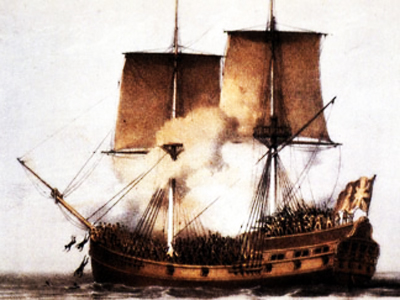
A revolt on a slave ship in 1787

In what amounts to a pioneering and path-breaking work, in The Slave Ship: A Human History Marcus Rediker reminds us of what he calls 'the darker and more violent side' of the history of Atlantic slavery, noting that with their 'abstract, indeed bloodless statistics...even the best histories of the slave trade and slavery have tended to minimise, one might even say sanitise, the violence and terror that lay at the heart of their subjects.' Not that Rediker passes over the bloody facts of the matter, but he contextualises them within the rise of the capitalist system from its breakthrough in Western Europe to global hegemony.

The slave trade lasted almost four hundred years, from the late fifteenth century to the late nineteenth century, and saw over 12 million souls transported across the Atlantic ocean in the greatest forced migration history has ever seen. Almost two million never survived the six to ten week long Middle Passage, whether dying from the ever present danger of deadly disease or from causes man-made, their bodies cast into the sea for the trailing sharks. If one attempts to calculate the initial costs of capturing and enslaving Africans in Africa, and then add the numbers who perished within the first year of work in the New World of the Americas, then some idea of the full horror becomes apparent. 'From stage to stage - expropriation in Africa, the Middle Passage, initial exploitation in America - roughly 5 million men, women and children died. Another way to look at the loss of life would be to say that an estimated 14 million people were enslaved to produce a "yield" of 9 million longer-surviving enslaved Atlantic workers'.

As Rediker notes though, there is a 'violence of abstraction' that has plagued the study of the slave trade and slavery in general. 'Numbers can occulate the pervasive torture and terror, but European, African, and American societies still live with their consequences, the multiple legacies of race, class, and slavery. The slaver is a ghost ship sailing on the edges of modern consciousness'.

Rediker's achievement is to resurrect this ghost ship, to bring back the dead as real living people with names and faces, and to try and let us listen as far as humanly possible to the voices of the voiceless. There is abundant scholarship on the slave trade, but the view from the slave ship itself, Rediker notes, remains 'in many ways unknown'. He describes for example the 'shock and awe' experienced by many Africans on seeing the European slave ships, bristling with cannon, for the first time. How did they sail? Did magical spirits make them start and stop? As the young eleven year old Olaudah Equiano was taken on board a ship with his enslaved fellow Africans, he felt astonished and terrified at the savagery on display by the 'white men', the motley crew of mainly European sailors. What did they want from him? Only a child, he feared cannabalism and being eaten alive, but some older slaves on board offered him comfort and 'gave me to understand we were to be carried to these white people's country to work for them'. Equiano of course was to have an extraordinary life, and grew up to become an abolitionist and author of the 'most influential literary work of the abolitionist movement from an African perspective'.

Rediker is at his strongest in describing how the slave ship and its crew changed through each leg of its journey, looking from the point of view of the increasingly tyrannical ship's captain, the motley crew of mariners, and the rebellious multitude of the enslaved. At first it looked a thing of beauty when constructed, then the slaver became a 'vast machine' from the point of view of its working crew, then a 'floating dungeon' housing a 'macabre chamber of horrors' from the point of view of both the sailors and the enslaved during the Middle Passage. In the process, racial thinking and ideas emerges, and 'race' is made and remade as the ship sails its course. The systematic terror and violence that it was necessary to deploy on board by the captain and crew against the enslaved in order to prevent the ever present danger of insurrection is also an overriding theme. The captives outnumbered the crew ten to one, and an estimated one in ten voyages saw an uprising. Rediker carefully describes the complicated 'deep dialectic of discipline and resistance' on board the slaves ships, from individual attempts to resist to mass collective acts of explosive opposition.

Explosive is the right word - sometimes the slaves succeeded in blowing up the whole ship with gunpowder - and an estimated total of 100,000 people died in insurrections in the history of the slave trade - with an average of 25 people killed in each attempted rising. Most uprisings failed - the whole slave ship was built as a prison in order to precisely stop them even getting off the ground, and there was a stash of weapons and torture equipment on board to punish and humiliate. To rise up, the unarmed enslaved had to first free themselves from their iron manacles and shackles, then escape from their dungeon below deck, and then try to take control of the ship by force against a crew armed with cutlasses and blunderbusses, often protected by a barricado especially constructed on the upper deck for just such an eventuality. If they did all that, they would then need to work out how to sail the ship itself. The vast majority of insurrections inevitably failed, and then the punishment meted out against the organisers of the rebellion was brutal and sadistic - as all counter-revolutionary violence tends to be. John Newton, a slave captain who later in life was to commit himself to the cause of abolition, once wrote in a private letter describing what he witnessed on board the Brownlow during its voyage of 1748-9. After a failed insurrection, the good Christian captain, Richard Jackson, sentenced the rebellious slaves to death. The first group:

'He jointed; that is, he cut off, with an axe, first their feet, then their legs below the knee, then their thighs; in like manner their hands, then their arms below the elbow, and then their shoulders, till their bodies remained only like the trunk of a tree when all their branches are lopped away; and lastly, their heads. And, as he proceeded in his operation he threw the reeking members and heads in the midst of the bulk of the trembling slaves, who were chained upon the main-deck.'

The second group of rebellious slaves:

'He tied round the upper parts of the heads...a soft, platted rope, which the sailors call a point, so loosely as to admit a short lever: by continuing to turn the lever, he drew the point more and more tight, till at length he forced their eyes to stand out of their heads; and when he had satiated himself with their torments, he cut their heads off.'

As Newton noted, 'a savageness of spirit, not easily conceived, infuses itself...into those who exercise power on board an African slave ship, from the captain downwards...it is the spirit of the trade'. Why such murderous barbarity? In part it was necessary to counter this enslaved African resistance, what Thomas Clarkson called those moments of 'the brightest Heroism [that] happen in the Holds or on the Decks of the slave vessels'. The economic costs of slave resistance were high - and resistance 'significantly reduced the shipments of slaves' to America by an estimated one million over the full history of the slave trade.

By the end of the 1780s, as Rediker notes, abolitionists were able to use the powerful image of the slave ship, built up by the likes of Thomas Clarkson, to demonstrate 'that the vessel that had carried millions of Africans into slavery also carried something else: the seeds of its own destruction'.

What made such a cruel barbaric system last so long? Well, the plantations of the Americas were able to devour the labour of Africans because there were huge profits to be made by merchant capitalists. In 1807 alone, one year, Britain imported for domestic consumption 297.9 million pounds of sugar, 3.77 million galleons of rum, 16.4 million pounds of tobacco and 72.74 million pounds of cotton, almost all of it produced by enslaved labour. The slave ship 'was a concentration of capital, and it was the bearer of capitalist assumptions and practices about the world and the way it ought to be.' As Rediker noted in a recent interview:

We sometimes think of slavery as being pre-capitalist or non-capitalist, and that capitalism only really begins with free waged labour, but I think that blinds us to a lot of very important processes.

People were expropriated in one setting and then moved to a more market-orientated setting where their labour was exploited through usually quite violent means. In that way the slave trade is emblematic of a larger process that is happening to workers everywhere.

All these enslaved Africans were moved to the western Atlantic plantation system and their lives would be consumed by producing sugar, tobacco and rice for the world market. I like to paraphrase the great Guyanese scholar and activist Walter Rodney who said that in the slave trade capitalism paraded without even a loincloth to cover its nakedness.


Today, when the great imperial powers are again using all kind of sophistry in order to try and re-colonise Africa, a historical understanding of the utterly barbaric methods by which European merchant capital under-developed Africa through the slave trade could not be more necessary. There could be few better introductions than Rediker's vivid and panoramic history, which surely deserves to become the classic account of life and death on the slave ships.

Labels: , , , , ,

Wednesday, November 21, 2007

Black Jacobins Conference


The banner of the Haitian revolutionary armies in 1803

In autumn 1938, the late great Trinidadian Marxist historian Cyril Lionel Robert James (1901-1989) published his magnum opus The Black Jacobins - which has become the classic history of the Haitian Revolution of 1791-1804, and stands as one of the great works of revolutionary history. As James wrote in his preface:

The revolt is the only successful slave revolt in history, and the odds it had to overcome is evidence of the magnitude of the interests that were involved. The transformation of slaves, trembling in hundreds before a single white man, into a people able to organise themselves and defeat the most powerful European nations of their day, is one of the great epics of revolutionary struggle and achievement. Why and how this happened is the theme of this book.

The Haitian revolt was not just of local relevance to the Caribbean - it was one of the great world-historical revolutions, and indeed it was intrinsically intertwined with the Great French Revolution. Not only did the revolt lead to the establishment of the world’s first independent black republic outside of Africa but it was central to the destruction of the entire Atlantic slave trade. The heroic enslaved black Africans - led by Toussaint Louverture - were central to the revolt and the people of Haiti have never been forgiven by the great imperialist powers for their part in the dismantling of this highly profitable enterprise - the fact that Haiti today is one of the world's poorest places on earth gives you some idea of the revenge that has been taken since then. All the more reason then to remember this great anti-imperialist liberation struggle and, to mark the seventieth anniversary of the publication of James's epic work, on 2 February 2008, the London Socialist Historians Group have organised a conference to try and do just that. The provisional programme is here, and keynote speakers include Darcus Howe, Selma James, Bill Schwarz, Marika Sherwood and Weyman Bennett. Highly recommended.

Labels: , , , , ,

Tuesday, October 09, 2007

Marcus Rediker Speaks


Marcus Rediker, who not only has to be one of the coolest socialist historians in the world but also has one of the coolest websites in the world full stop, is on tour speaking in the US and the UK, speaking about his new book on slave ships. This tour includes London on November 6th, where he will give a paper on 'The Slave Ship and the Memory of Terror'. Highly recommended.

Edited to add: Duncan Hallas's review of Rediker's first book Between the Devil and the Deep Blue Sea

Labels: , , ,

Thursday, August 23, 2007

William Wilberforce on Africans

Today being the International Day for the Remembrance of the Slave Trade and its Abolition, I thought I ought to really put up a quote from William Wilberforce about enslaved Africans to mark the occasion. The quote I found, for some reason, has not recieved a great deal of attention so far during the official British bicentennary commemoration of the abolition of the slave trade, but I found it to be quite enlightening when it comes to how we might want to remember Wilberforce. As Marika Sherwood notes of Wilberforce in After Abolition:

'He held racist views, for example believing that "negroes' minds are uninformed and their moral characters are debased...their notions of morality extremely rude," while African kings had two great vices, "personal avarice and sensuality."'

Labels: , , , , ,

Tuesday, April 24, 2007

On abolition

Lenin's Tomb has a link to film footage of Paul Gilroy and Weyman Bennett speaking last week in Friends Meeting House, London at a SWP rally to mark the 200th anniversary of the official abolition of the slave trade by Britain.

Labels: , , , ,

Sunday, March 25, 2007

Of apologists and apologies


A slave ship - today marks the 200th anniversary of the British abolition of the slave trade

The British intellectual James Boswell, (1740-1795) when remembered at all, is best known for being the biographer of Samuel Johnson, who was inventor of the Dictionary among other things. Indeed, Boswell's 1791 Life of Samuel Johnson is regarded by some as the best biography ever written. Less well known about - indeed there is currently no mention of it whatsoever on his Wikipedia entry (something that I may well get round to fixing at some point) is his defence of the barbaric Atlantic slave trade and slavery. Indeed, in 1791, the same year as his celebrated biography of Johnson came out, he wrote a poem entitled 'No abolition of slavery, or the universal empire of love'. Ostensibly a love poem, its first lines are:

Most pleasing of thy sex,
Born to delight and never vex;
Whose kindness gently can controul
My wayward turbulence of soul.


Yet what follows is really a rant at those abolitionists trying to end the barbarism of the slave trade, as the title suggested. Other passages note:

Let COURTENAY sneer, and gibe, and hack,
We know Ham's sons are always black;
On sceptick themes he wildly raves,
Yet Africk's sons were always slaves;


And:

But should our Wrongheads have their will,
Should Parliament approve their bill,
Pernicious as th' effect would be,
T' abolish negro slavery,
Such partial freedom would be vain,
Since Love's strong empire must remain.


A poem that is ostensibly about the 'empire of love' turns out to be actually about a love of empire. It ends:

My charming friend! it is full time
To close this argument in rhime;
The rhapsody must now be ended,
My proposition I've defended;
For, Slavery there must ever be,
While we have Mistresses like thee!


It is not known whether the one for whom this 'love poem' was intended was impressed by such racist doggerel, but in any case in his Life of Johnson Boswell spelled out his argument in more depth:

'The wild and dangerous attempt which has for some time been persisted in order to obtain an act of our legislature, to abolish so very important and necessary branch of commercial interest, must have been crushed at once, had not the insignificance of the zealots who vainly took the lead in it, made the vast body of Planters, Merchants, and others, whose immense properties are involved in that trade, reasonably enough suppose that there could be no danger. The encouragement which the attempt has received excites my wonder and indignation; and though some men of superior abilities have supported it, whether from a love of temporary popularity, when prosperous; or a love of general mischief, when desperate, my opinion is unshaken. To abolish a status which in all ages GOD has sanctioned, and man has continued, would not only be robbery to an innumerable class of our fellow-subjects; but it would be extreme cruelty to the African Savages, a portion of whom it saves from massacre, or intolerable bondage in their own country, and introduces into a much happier state of life; especially now when their passage to the West Indies and their treatment there is humanely regulated. To abolish that trade would be to shut the gates of mercy on mankind.'

Today, such past apologetics for the slave trade and slavery are quietly hushed up - the complicity of the whole British ruling class in the affair - the worst crime in British history - is distinctly embarrassing. 'Stop apologising!' screams the Tory commentator Simon Jenkins, describing how he 'cheered when a descendent of the Bristol slaver, Pinney, refused to apologise for the deeds of his forefathers'. What conservatives of all stripes want us to do is forget the whole affair - they know above all that 'Great' Britain, or their green and pleasant land of England, might be tarnished or complicated by such unpleasant and brutal realities. Nationalism is an ideology which has to be constantly produced and reproduced to survive - it depends on myths, on the ideal of national unity - despite that fact that nations are always imagined communities designed to help our rulers shore up hierachical divisions of race, class and power.

Yet we have plenty of modern equivalents of Boswell today, opportunist intellectuals prepared to prostrate themselves before the rich and powerful, even if it means defending the indefensible in the process. In 2003, the Blairite warmonger Denis Macshane argued that 'It is time for the elected and community leaders of the British Muslims to make a choice – the British way, based on political dialogue and non-violent protests, or the way of the terrorists, against which the whole democratic world is uniting.'

The reason why we should remember the horrors of colonial slavery and the barbarism of the slave trade it seems to me - and the reason why the heads of states, and heads of institutions and corporations who profited hugely from the trade should be made to apologise - is precisely because without such collective memories the most pernicious and racist ideals of nationalism can take hold and spread, encouraged by New Labour scum like Macshane. 'The British way' as experienced by millions of Africans and people of African descent for generations was not one of 'dialogue', 'democracy' and 'non-violence' but one of suffering under regimes of state terror. The British Empire was one of the greatest instruments of tyranny and oppression ever - and it was an historic victory for democracy when it was finally brought down. Those who resisted this Empire were demonised as 'terrorists' - and I am sure had Macshane been around in 1819 to hear the son of a Jamaican slave, Robert Wedderburn defend the moral right of slaves to murder their masters to cheers from a British working class audience, he would have defended those who sent Wedderburn to jail for sedition in 1820. Had Macshane witnessed another Jamaican son of a slave, William Davidson, help organise the Cato Street Conspiracy to try to put Wedderburn's ideas into practice, he would have been to the fore in cheering him, along with the countless unknown other slaves who rebelled against slavery, to the gallows to be hung.

Davidson's speech in court was superb, and his words ring down the ages to us today with all their power:

'It is an ancient custom to resist tyranny... And our history goes on further to say, that when another of their Majesties the Kings of England tried to infringe upon those rights, the people armed, and told him that if he did not give them the privileges of Englishmen, they would compel him by the point of the sword... Would you not rather govern a country of spirited men, than cowards?'

It is not too difficult to imagine how today's Blairites might answer that one.

Some further reading on slave trade abolition

The revolt against slavery - an excellent Socialist Worker supplement featuring articles by Adam Hochschild, Charlie Kimber, Yuri Prasad and Marika Sherwood.
Slaves and Slavery 1807-2007 by Marika Sherwood.
CLR James and The Black Jacobins by David Renton
Why I am saying sorry for London's role by Ken Livingstone.
Man's unconquerable mind by Paul Foot
Anti Slavery International on the slave trade
A Free Man - Toussaint L'Ouverture by Laurent Dubois


My past posts on the topic

Who abolished the slave trade?
On remembering Toussaint L'Ouverture
Winston Churchill on the benefits of slavery
Blair and the anniversary of abolition
Eric Williams on Emancipation

Labels: , , , , ,

Sunday, March 18, 2007

Eric Williams on the 'Emancipation Complex'


Capitalism and Slavery (1944) by Eric Williams - A classic.

[In 1938, Trinidadian historian (and later Prime Minister) Eric Williams wrote the following short article for 'The Keys', journal of the League of Coloured Peoples on the centenary anniversary of the abolition of colonial slavery in the British Caribbean. Entitled 'That Emancipation Complex', I think it is worth putting online as Williams makes a number of pertinent points relevant to the bicentennial anniversary of the abolition of the British slave trade this month]:

That Emancipation Complex by Eric Williams.

In 1833 the British Parliament passed a law providing for the abolition in 1838 of slavery throughout its territories. This measure was accompanied by a provision for the payment of an indemnity of twenty million pounds to the slaveowners. The "freed" slaves were left to fend for themselves - propertyless, uneducated, destitute, and almost naked, they stood on the threshold of a new era gazing wistfully into the future. The so-called emancipators having relieved their consciences of the "sin" of theoretical slavery were not prepared to carry their idealism into the realm of the practical and actual abolition of slavery. The "emancipated," left to themselves and compelled by the force of economic facts to work for their former masters, who now opposed their progress at every turn, were yet spirited enough to accept the challenge and to carve out for themselves and their children some sort of place in the scheme of things.

Since for the past hundred years the possessors of the "emancipation complex" have been engaged in spreading persistent propaganda to the effect that the abolition of slavery was a gift from heaven due to the efforts of a few reformers, we feel it to be our duty to prick the "emancipation bubble".

With all due respect for the idealism that inspired the "abolitionists," we call attention to the fact that such reformers have existed in all ages and throughout all periods of human history; also that it is only when the socio-economic relations of a given period demand it that any attention is ever paid on the part of the "powers that be" to the desires and counsels of such persons. The West Indies at the time of "emancipation" no longer provided a secure field for the successful investment of British capital. Many of the leading supporters of abolition themselves possessed substantial trading interests in the East India Company which was then busily engaged in the exploitation of black and brown labour in the East. At the same time multitudes of white "slaves," including tiny boys and girls and women, were being mercilessly exploited in the fields, mines and factories of Britain; and the protagonists of the abolition of black slavery merely winked an eye at such "necessary" evils. Similarly in our time effusive and self-congratulatory speeches are delivered on "emancipation" anniversary days by pharisaical patriots while Africans are being daily robbed of their lands by such gentlemen, and reduced to a level of living far lower in many respects than that which obtains in chattel slavery.

In the face of these facts we are forced to conclude that there can be no place for sentiment in a just consideration of the "emancipation" question. The discovery of America and the consequent investment on a large scale of European capital in this new land brought with them a demand for cheap labour. Millions of native Indians were enslaved and worked to death by the masters of capital. White European slaves of whom there were many thousands in the West Indies - men, women, boys and girls - proved incapable of working sufficiently well in the hot climate. Hence the demand for sturdy Africans who became the prime object of attention on the part of the capitalist slave-masters encouraged by their respective governments which incidently also reaped a rich harvest from the profits of the slave trade. The great civilisation of West Africa, as represented by the Songhay Empire, was then in decline, and the resulting disunity and chaos made of this section of Africa a tempting field for the unscrupulous capitalist adventurer. It was to this part of Africa that the slavers directed their efforts. A parallel to this state of things could be seen a few years ago in the case of China whose citizens, after the disintegration of their empire as a consequence of the imperialist attacks of the Western powers, were sold as indentured slaves in the South American and Caribbean countries. This practice was to some extent countered by the attitude of the Japanese government which sternly opposed the exportation of orientals into slavery in the West. Here it may also be mentioned that in the earlier part of last century during the period of German disunity thousands of indentured German slaves were worked to death in the forests and swamps of South America.

The African, like the Briton, like the Chinaman, like the Indian, like the German, was thus a victim of socio-economic conditions inherent in the contradictions of a system of society which employed him for the making of quick and handsome profits. For those who understand the real nature of slavery there can be no "emancipation complex". Emancipation should mean freedom to compete successfully - and therefore with equal instruments - with ones fellow-citizens in every branch of endeavour. In the West Indies, as elsewhere, the appalling conditions of today are the direct result of the "emancipation" so fervently acclaimed by the theoretical eulogists of imperialism.

For the benefit of those who are yet victims of the "emancipation complex," we quote the following from the Encyclopedia Britannica, Vol. 23; 14th Edition. Pages 537-538:-

"One of the most important developments in the history of the West Indies was the abolition of slavery. In the French, British, Dutch and Danish islands the negro and mulatto element had become so numerous that it was no longer possible to hold them in bondage. Long continued agitation and repeated revolts, particularly in the French colony of Haiti, where the white population was nearly exterminated, made it necessary to remedy the evil. In 1838 the British freed all slaves in their West Indian possessions, the French and Danes following ten years later."

For which let us thank such leaders as Toussaint L'Ouverture, Henri Christophe, and countless unknown heroes.

Congratulations on "emancipation" are quite out of place in a world in which so much remains to be done.

Labels: , , , ,

Sunday, February 25, 2007

Who abolished the slave trade?


Toussaint L'Ouverture - Haitian revolutionary hero.

I promise at some point to mark next month's 200th anniversary of the formal abolition of the British slave trade with a proper post, but in the meantime I thought I would just highlight some articles for people to read to be going on with. The first appeared a month or so ago in the Guardian, and was by the historian Richard Gott - 'Britain's vote to end its slave trade was a precursor to today's liberal imperialism'. The title speaks for itself, but it is a useful contextualisation of the 'pioneering achievement' of the British. Another useful antidote to the modern tendency towards 'Wilberforce worship' comes from Louis Proyect in a film review. Finally, those with time on their hands and a love for historical fiction could do far worse than track down Madison Smartt Bell's trilogy about the Haitian Revolution All Souls' Rising, Master Of The Crossroads and The Stone That The Builder Refused, reviewed by John Newsinger here.

Edited to add: Peter Linebaugh 'An amazing disgrace' - another Marxist review of the film on Wilberforce on Counterpunch

Labels: , , , , ,

Monday, November 27, 2006

Rejoice! Rejoice! Britain has nothing to apologise for

Tony Blair is set to turn the 200th anniversary of the abolition of the slave trade next year into part of his 'feel good' farewell tour, where a grateful British public will hail the historic victories of Blairism. Rather than apologising for possibly the worst crime in British history - the slave trade - Blair wants us to 'rejoice' because eventually and reluctantly the British Government was forced to abolish it.

As Blair notes, perhaps with a trace of bitterness in his voice at the fact that his criminal Iraq war was declared 'illegal' by the former Secretary of the United Nations, 'It is hard to believe what would now be a crime against humanity was legal at the time.' He continues, 'I believe the bicentenary offers us not only a chance to say how profoundly shameful the slave trade was - how we condemn its existence utterly and praise those who fought for its abolition - but also to express our deep sorrow that it could ever have happened and rejoice at the better times we live in.'

It would of course be nice indeed if Blair really did praise the true heroes of abolition - the likes of Toussaint L'Ouverture and other leaders of slave revolts - or indeed the working class radicals and liberals in Britain - rather than simply praising British MPs like the Tory Wilberforce. Somehow I can't quite see Blair championing the Haitian war of Independence from British, French and Spanish colonial power - just as the Americans and British are getting their butts kicked in Iraq and Afghanistan.

Just as over Iraq, Blair expresses 'sorrow' and 'regret' over the 'disaster' - but explicitly appears to rule out an apology - as this inevitably would raise the question of blame and possibly reparations. And, just as over Iraq, as Gary Younge points out, an apology would inevitably undermine the 'necessary illusion' that Britain and 'the West' in general is superior to everyone else.

If Blair apologised for slavery - or indeed for Iraq - then it would undermine the Whig idea that Britain's past is one of the rise of 'democracy' and 'civilisation' and it would make people question New Labour's whole embrace of Victorian values on just about everything, from Gladstonian 'moral imperialism' abroad, to attacks on the 'feckless' 'undeserving' 'anti-social' poor at home.

Already New Labour historian Tristram Hunt has been wheeled out to try and explain to us why an apology would apparently be 'politically driven and devoid of historical context':

'William Wilberforce had no great affection for the African slave, but he had considerable regard for the spiritual state of England. He led the abolitionist crusade as part of his own evangelical vision for curtailing moral corruption. When Wilberforce's dogged certitude coalesced with a broader demand for political and social reform, the momentum towards 1807 was unstoppable. Ultimately it wasn't economics or security fears which ended the slave trade, it was public pressure and moral sentiment.

Which is why the 200th anniversary of abolition should be a moment of pride as much as guilt. The complexities of abolition mean that the kind of apology Tony Blair offered for the 1840s Irish potato famine - politically driven and devoid of historical context - does no service to the significance of abolition.'


After trying and failing to justify the lack of an apology as a historian, Hunt then simply gives the real reason why New Labour can't and won't apologise:'Any official apology on behalf of the British government would...be logically incoherent, it would unnecessarily goad middle England opinion and open up claims for reparations.' There we are - we can't tell the truth to [white] 'middle England' - because firstly they can't handle the truth and if we did tell them the truth their whole world would fall apart and secondly, it would cost us money that would be better spent on things like Trident nuclear submarines.

Yet without an acknowledgement that the British Empire did commit this historic 'crime against humanity', then the door is open for all sorts of myth making about British 'enlightened' rule and love of 'liberty'. As Professor James Walvin has commented: 'My worry about 2007 is that there will be such a euphoria of nationalistic pride that people will forget what happened before, which was that the British had shipped extraordinary numbers of Africans across the Atlantic.' His worries look well founded. After all the dominant traditional Oxford School of historiography about the slave trade - which Hunt represents - still rules in the academy as well as outside it. As the Trinidadian historian Eric Williams, author of the pioneering Capitalism and Slavery (1944), once pointed out, it seems at times that the only reason that the British engaged in the slave trade in the first place was so that they could have the glory of abolishing it. 2007, unfortunately, looks set to be one of those times.

Labels: , , , , , ,